Every measurement carries some uncertainty. Systematic errors are one-sided, consistently making a reading too high or too low, and stem from instrumental defects (a zero error in a vernier or screw gauge), flawed technique, or observer bias; correcting the instrument or method reduces them. Random errors come from unpredictable fluctuations — in temperature, supply voltage, or judgement — and scatter readings both ways; averaging many observations reduces their effect. Gross errors are outright mistakes, such as misreading a scale, avoidable only through care. Every instrument also carries a least count error set by its smallest readable division.
For measurements of a quantity with mean value , the absolute error in one reading is , and the mean absolute error is the average of these over all readings. The ratio is the relative (fractional) error, and times this is the percentage error.
Errors combine differently depending on the operation:
- For a sum or difference, , absolute errors always add: .
- For a product or quotient, or , relative errors add: .
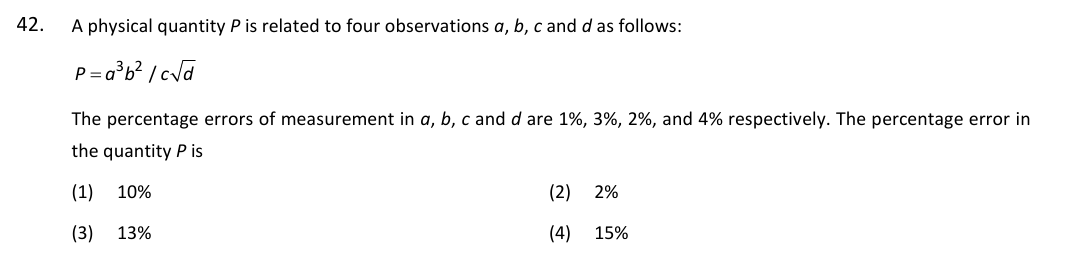
- For , relative errors add after weighting by the powers: .
Significant figures are the digits known with certainty plus one uncertain digit. All non-zero digits count; zeros between non-zero digits count; leading zeros before the first non-zero digit never count; and trailing zeros count only when a decimal point is present — which is why an unqualified number like 12300 is ambiguous and is better written in scientific notation to fix its precision. In calculations, a product or quotient is rounded to the least number of significant figures among the inputs, while a sum or difference is rounded instead to the least number of decimal places.
A frequent NEET trap is assuming subtraction reduces uncertainty: for , the temptation is to subtract the errors instead of adding them. Errors add for every sum or difference, never cancel, so the difference of two large, nearly equal, similarly uncertain quantities can carry a large percentage error even though each quantity alone was measured precisely.