Skip to content
PhysicsNEET 2025Surface tension, capillarity, excess pressure

Mechanical Properties of Fluids

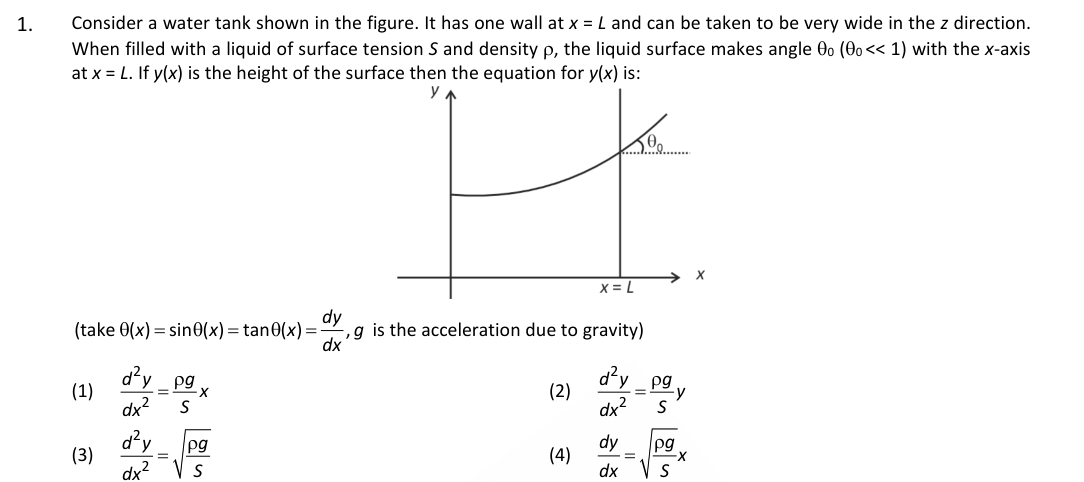
Consider a water tank shown in the figure. It has one wall at x=Lx = L and can be taken to be very wide in the zz direction. When filled with a liquid of surface tension SS and density ρ\rho, the liquid surface makes an angle θ0\theta_0 (θ0≪1\theta_0 \ll 1) with the xx-axis at x=Lx = L. If y(x)y(x) is the height of the surface, then the equation for y(x)y(x) is (take sin⁡θ(x)≈tan⁡θ(x)≈dydx\sin\theta(x) \approx \tan\theta(x) \approx \dfrac{dy}{dx}; gg is the acceleration due to gravity):

Question 1 as printed in the NEET 2025 booklet

  1. A.d2ydx2=ρgS x\dfrac{d^2y}{dx^2} = \dfrac{\rho g}{S}\,x
  2. B.d2ydx2=ρgS y\dfrac{d^2y}{dx^2} = \dfrac{\rho g}{S}\,y✓
  3. C.d2ydx2=ρgS\dfrac{d^2y}{dx^2} = \dfrac{\rho g}{S}
  4. D.dydx=ρgS x\dfrac{dy}{dx} = \dfrac{\rho g}{S}\,x

Solution

At height yy the hydrostatic pressure ρgy\rho g y is balanced by the surface-tension pressure S×S \times (curvature). For a nearly flat surface the curvature is d2ydx2\frac{d^2y}{dx^2}, so Sd2ydx2=ρg yS\frac{d^2y}{dx^2} = \rho g\,y, i.e. d2ydx2=ρgSy\frac{d^2y}{dx^2} = \frac{\rho g}{S}y.

Save for spaced revision (free account)

More from this chapter in past papers

From Physics › Mechanical Properties of Fluids › Surface tension, capillarity, excess pressure — lectures, notes and every past question on it.

Last revised . Found a mistake? Tell us — corrections are the fastest thing we act on.

ShareWhatsAppTelegram