Skip to content
PhysicsNEET 2025Power and vertical circular motion

Work, Energy and Power

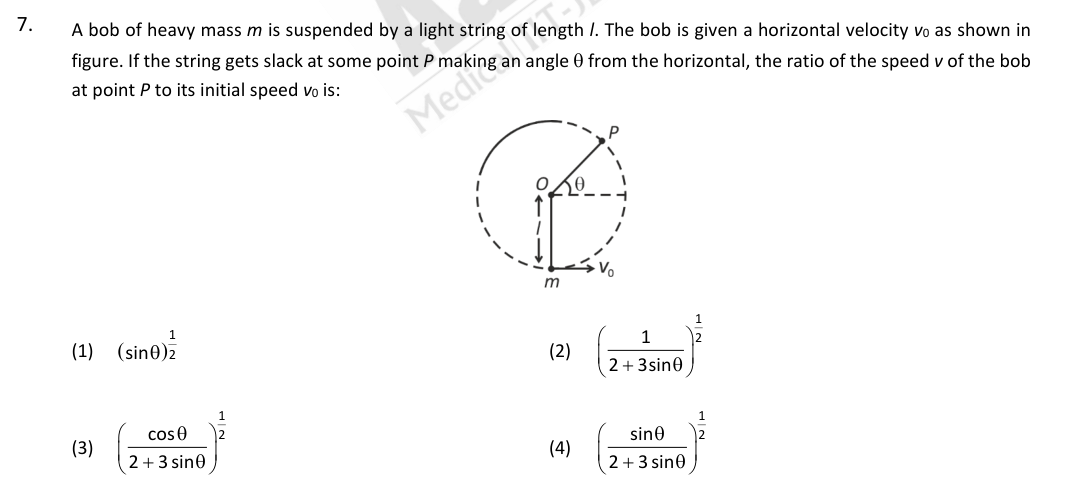
A bob of heavy mass mm is suspended by a light string of length ll. The bob is given a horizontal velocity v0v_0 as shown in the figure. If the string gets slack at some point P making an angle θ\theta from the horizontal, the ratio of the speed vv of the bob at point P to its initial speed v0v_0 is:

Question 7 as printed in the NEET 2025 booklet

  1. A.(sin⁡θ)1/2\left(\sin\theta\right)^{1/2}
  2. B.(12+3sin⁡θ)1/2\left(\dfrac{1}{2 + 3\sin\theta}\right)^{1/2}
  3. C.(cos⁡θ2+3sin⁡θ)1/2\left(\dfrac{\cos\theta}{2 + 3\sin\theta}\right)^{1/2}
  4. D.(sin⁡θ2+3sin⁡θ)1/2\left(\dfrac{\sin\theta}{2 + 3\sin\theta}\right)^{1/2}✓

Solution

Let the string go slack at P, where the radius makes angle θ\theta above the horizontal, so P is at height l(1+sin⁡θ)l(1 + \sin\theta) above the lowest point. Slack means tension is zero: mgsin⁡θ=mv2lmg\sin\theta = \frac{mv^2}{l}, i.e. v2=glsin⁡θv^2 = gl\sin\theta. Energy: v02=v2+2gl(1+sin⁡θ)v_0^2 = v^2 + 2gl(1 + \sin\theta). Hence v2v02=sin⁡θ2+3sin⁡θ\frac{v^2}{v_0^2} = \frac{\sin\theta}{2 + 3\sin\theta}.

Save for spaced revision (free account)

More from this chapter in past papers

From Physics › Work, Energy and Power › Power and vertical circular motion — lectures, notes and every past question on it.

Last revised . Found a mistake? Tell us — corrections are the fastest thing we act on.

ShareWhatsAppTelegram