A tissue is a group of cells with a common origin that work together to perform a specific function. Plant tissues fall into two broad classes: meristematic tissue, made of actively dividing cells, and permanent tissue, made of cells that have stopped dividing and differentiated for a particular role. Meristems are classified by position: apical meristem, at the tips of root and sh
Anatomy of Flowering Plants
Class 1118 previous-year questions from this chapter every option and the correct answer, free · where the marks are
1. Tissues and tissue systems
Exam focus: Living versus dead at maturity is the axis NEET tests: collenchyma stays alive and can keep dividing, giving flexible support to organs still growing, while sclerenchyma is dead and uniformly lignified, giving rigid support wherever growth has already stopped — options like to swap "living" and "dead" between the two.
Plant Tissues and Tissue Systems
Competition Wallah
Full chapter video with explicit tissue, simple-tissue-system, complex-permanent-tissue and tissue-system segments — a direct match.
BotanyNEET 2024show ▾In the given figure, which component has thin outer walls and highly thickened inner walls?
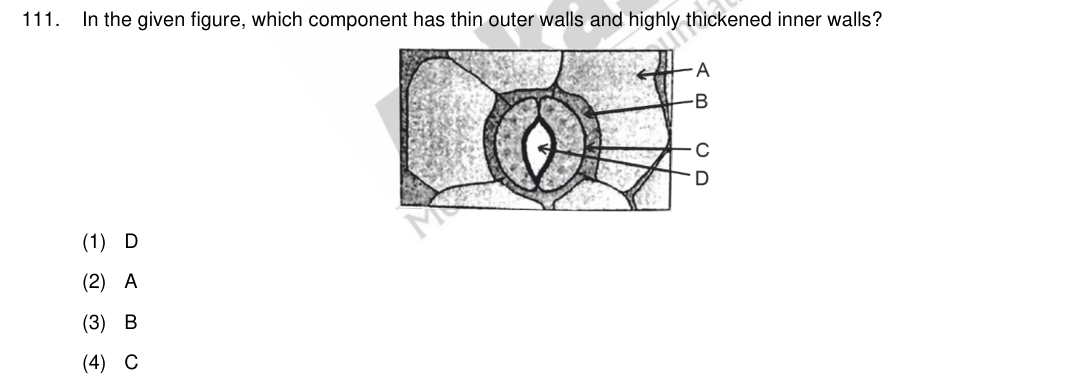
- A.D
- B.A
- C.B
- D.C✓
Solution
Label C points to a guard cell. Guard cells have thin outer walls and thick inner walls (facing the pore); this unequal thickening lets them bow outward when turgid and open the stoma.
Open this question on its own page →
Save for spaced revision (free account)BotanyNEET 2024show ▾Given below are two statements:
Statement I: Parenchyma is living but collenchyma is dead tissue.
Statement II: Gymnosperms lack xylem vessels but the presence of xylem vessels is characteristic of angiosperms.
In the light of the above statements, choose the correct answer from the options given below:
- A.Both Statement I and Statement II are false
- B.Statement I is true but Statement II is false
- C.Statement I is false but Statement II is true✓
- D.Both Statement I and Statement II are true
Solution
Collenchyma is a living tissue (Statement I false). Vessels are characteristic of angiosperms and absent from gymnosperms, whose xylem has only tracheids (Statement II true).
Open this question on its own page →
Save for spaced revision (free account)BotanyNEET 2021show ▾Which of the following is an incorrect statement?
- A.Mature sieve tube elements possess a conspicuous nucleus and usual cytoplasmic organelles✓
- B.Microbodies are present in both plant and animal cells
- C.The perinuclear space forms a barrier between the materials present inside the nucleus and those of the cytoplasm
- D.Nuclear pores act as passages for proteins and RNA molecules in both directions between nucleus and cytoplasm
The worked solution is part of a paid pack.
BotanyNEET 2021show ▾Match List-I with List-II.
List-I List-II (a) Cells with active cell division capacity (i) Vascular tissues (b) Tissue having all cells similar in structure and function (ii) Meristematic tissue (c) Tissue having different types of cells (iii) Sclereids (d) Dead cells with highly thickened walls and narrow lumen (iv) Simple tissue
Select the correct answer from the options given below:
- A.(a)-(ii), (b)-(iv), (c)-(i), (d)-(iii)✓
- B.(a)-(iv), (b)-(iii), (c)-(ii), (d)-(i)
- C.(a)-(i), (b)-(ii), (c)-(iii), (d)-(iv)
- D.(a)-(iii), (b)-(ii), (c)-(iv), (d)-(i)
The worked solution is part of a paid pack.
2. Anatomy of dicot and monocot root, stem, leaf
Exam focus: The anatomical fact that predicts almost everything else asked here: dicot stems have open vascular bundles (cambium present, so secondary growth is possible) arranged in a ring, while monocot stems have closed bundles (no cambium, no secondary growth) scattered through the ground tissue.
Anatomy of Stem and Leaf: Dicot vs Monocot
Aakash NEET
Stem and leaf anatomy side by side for dicot vs monocot — the comparison NEET actually asks about. Root anatomy is a companion video in the same series.
BotanyNEET 2025show ▾Find the statement that is not correct with regard to the structure of the monocot stem.
- A.The hypodermis is parenchymatous.✓
- B.Vascular bundles are scattered.
- C.Vascular bundles are conjoint and closed.
- D.Phloem parenchyma is absent.
Solution
In a monocot stem the hypodermis is sclerenchymatous, not parenchymatous — Statement 1 is wrong. Scattered, conjoint, closed bundles and absent phloem parenchyma are all correct.
Open this question on its own page →
Save for spaced revision (free account)BotanyNEET 2024show ▾Bulliform cells are responsible for:
- A.Protecting the plant from salt stress.
- B.Increased photosynthesis in monocots.
- C.Providing large spaces for storage of sugars.
- D.Inward curling of leaves in monocots.✓
Solution
Bulliform (motor) cells in the upper epidermis of grass leaves lose turgor in dry conditions and make the leaf roll inward, reducing water loss.
Open this question on its own page →
Save for spaced revision (free account)BotanyNEET 2023show ▾Given below are two statements: one is labelled as Assertion A and the other is labelled as Reason R.
Assertion A: Late wood has fewer xylary elements with narrow vessels.
Reason R: Cambium is less active in winter.
In the light of the above statements, choose the correct answer from the options given below:
- A.Both A and R are true and R is the correct explanation of A✓
- B.Both A and R are true but R is NOT the correct explanation of A
- C.A is true but R is false
- D.A is false but R is true
The worked solution is part of a paid pack.
BotanyNEET 2023show ▾Identify the correct statements:
A. Lenticels are lens-shaped openings permitting the exchange of gases.
B. Bark formed early in the season is called hard bark.
C. Bark is a technical term that refers to all tissues exterior to the vascular cambium.
D. Bark refers to the periderm and secondary phloem.
E. Phellogen is single-layered in thickness.
Choose the correct answer from the options given below:
- A.B, C and E only
- B.A and D only✓
- C.A, B and D only
- D.B and C only
The worked solution is part of a paid pack.
BotanyNEET 2023show ▾Given below are two statements:
Statement I: Endarch and exarch are the terms often used for describing the position of secondary xylem in the plant body.
Statement II: The exarch condition is the most common feature of the root system.
In the light of the above statements, choose the correct answer from the options given below:
- A.Both Statement I and Statement II are true
- B.Both Statement I and Statement II are false
- C.Statement I is correct but Statement II is false
- D.Statement I is incorrect but Statement II is true✓
The worked solution is part of a paid pack.
BotanyNEET 2022show ▾Read the following statements about the vascular bundles:
(a) In roots, xylem and phloem in a vascular bundle are arranged in an alternate manner along the different radii
(b) Conjoint closed vascular bundles do not possess cambium
(c) In open vascular bundles, cambium is present in between xylem and phloem
(d) The vascular bundles of the dicotyledonous stem possess endarch protoxylem
(e) In the monocotyledonous root, usually there are more than six xylem bundles present
Choose the correct answer from the options given below:
- A.(a), (c), (d) and (e) only
- B.(a), (b) and (d) only
- C.(b), (c), (d) and (e) only✓
- D.(a), (b), (c) and (d) only
The worked solution is part of a paid pack.
BotanyNEET 2022show ▾The anatomy of springwood shows some peculiar features. Identify the correct set of statements about springwood:
(a) It is also called earlywood
(b) In the spring season the cambium produces xylem elements with narrow vessels
(c) It is lighter in colour
(d) The springwood along with autumnwood shows alternate concentric rings forming annual rings
(e) It has lower density
Choose the correct answer from the options given below:
- A.(c), (d) and (e) only
- B.(a), (b), (d) and (e) only
- C.(a), (c), (d) and (e) only✓
- D.(a), (b) and (d) only
The worked solution is part of a paid pack.
BotanyNEET 2022show ▾In old trees the greater part of secondary xylem is dark brown and resistant to insect attack due to:
(a) secretion of secondary metabolites and their deposition in the lumen of vessels
(b) deposition of organic compounds like tannins and resins in the central layers of the stem
(c) deposition of suberin and aromatic substances in the outer layer of the stem
(d) deposition of tannins, gum, resin and aromatic substances in the peripheral layers of the stem
(e) presence of parenchyma cells, functionally active xylem elements and essential oils
Choose the correct answer from the options given below:
- A.(b) and (d) only
- B.(a) and (b) only✓
- C.(c) and (d) only
- D.(d) and (e) only
The worked solution is part of a paid pack.
BotanyNEET 2021show ▾Match List-I with List-II.
List-I List-II (a) Lenticels (i) Phellogen (b) Cork cambium (ii) Suberin deposition (c) Secondary cortex (iii) Exchange of gases (d) Cork (iv) Phelloderm
Choose the correct answer from the options given below:
- A.(a)-(iv), (b)-(i), (c)-(iii), (d)-(ii)
- B.(a)-(iii), (b)-(i), (c)-(iv), (d)-(ii)✓
- C.(a)-(ii), (b)-(iii), (c)-(iv), (d)-(i)
- D.(a)-(iv), (b)-(ii), (c)-(i), (d)-(iii)
The worked solution is part of a paid pack.
BotanyNEET 2021show ▾Select the correct pair.
- A.Large colourless empty cells in the epidermis of grass leaves – Subsidiary cells
- B.In dicot leaves, vascular bundles are surrounded by large thick-walled cells – Conjunctive tissue
- C.Cells of medullary rays that form part of the cambial ring – Interfascicular cambium✓
- D.Loose parenchyma cells rupturing the epidermis and forming a lens-shaped opening in bark – Spongy parenchyma
The worked solution is part of a paid pack.
BotanyNEET 2020show ▾The transverse section of a plant part shows the following anatomical features:
(a) A large number of scattered vascular bundles surrounded by a bundle sheath
(b) Large, conspicuous parenchymatous ground tissue
(c) Vascular bundles conjoint and closed
(d) Phloem parenchyma absent
Identify the category of plant and its part:
- A.Monocotyledonous stem✓
- B.Monocotyledonous root
- C.Dicotyledonous stem
- D.Dicotyledonous root
The worked solution is part of a paid pack.
BotanyNEET 2020show ▾Identify the incorrect statement.
- A.Heartwood does not conduct water but gives mechanical support
- B.Sapwood is involved in the conduction of water and minerals from root to leaf
- C.Sapwood is the innermost secondary xylem and is lighter in colour✓
- D.Due to the deposition of tannins, resins, oils etc., heartwood is dark in colour
The worked solution is part of a paid pack.
BotanyNEET 2019show ▾Grass leaves curl inwards during very dry weather. Select the most appropriate reason from the following:
- A.Closure of stomata
- B.Flaccidity of bulliform cells✓
- C.Shrinkage of air spaces in spongy mesophyll
- D.Tyloses in vessels
The worked solution is part of a paid pack.
BotanyNEET 2019show ▾Which of the statements given below is NOT true about the formation of annual rings in trees?
- A.An annual ring is a combination of spring wood and autumn wood produced in a year
- B.Differential activity of the cambium causes light and dark bands of tissue — early wood and late wood respectively
- C.Activity of the cambium depends upon variation in climate
- D.Annual rings are not prominent in trees of the temperate region✓
The worked solution is part of a paid pack.