The flower is the reproductive structure of angiosperms, its four whorls arranged calyx–corolla–androecium–gynoecium from outside in; only the last two, the male androecium (stamens) and female gynoecium (the pistil, made of one or more carpels), are directly reproductive. Each stamen has a filament bearing a bilobed anther; each lobe carries two theca, so a typical anther is *
Sexual Reproduction in Flowering Plants
Class 1222 previous-year questions from this chapter every option and the correct answer, free · where the marks are
1. Flower structure, microsporogenesis and megasporogenesis
Exam focus: Microsporogenesis and megasporogenesis are not symmetric: meiosis in the microspore mother cell gives four functional pollen grains, but meiosis in the megaspore mother cell gives four megaspores of which normally only one — usually the chalazal one — survives to form the embryo sac.
Structure of a Flower and Microsporogenesis
Vedantu Biotonic for NEET
Dedicated lecture covering flower structure, anther/stamen anatomy and microsporogenesis; megasporogenesis is covered more lightly toward the end.
ZoologyNEET 2025show ▾How many meiotic and mitotic divisions need to occur for the development of a mature female gametophyte from the megaspore mother cell in an angiosperm plant?
- A.2 meiosis and 3 mitosis
- B.1 meiosis and 2 mitosis
- C.1 meiosis and 3 mitosis✓
- D.No meiosis and 2 mitosis
Solution
One meiosis of the megaspore mother cell gives four megaspores; the surviving one undergoes three mitotic divisions to form the 8-nucleate embryo sac. So 1 meiosis and 3 mitoses.
Open this question on its own page →
Save for spaced revision (free account)ZoologyNEET 2025show ▾Given below are two statements: one is labelled as Assertion (A) and the other is labelled as Reason (R).
Assertion (A): Cells of the tapetum possess dense cytoplasm and generally have more than one nucleus.
Reason (R): The presence of more than one nucleus in the tapetum increases the efficiency of nourishing the developing microspore mother cells.
In the light of the above statements, choose the most appropriate answer from the options given below:
- A.Both A and R are true and R is the correct explanation of A✓
- B.Both A and R are true but R is NOT the correct explanation of A
- C.A is true but R is false
- D.A is false but R is true
Solution
Tapetal cells are multinucleate with dense cytoplasm (A true), and this polyploid, multinucleate state supports their role of nourishing the developing microspores (R true, and it explains A).
Open this question on its own page →
Save for spaced revision (free account)BotanyNEET 2025show ▾Given below are two statements: one is labelled as Assertion (A) and the other is labelled as Reason (R).
Assertion (A): A typical unfertilised angiosperm embryo sac at maturity is 8-nucleate and 7-celled.
Reason (R): The egg apparatus has 2 polar nuclei.
In the light of the above statements, choose the correct answer from the options given below:
- A.Both A and R are true and R is the correct explanation of A
- B.Both A and R are true but R is NOT the correct explanation of A
- C.A is true but R is false✓
- D.A is false but R is true
Solution
A mature embryo sac is 7-celled and 8-nucleate (A true) because the central cell carries two polar nuclei. The egg apparatus is the egg plus two synergids — the polar nuclei are not part of it, so R is false.
Open this question on its own page →
Save for spaced revision (free account)BotanyNEET 2021show ▾A typical angiosperm embryo sac at maturity is:
- A.8-nucleate and 7-celled✓
- B.7-nucleate and 8-celled
- C.7-nucleate and 7-celled
- D.8-nucleate and 8-celled
The worked solution is part of a paid pack.
BotanyNEET 2021show ▾In some members of which of the following pairs of families do pollen grains retain their viability for months after release?
- A.Poaceae; Rosaceae
- B.Poaceae; Leguminosae
- C.Poaceae; Solanaceae
- D.Rosaceae; Leguminosae✓
The worked solution is part of a paid pack.
BotanyNEET 2020show ▾The body of the ovule is fused with the funicle at the:
- A.Hilum✓
- B.Micropyle
- C.Nucellus
- D.Chalaza
The worked solution is part of a paid pack.
2. Pollination and double fertilisation
Exam focus: "Triple fusion" names one single fusion event involving three haploid nuclei — one male gamete plus both polar nuclei — not three separate fusions, and it's this event, not syngamy, that produces the triploid primary endosperm nucleus.
Pollination and Double Fertilisation — Full Chapter
Sankalp NEET Vedantu
Full-chapter one-shot that includes pollination types/outbreeding devices and double fertilisation in full detail, bundled with the rest of the chapter (flower structure, post-fertilisation events).
BotanyNEET 2025show ▾Given below are two statements: one is labelled as Assertion (A) and the other is labelled as Reason (R).
Assertion (A): Both wind- and water-pollinated flowers are not very colourful and do not produce nectar.
Reason (R): Wind- and water-pollinated flowers produce an enormous amount of pollen grains.
In the light of the above statements, choose the correct answer from the options given below:
- A.Both A and R are true and R is the correct explanation of A
- B.Both A and R are true but R is NOT the correct explanation of A✓
- C.A is true but R is false
- D.A is false but R is true
Solution
Both statements are true: wind- and water-pollinated flowers are inconspicuous, nectarless and produce pollen in enormous quantity. But the large pollen output compensates for wastage in an unreliable vector — it is not the reason the flowers lack colour and nectar, so R does not explain A.
Open this question on its own page →
Save for spaced revision (free account)BotanyNEET 2024show ▾Identify the set of correct statements:
A. The flowers of Vallisneria are colourful and produce nectar.
B. The flowers of water lily are not pollinated by water.
C. In most water-pollinated species, the pollen grains are protected from wetting.
D. Pollen grains of some hydrophytes are long and ribbon-like.
E. In some hydrophytes, the pollen grains are carried passively inside water.
Choose the correct answer from the options given below:
- A.A, B, C and D only
- B.A, C, D and E only
- C.B, C, D and E only✓
- D.C, D and E only
Solution
Vallisneria flowers are small and nectarless (A false); water lilies are pollinated by insects, not water (B true). Water-pollinated species protect pollen with a mucilaginous coat, some have ribbon-like pollen, and in some the pollen is carried passively under water. So B, C, D and E.
Open this question on its own page →
Save for spaced revision (free account)BotanyNEET 2024show ▾Identify the correct description of the given figure:
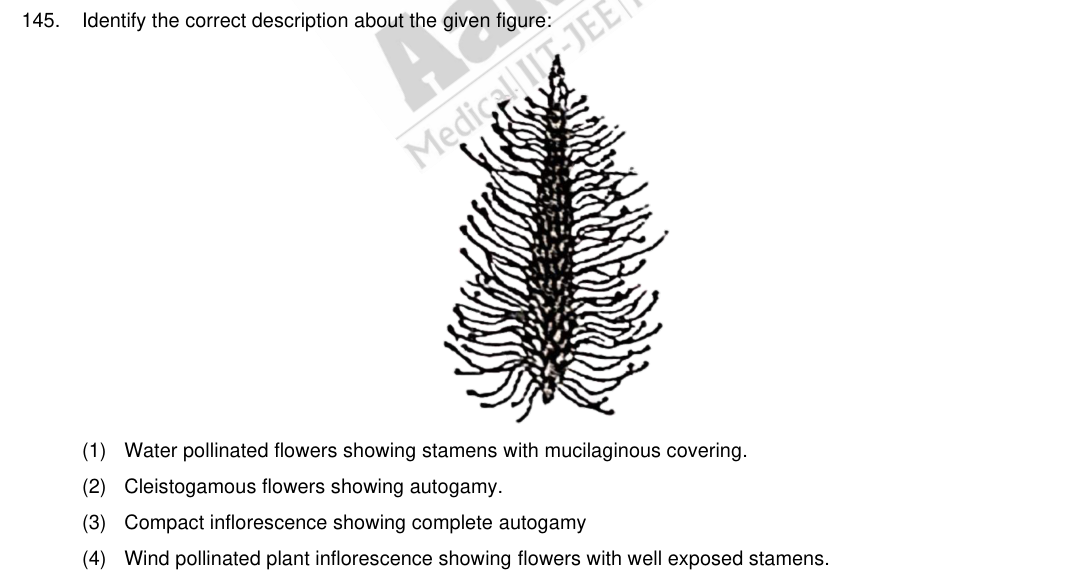
- A.Water-pollinated flowers showing stamens with mucilaginous covering.
- B.Cleistogamous flowers showing autogamy.
- C.Compact inflorescence showing complete autogamy.
- D.Wind-pollinated plant inflorescence showing flowers with well-exposed stamens.✓
Solution
The figure shows a grass inflorescence with long, dangling stamens hanging well out of the florets — an adaptation of wind-pollinated flowers, which expose stamens and feathery stigmas to the air. Water-pollinated stamens have a mucilaginous coat, and cleistogamous flowers never open.
Open this question on its own page →
Save for spaced revision (free account)BotanyNEET 2023show ▾In an angiosperm, the haploid, diploid and triploid structures of a fertilised embryo sac, sequentially, are:
- A.Synergids, primary endosperm nucleus and zygote
- B.Antipodals, synergids and primary endosperm nucleus
- C.Synergids, zygote and primary endosperm nucleus✓
- D.Synergids, antipodals and polar nuclei
The worked solution is part of a paid pack.
BotanyNEET 2023show ▾Large, colourful, fragrant flowers with nectar are seen in:
- A.Insect-pollinated plants✓
- B.Bird-pollinated plants
- C.Bat-pollinated plants
- D.Wind-pollinated plants
The worked solution is part of a paid pack.
BotanyNEET 2023show ▾What is the function of tassels in the corn cob?
- A.To attract insects
- B.To trap pollen grains✓
- C.To disperse pollen grains
- D.To protect seeds
The worked solution is part of a paid pack.
BotanyNEET 2022show ▾Given below are two statements:
Statement I: Cleistogamous flowers are invariably autogamous.
Statement II: Cleistogamy is disadvantageous as there is no chance for cross-pollination.
In the light of the above statements, choose the correct answer from the options given below:
- A.Statement I is incorrect but Statement II is correct
- B.Both Statement I and Statement II are correct✓
- C.Both Statement I and Statement II are incorrect
- D.Statement I is correct but Statement II is incorrect
The worked solution is part of a paid pack.
BotanyNEET 2022show ▾Identify the incorrect statement related to pollination:
- A.Moths and butterflies are the most dominant pollinating agents among insects✓
- B.Pollination by water is quite rare in flowering plants
- C.Pollination by wind is more common amongst abiotic pollination
- D.Flowers produce foul odours to attract flies and beetles to get pollinated
The worked solution is part of a paid pack.
BotanyNEET 2021show ▾The term used for the transfer of pollen grains from anthers of one plant to the stigma of a different plant which, during pollination, brings genetically different types of pollen grains to the stigma, is:
- A.Xenogamy✓
- B.Geitonogamy
- C.Chasmogamy
- D.Cleistogamy
The worked solution is part of a paid pack.
BotanyNEET 2020show ▾In water hyacinth and water lily, pollination takes place by:
- A.Insects or wind✓
- B.Water currents only
- C.Wind and water
- D.Insects and water
The worked solution is part of a paid pack.
BotanyNEET 2019show ▾What is the fate of the two male gametes discharged into a synergid, in a flowering plant?
- A.One fuses with the egg, the other(s) degenerate(s) in the synergid
- B.All fuse with the egg
- C.One fuses with the egg, the other(s) fuse(s) with the synergid nucleus
- D.One fuses with the egg and the other fuses with the central cell's polar nuclei✓
The worked solution is part of a paid pack.
3. Post-fertilisation: embryo, seed, fruit; apomixis
Exam focus: Apomixis produces a seed without any fertilisation at all, often by a nucellar cell developing directly into an embryo — and it matters commercially because it would let a hybrid variety breed true, passing on its hybrid vigour indefinitely instead of segregating out in the very next generation.
Post-Fertilisation: Embryo, Endosperm, Seed, Fruit, Apomixis
NCERT Wallah
Directly covers endosperm/embryo development, seed structure and development, fruit formation, and apomixis/polyembryony.
ZoologyNEET 2025show ▾Match List I with List II.
List I List II A. Scutellum I. Persistent nucellus B. Non-albuminous seed II. Cotyledon of monocot seed C. Epiblast III. Groundnut D. Perisperm IV. Rudimentary cotyledon
Choose the option with all correct matches:
- A.A-II, B-III, C-IV, D-I✓
- B.A-IV, B-III, C-II, D-I
- C.A-IV, B-III, C-I, D-II
- D.A-II, B-IV, C-III, D-I
Solution
The scutellum is the single cotyledon of a grass seed (II); groundnut is a non-albuminous seed (III); the epiblast is a rudimentary cotyledon in some monocot embryos (IV); perisperm is persistent nucellus (I).
Open this question on its own page →
Save for spaced revision (free account)BotanyNEET 2020show ▾The plant parts which consist of two generations, one within the other:
(a) Pollen grains inside the anther
(b) A germinated pollen grain with two male gametes
(c) A seed inside the fruit
(d) An embryo sac inside the ovule
- A.(a) only
- B.(a), (b) and (c)
- C.(c) and (d)
- D.(a) and (d)✓
The worked solution is part of a paid pack.
BotanyNEET 2019show ▾Which one of the following statements regarding post-fertilisation development in flowering plants is incorrect?
- A.Ovary develops into fruit
- B.Zygote develops into embryo
- C.Central cell develops into endosperm
- D.Ovules develop into embryo sac✓
The worked solution is part of a paid pack.
BotanyNEET 2019show ▾Persistent nucellus in the seed is known as:
- A.Chalaza
- B.Perisperm✓
- C.Hilum
- D.Tegmen
The worked solution is part of a paid pack.
BotanyNEET 2019show ▾In some plants, the female gamete develops into an embryo without fertilisation. This phenomenon is known as:
- A.Autogamy
- B.Parthenocarpy
- C.Syngamy
- D.Parthenogenesis✓
The worked solution is part of a paid pack.