Alcohols can be built by several distinct routes, each installing the group through a different mechanism. From alkenes, acid-catalysed hydration (dilute ) adds water through a carbocation intermediate and follows Markovnikov's rule, putting on the more substituted carbon; the cleaner oxymercuration–demercuration route ($\mathrm{Hg(OAc)_2}
Alcohols, Phenols and Ethers
Class 1210 previous-year questions from this chapter every option and the correct answer, free · where the marks are
1. Preparation and reactions of alcohols
Exam focus: The Lucas test tells 1°, 2° and 3° alcohols apart by how fast turbidity appears with ZnCl₂/HCl — instantly for 3° (via a stable carbocation), within minutes for 2°, not at all at room temperature for 1°. Acidity among simple alcohols runs 1° > 2° > 3°, the opposite of carbocation stability, because the same electron-donating alkyl groups that stabilise a cation destabilise the alkoxide anion instead.
Alcohols, Phenols and Ethers — Full Chapter
Competition Wallah
Full-chapter one-shot that includes alcohol preparation/reactions, bundled with phenols and ethers.
ChemistryNEET 2024show ▾The products A and B obtained in the following reactions, respectively, are:
- A. and
- B. and
- C. and ✓
- D. and
Solution
with an alcohol gives the alkyl chloride and phosphorous acid ; gives the alkyl chloride, HCl and phosphoryl chloride .
Open this question on its own page →
Save for spaced revision (free account)ChemistryNEET 2024show ▾Identify the correct reagents that would bring about the transformation shown in the figure.
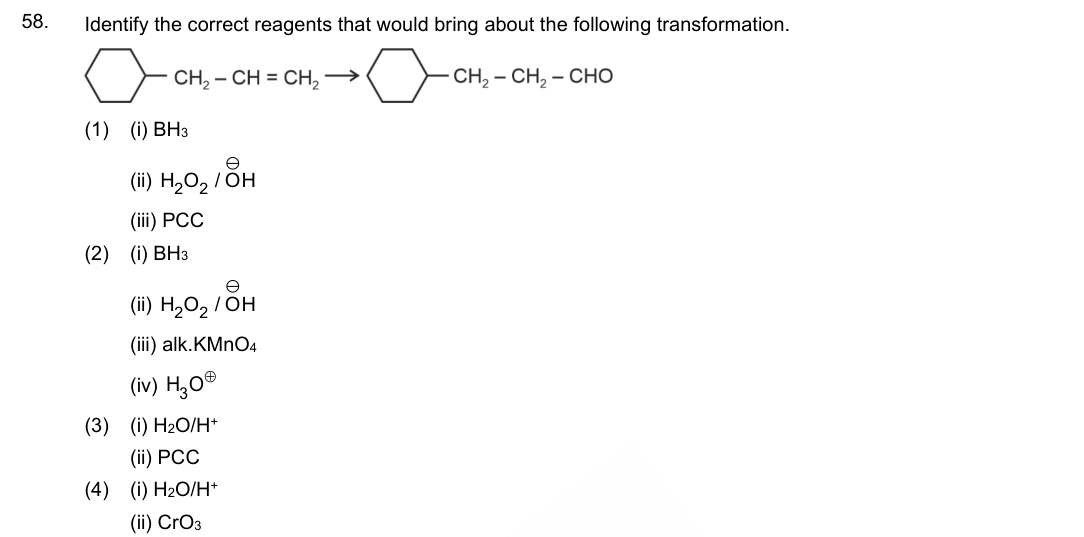
- A.(i) (ii) (iii) PCC✓
- B.(i) (ii) (iii) alk. (iv)
- C.(i) (ii) PCC
- D.(i) (ii)
Solution
Converting a terminal alkene to the aldehyde with one more carbon at the chain end needs anti-Markovnikov hydration: then gives the primary alcohol, and PCC oxidises it gently to the aldehyde without going on to the acid — option (1).
Open this question on its own page →
Save for spaced revision (free account)ChemistryNEET 2024show ▾Which one of the following alcohols (three drawn as structures; the fourth is ) reacts instantaneously with Lucas reagent?
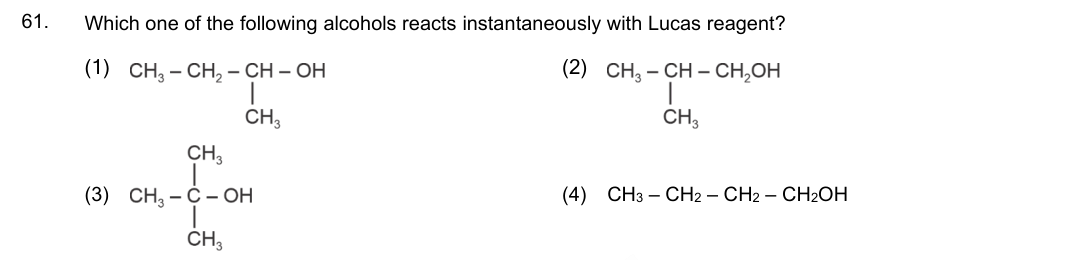
- A.Structure (1)
- B.Structure (2)
- C.Structure (3)✓
- D.
Solution
The Lucas test turns turbid instantly only with tertiary alcohols, which form a stable tertiary carbocation. 2-Methylpropan-2-ol, (structure 3), is tertiary; (1) is secondary and (2), (4) are primary.
Open this question on its own page →
Save for spaced revision (free account)ChemistryNEET 2023show ▾Which amongst the following (structures shown) will be most readily dehydrated under acidic conditions?
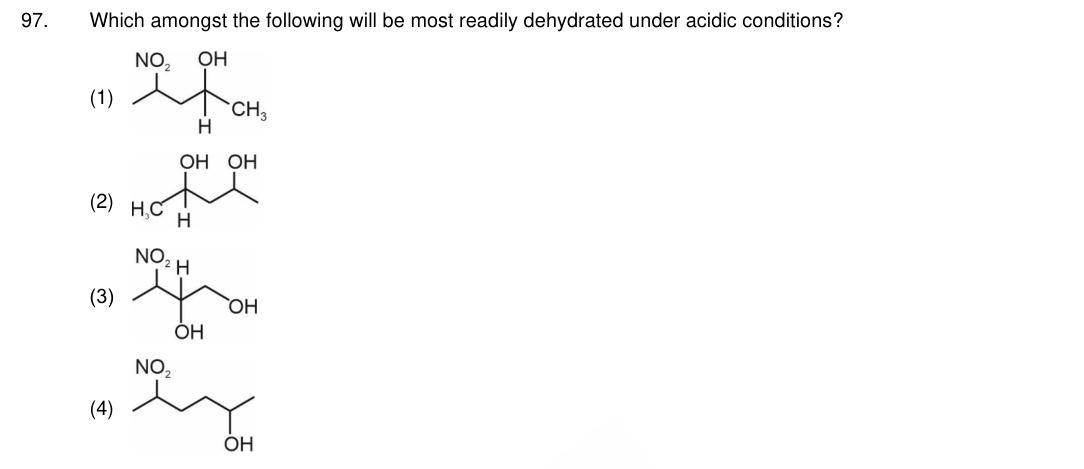
- A.Structure (1)
- B.Structure (2)✓
- C.Structure (3)
- D.Structure (4)
The worked solution is part of a paid pack.
ChemistryNEET 2023show ▾Identify the final product [D] obtained in the following sequence of reactions:
(the remaining steps are shown in the figure)
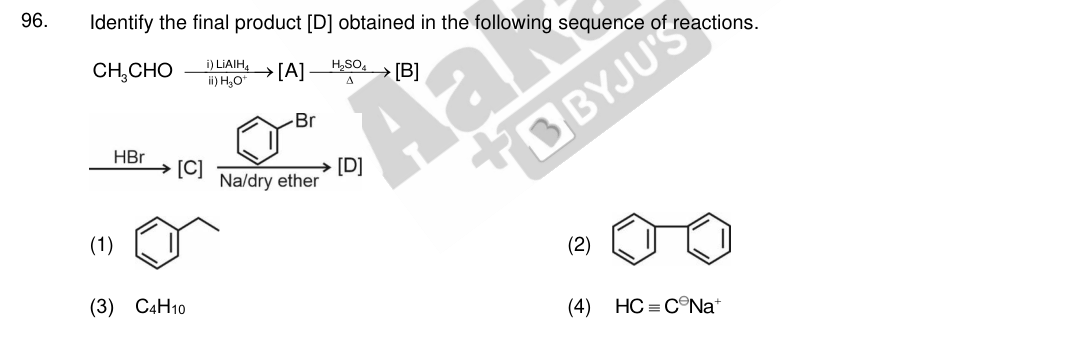
- A.Structure (1)✓
- B.Structure (2)
- C.
- D.
The worked solution is part of a paid pack.
ChemistryNEET 2022show ▾Given below are two statements:
Statement I: In the Lucas test, primary, secondary and tertiary alcohols are distinguished on the basis of their reactivity with conc. HCl + , known as Lucas reagent.
Statement II: Primary alcohols are the most reactive and immediately produce turbidity at room temperature on reaction with Lucas reagent.
In the light of the above statements, choose the most appropriate answer from the options given below:
- A.Statement I is incorrect but Statement II is correct
- B.Both Statement I and Statement II are correct
- C.Both Statement I and Statement II are incorrect
- D.Statement I is correct but Statement II is incorrect✓
The worked solution is part of a paid pack.
ChemistryNEET 2021show ▾What is the IUPAC name of the organic compound formed in the following chemical reaction?
- A.2-methylpropan-2-ol
- B.pentan-2-ol
- C.pentan-3-ol
- D.2-methylbutan-2-ol✓
The worked solution is part of a paid pack.
2. Acidity and reactions of phenols
Exam focus: Phenol is more acidic than an alcohol because the phenoxide ion delocalises its negative charge into the ring by resonance, but it's still far less acidic than a carboxylic acid, whose carboxylate spreads over two equivalent oxygens instead. An electron-withdrawing group at the ortho or para position (like NO₂) raises phenol's acidity further; an electron-donating one (CH₃, OCH₃) lowers it — ranking substituted phenols by acidity is a recurring question type.
Alcohols, Phenols and Ethers — Full Chapter
Competition Wallah
Same full-chapter video; covers phenol acidity and reactions bundled with alcohols and ethers content.
ChemistryNEET 2022show ▾Given below are two statements:
Statement I: The acidic strength of monosubstituted nitrophenol is higher than that of phenol because of the electron-withdrawing nitro group.
Statement II: o-Nitrophenol, m-nitrophenol and p-nitrophenol will have the same acidic strength as they have one nitro group attached to the phenolic ring.
In the light of the above statements, choose the most appropriate answer from the options given below:
- A.Statement I is incorrect but Statement II is correct
- B.Both Statement I and Statement II are correct
- C.Both Statement I and Statement II are incorrect
- D.Statement I is correct but Statement II is incorrect✓
The worked solution is part of a paid pack.
3. Ethers: preparation and cleavage
Exam focus: Williamson synthesis is an SN2 reaction, so the alkyl halide half must be primary or unhindered — pair a bulky 3° alkyl halide with an alkoxide instead and you get an eliminated alkene, not the ether, because the strongly basic alkoxide just deprotonates it. In cleavage of an alkyl aryl ether by HI, the aryl–oxygen bond never breaks — the products are always phenol plus an alkyl iodide, never a haloarene.
Alcohols, Phenols and Ethers — Full Chapter
Competition Wallah
Same full-chapter video; no ether-only dedicated lecture could be verified, so ether preparation/cleavage is covered as part of this bundle.
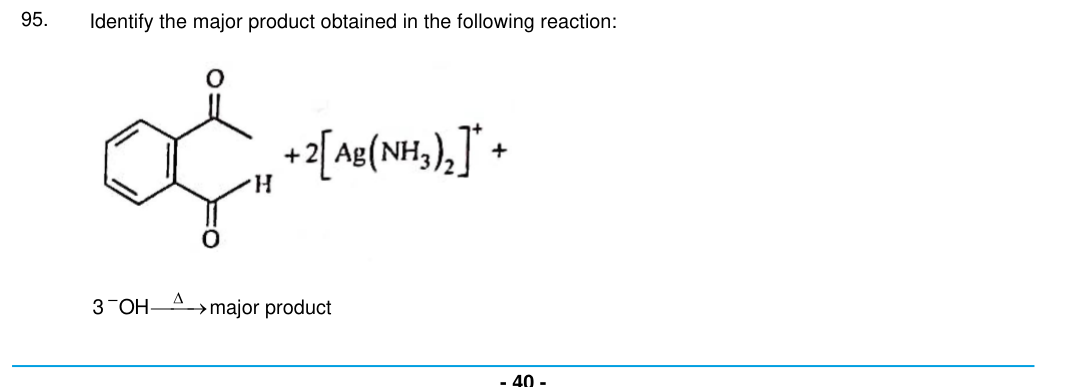
ChemistryNEET 2023show ▾Identify the major product obtained in the reaction shown in the figure (treatment with ).
- A.Structure (1)
- B.Structure (2)
- C.Structure (3)✓
- D.Structure (4)
The worked solution is part of a paid pack.
ChemistryNEET 2020show ▾Anisole on cleavage with HI gives:
- A.Phenol + ✓
- B.Iodobenzene +
- C.Phenol +
- D.Iodobenzene +
The worked solution is part of a paid pack.