The IUPAC (International Union of Pure and Applied Chemistry) nomenclature system builds a systematic name from three parts: a word root giving the number of carbons in the parent chain (meth-, eth-, prop-, but-, pent-...), a primary suffix showing saturation (-ane, -ene, -yne for a single, double or triple bond), and prefixes/suffixes that locate substituents and functional groups. Th
Organic Chemistry: Some Basic Principles and Techniques
Class 1111 previous-year questions from this chapter every option and the correct answer, free · where the marks are
1. IUPAC nomenclature
Exam focus: When two numbering directions both give substituents low locants, the tie breaks at the first point of difference, not the lowest sum — a frequent numbering slip. The functional-group seniority order (roughly: acid > ester > amide > nitrile > aldehyde > ketone > alcohol > amine) decides which group becomes the suffix and which get demoted to prefixes like oxo- or hydroxy-.
IUPAC Nomenclature of Organic Compounds
PW NEET
Dedicated one-shot on IUPAC naming rules with tricks and PYQs.
ChemistryNEET 2024show ▾A compound with the molecular formula has two tertiary carbons. Its IUPAC name is:
- A.2-methylpentane
- B.2,3-dimethylbutane✓
- C.2,2-dimethylbutane
- D.n-hexane
Solution
A tertiary carbon is bonded to three other carbons. 2,3-Dimethylbutane, , has two such carbons (C2 and C3). The others have at most one, or none.
Open this question on its own page →
Save for spaced revision (free account)ChemistryNEET 2022show ▾The correct IUPAC name of the following compound is:
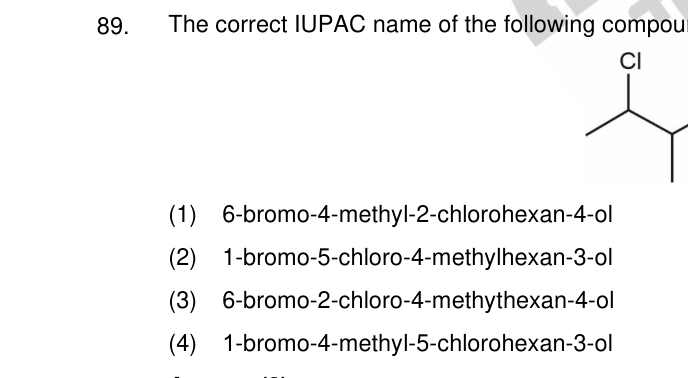
- A.6-bromo-4-methyl-2-chlorohexan-4-ol
- B.1-bromo-5-chloro-4-methylhexan-3-ol✓
- C.6-bromo-2-chloro-4-methylhexan-4-ol
- D.1-bromo-4-methyl-5-chlorohexan-3-ol
The worked solution is part of a paid pack.
ChemistryNEET 2021show ▾The correct structure of 2,6-dimethyldec-4-ene is:
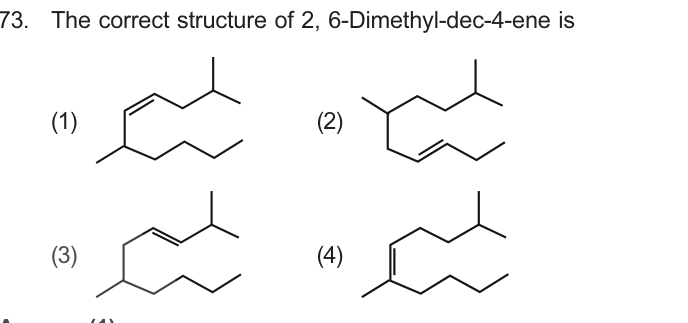
- A.Structure (1)✓
- B.Structure (2)
- C.Structure (3)
- D.Structure (4)
The worked solution is part of a paid pack.
2. Isomerism: structural and stereo
Exam focus: Cis/trans and E/Z don't always agree — E/Z is assigned by CIP priority, cis/trans by which groups simply look alike, so a compound can be "cis" by eye but "E" by priority. Meso compounds are the other classic trap: chiral centres present, but an internal plane of symmetry cancels the optical rotation, so 2ⁿ overcounts the stereoisomers whenever a meso form exists — tartaric acid is the standard example.
Isomerism: Structural and Stereoisomerism
PW Class 11 Science
Full-chapter video covering both structural and stereoisomerism (geometrical, optical).
ChemistryNEET 2025show ▾Which one of the following compounds can exist as cis–trans isomers?
- A.Pent-1-ene
- B.2-Methylhex-2-ene
- C.1,1-Dimethylcyclopropane
- D.1,2-Dimethylcyclohexane✓
Solution
Cis–trans isomerism needs two different groups on each of two ring carbons (or double-bond carbons). 1,2-Dimethylcyclohexane can place the two methyls on the same or opposite faces of the ring. Pent-1-ene and 2-methylhex-2-ene have identical groups on one double-bond carbon; 1,1-dimethylcyclopropane has both methyls on one carbon.
Open this question on its own page →
Save for spaced revision (free account)ChemistryNEET 2025show ▾The total number of possible isomers (both structural as well as stereoisomers) of cyclic ethers of molecular formula is:
- A.6
- B.8
- C.10✓
- D.11
Solution
Six structural isomers: oxolane (THF), 2-methyloxetane, 3-methyloxetane, 2-ethyloxirane, 2,2-dimethyloxirane and 2,3-dimethyloxirane. Adding stereoisomers: 2-methyloxetane and 2-ethyloxirane are each a pair of enantiomers, and 2,3-dimethyloxirane exists as the cis (meso) form plus a trans pair. Total .
Open this question on its own page →
Save for spaced revision (free account)ChemistryNEET 2022show ▾The incorrect statement regarding chirality is:
- A.A racemic mixture shows zero optical rotation
- B. reaction yields a 1 : 1 mixture of both enantiomers
- C.The product obtained by reaction of a haloalkane having chirality at the reactive site shows inversion of configuration
- D.Enantiomers are superimposable mirror images of each other✓
The worked solution is part of a paid pack.
ChemistryNEET 2021show ▾The compound which shows metamerism is:
3. Electronic effects: inductive, resonance, hyperconjugation
Exam focus: Hyperconjugation needs a C–H (or C–C) sigma bond directly attached to an sp² carbon — more such adjacent H's means more stability, which is why carbocation and alkene stability both rise with the number of alkyl-substituted carbons. Inductive effect fades with distance through sigma bonds; resonance doesn't fade the same way, but does need the participating orbitals to be coplanar — twist them out of plane and resonance stops working even though the atoms are still technically conjugated.
Electronic Effects: Inductive, Resonance, Hyperconjugation
Sri Chaitanya Academy NEET
Dedicated one-shot on electronic displacement effects for NEET.
ChemistryNEET 2020show ▾A tertiary-butyl carbocation is more stable than a secondary-butyl carbocation because of:
- A.The effect of groups
- B.The effect of groups
- C.The effect of groups
- D.Hyperconjugation✓
The worked solution is part of a paid pack.
ChemistryNEET 2019show ▾The compound that is most difficult to protonate (at the carbonyl oxygen) among the following is:
- A.Formaldehyde,
- B.Acetaldehyde,
- C.Acetone,
- D.Benzaldehyde, ✓
The worked solution is part of a paid pack.
4. Reaction intermediates and types of reactions
Exam focus: Carbocation stability (3° > 2° > 1° > methyl, from hyperconjugation and +I) is exactly reversed for carbanions (methyl > 1° > 2° > 3°) — alkyl groups that stabilise a positive centre by donating electron density destabilise a centre that's already electron-rich. Mixing up which intermediate benefits from alkyl substitution is the trap.
General Organic Chemistry: Reaction Intermediates and Types of Reactions (Part 1)
Sri Chaitanya Academy NEET
Part 1 of a two-part GOC series; covers carbocation/carbanion/free-radical intermediates and reaction types, but is only half the full chapter (Part 2 exists separately, not included here).
ChemistryNEET 2025show ▾Among the given compounds I–III (shown), the correct order of bond dissociation energy of the C–H bond marked with * is:
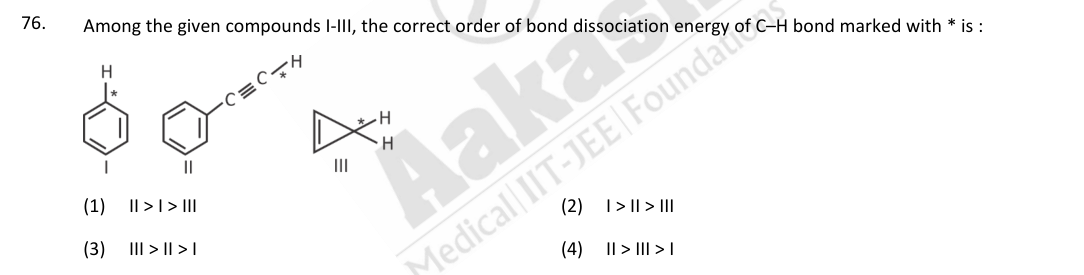
- A.II > I > III✓
- B.I > II > III
- C.III > II > I
- D.II > III > I
Solution
Bond strength rises with the -character of the carbon orbital. The terminal alkyne C–H (II, ) is strongest, then the aromatic C–H (I, ), then the cyclopropane C–H (III, roughly but weaker than aryl). II > I > III.
Open this question on its own page →
Save for spaced revision (free account)ChemistryNEET 2024show ▾The most stable carbocation among the four structures shown is:
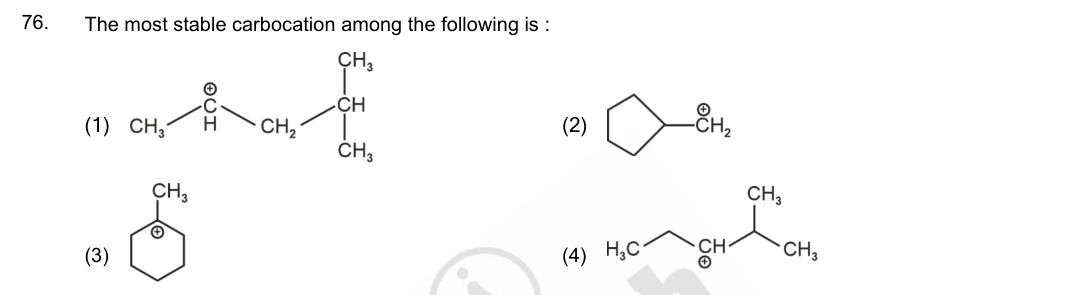
- A.Structure (1)
- B.Structure (2)
- C.Structure (3)✓
- D.Structure (4)
Solution
The 1-methylcyclohexyl cation (3) is tertiary — three alkyl groups stabilise it by hyperconjugation and +I effect. (1) and (4) are secondary and (2) is primary.
Open this question on its own page →
Save for spaced revision (free account)