Purification of an organic compound means separating it from accompanying impurities to obtain a single homogeneous substance, and the method chosen depends on whether the compound is solid or liquid. Crystallisation purifies solids using a difference in solubility: the impure solid is dissolved in a solvent in which it is sparingly soluble cold but freely soluble hot, the hot solution is
Purification and Characterisation of Organic Compounds
Class 116 previous-year questions from this chapter every option and the correct answer, free · where the marks are
1. Purification methods: crystallisation, distillation, chromatography
Exam focus: Steam distillation only works for a substance that's virtually insoluble in water and has some vapour pressure at 373 K — it lets something like aniline distil below its own, much higher, boiling point instead of decomposing there. In chromatography, Rf is the distance moved by the compound divided by the distance moved by the solvent front, always less than 1 — a value NEET expects you to compute, not just define.
Purification of Organic Compounds: Crystallisation, Distillation, Chromatography
Kota Pulse by Unacademy
Dedicated one-shot on purification techniques, taught by a Kota-based faculty on Unacademy's NEET channel.
ChemistryNEET 2025show ▾Match List I with List II.
List I (Mixture) List II (Method of separation) A. I. Distillation under reduced pressure B. Crude oil in the petroleum industry II. Steam distillation C. Glycerol from spent-lye III. Fractional distillation D. Aniline–water IV. Simple distillation
Choose the correct answer from the options given below:
- A.A-IV, B-III, C-I, D-II✓
- B.A-IV, B-III, C-II, D-I
- C.A-III, B-IV, C-I, D-II
- D.A-III, B-IV, C-II, D-I
Solution
Chloroform (b.p. 61 °C) and aniline (184 °C) differ widely — simple distillation (IV). Crude oil fractions — fractional distillation (III). Glycerol decomposes at its boiling point — distillation under reduced pressure (I). Aniline from water — steam distillation (II). Hence A-IV, B-III, C-I, D-II.
Open this question on its own page →
Save for spaced revision (free account)ChemistryNEET 2024show ▾On heating, some solid substances change from the solid to the vapour state without passing through the liquid state. The technique used for the purification of such solid substances, based on the above principle, is known as:
- A.Sublimation✓
- B.Distillation
- C.Chromatography
- D.Crystallisation
Solution
A solid that passes directly to vapour on heating (e.g. camphor, naphthalene, ammonium chloride) is purified by sublimation: the vapour is condensed back to pure solid, leaving non-volatile impurities behind.
Open this question on its own page →
Save for spaced revision (free account)ChemistryNEET 2020show ▾Paper chromatography is an example of:
- A.Adsorption chromatography
- B.Partition chromatography✓
- C.Thin-layer chromatography
- D.Column chromatography
The worked solution is part of a paid pack.
2. Qualitative and quantitative analysis
Exam focus: Kjeldahl's method for %N fails for nitro, azo and diazo compounds, and for nitrogen locked in a ring like pyridine — that nitrogen doesn't convert to ammonium sulphate the way amine nitrogen does, so the method silently underestimates. In Lassaigne's test, if both N and S are present but sodium is insufficient, NaSCN can form instead of separate NaCN and Na₂S — giving a false-negative Prussian-blue test for nitrogen.
Qualitative and Quantitative Analysis of Organic Compounds
Vedantu NEET Toppers
NCERT line-by-line one-shot covering both qualitative (Lassaigne's test) and quantitative elemental analysis; also bundles purification content from the same chapter.
ChemistryNEET 2025show ▾Which one of the following reactions does not belong to Lassaigne's test?
- A.
- B.
- C.
- D.✓
Solution
Fusing sodium with the compound gives NaCN, and NaX from nitrogen, sulphur and halogen respectively — the basis of Lassaigne's test. Oxidising carbon with CuO to is the Liebig combustion method for estimating carbon, not Lassaigne's.
Open this question on its own page →
Save for spaced revision (free account)ChemistryNEET 2023show ▾In the Lassaigne's extract of an organic compound, both nitrogen and sulphur are present, which gives a blood-red colour with due to the formation of:
ChemistryNEET 2022show ▾Kjeldahl's method for the estimation of nitrogen can be used to estimate the amount of nitrogen in which one of the following compounds?
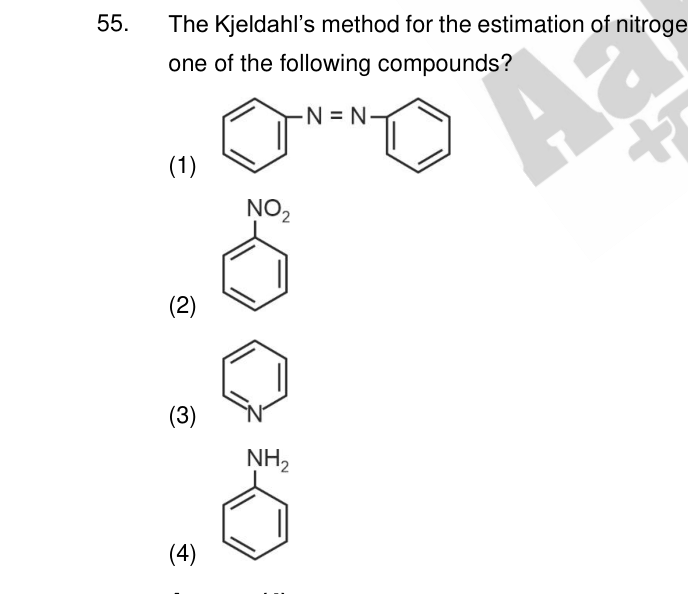
- A.Structure (1)
- B.Structure (2)
- C.Structure (3)
- D.Structure (4)✓
The worked solution is part of a paid pack.