The first law of thermodynamics is the law of conservation of energy applied to a system: energy can be neither created nor destroyed, only exchanged with the surroundings as heat or work. For a closed system this is written , where is heat absorbed by the system and is work done on the system, NCERT's convention throughout. For expansion or compression against a cons
Thermodynamics
Class 1115 previous-year questions from this chapter every option and the correct answer, free · where the marks are
1. First law, enthalpy and Hess's law
Exam focus: NCERT's sign convention is ΔU = q + w with w the work done ON the system — mix that up with the older "w = work done BY the system" convention and every work term flips sign. For gas-phase reactions, ΔH and ΔU differ by Δn(gas)×RT, a correction it's easy to forget even when Δn(gas) isn't zero.
Thermodynamics 08: Hess's Law & Enthalpy Change
Physics Wallah - Alakh Pandey
Hess's law and enthalpy-change bookkeeping — the calculation NEET actually sets numericals on. Assumes the first law from earlier lectures in this series.
ChemistryNEET 2025show ▾The standard heat of formation, in kcal/mol, of is: [Given: standard heat of formation of the ion (aq) = –216 kcal/mol, standard heat of crystallisation of = –4.5 kcal/mol, standard heat of formation of = –349 kcal/mol]
- A.–128.5✓
- B.–133.0
- C.+133.0
- D.+220.5
Solution
: kcal/mol.
Open this question on its own page →
Save for spaced revision (free account)ChemistryNEET 2025show ▾; . Which of the following diagrams (shown) gives an accurate representation of the above reaction? [R → reactants; P → products]
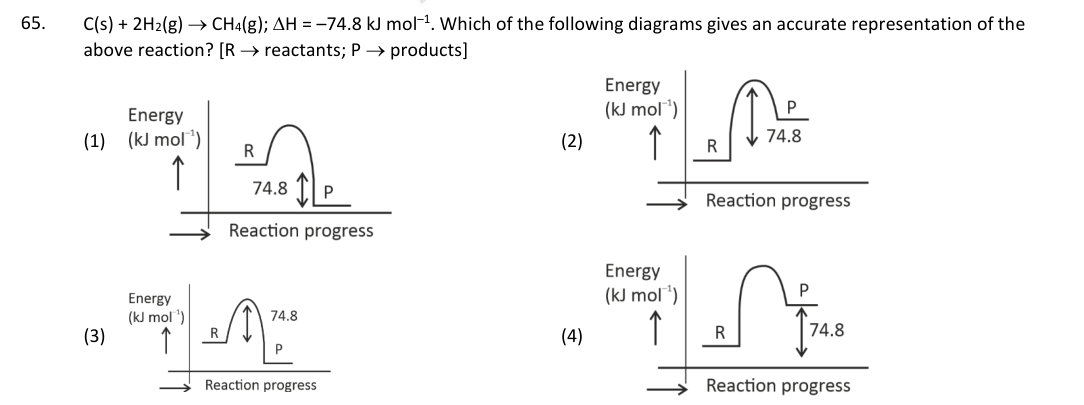
- A.Diagram (1)✓
- B.Diagram (2)
- C.Diagram (3)
- D.Diagram (4)
Solution
The reaction is exothermic ( kJ/mol), so the products must lie 74.8 kJ below the reactants, and there must still be an activation barrier between them. Only diagram (1) shows a hump followed by products lower than reactants.
Open this question on its own page →
Save for spaced revision (free account)ChemistryNEET 2024show ▾The work done during the reversible isothermal expansion of one mole of hydrogen gas at C from a pressure of 20 atmosphere to 10 atmosphere is (given ):
- A.–413.14 calories✓
- B.413.14 calories
- C.100 calories
- D.0 calorie
Solution
cal. Work done by the gas on expansion is negative in the sign convention used.
Open this question on its own page →
Save for spaced revision (free account)ChemistryNEET 2024show ▾Match List I with List II.
List I (Process) List II (Condition) A. Isothermal process I. No heat exchange B. Isochoric process II. Carried out at constant temperature C. Isobaric process III. Carried out at constant volume D. Adiabatic process IV. Carried out at constant pressure
Choose the correct answer from the options given below:
- A.A-IV, B-II, C-III, D-I
- B.A-I, B-II, C-III, D-IV
- C.A-II, B-III, C-IV, D-I✓
- D.A-IV, B-III, C-II, D-I
Solution
Isothermal: constant temperature (II). Isochoric: constant volume (III). Isobaric: constant pressure (IV). Adiabatic: no heat exchange (I).
Open this question on its own page →
Save for spaced revision (free account)ChemistryNEET 2023show ▾Which amongst the following options is the correct relation between the change in enthalpy and the change in internal energy?
ChemistryNEET 2022show ▾Which of the following – curves represents maximum work done?
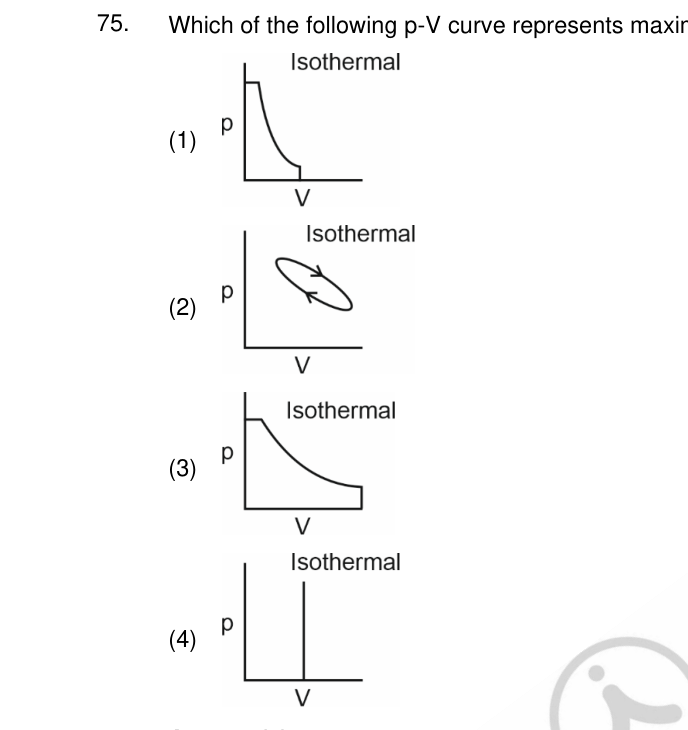
- A.Curve (1)
- B.Curve (2)
- C.Curve (3)✓
- D.Curve (4)
The worked solution is part of a paid pack.
ChemistryNEET 2021show ▾Which one among the following is the correct option for the right relationship between and for one mole of an ideal gas?
ChemistryNEET 2020show ▾The correct option for the free expansion of an ideal gas under adiabatic conditions is:
- A. and ✓
- B. and
- C. and
- D. and
The worked solution is part of a paid pack.
ChemistryNEET 2019show ▾Under isothermal conditions, a gas at 300 K expands from 0.1 L to 0.25 L against a constant external pressure of 2 bar. The work done BY the gas is: (Given: 1 L bar = 100 J)
- A. J
- B.5 kJ
- C.25 J
- D.30 J✓
The worked solution is part of a paid pack.
2. Entropy and Gibbs energy, spontaneity
Exam focus: Spontaneity is decided by ΔG = ΔH − TΔS, never by ΔH or ΔS alone — an endothermic process (ΔH positive) can still be spontaneous if ΔS is large enough and T is high, which is exactly the case NEET uses to catch anyone pattern-matching "exothermic means spontaneous."
Thermodynamics — Full Chapter
PW Class 11 Science
Full-chapter one-shot; entropy, Gibbs free energy and spontaneity are covered as part of this chapter video.
ChemistryNEET 2024show ▾In which of the following processes does entropy increase?
A. A liquid evaporates to vapour.
B. The temperature of a crystalline solid is lowered from 130 K to 0 K.
C.
D.
Choose the correct answer from the options given below:
- A.A, B and D
- B.A, C and D✓
- C.C and D
- D.A and C
Solution
Entropy rises when disorder rises: liquid → vapour (A), a solid giving two gases (C), and one gas molecule becoming two (D). Cooling a crystal towards 0 K lowers entropy (B). So A, C and D.
Open this question on its own page →
Save for spaced revision (free account)ChemistryNEET 2023show ▾The equilibrium concentrations of the species in the reaction are 2, 3, 10 and 6 , respectively, at 300 K. for the reaction is ( cal/mol K):
- A.1372.60 cal
- B.–137.26 cal
- C.–1381.80 cal✓
- D.–13.73 cal
The worked solution is part of a paid pack.
ChemistryNEET 2021show ▾For the irreversible expansion of an ideal gas under isothermal conditions, the correct option is:
ChemistryNEET 2020show ▾Hydrolysis of sucrose is given by the following reaction:
If the equilibrium constant () is at 300 K, the value of at the same temperature will be:
ChemistryNEET 2020show ▾For the reaction , the correct option is:
- A. and
- B. and
- C. and
- D. and ✓
The worked solution is part of a paid pack.
ChemistryNEET 2019show ▾In which case is the change in entropy negative?
- A.Evaporation of water
- B.Expansion of a gas at constant temperature
- C.Sublimation of a solid to a gas
- D.✓
The worked solution is part of a paid pack.
3. Bond enthalpy and thermochemistry
Exam focus: Bond enthalpies used in ΔH = Σ(bonds broken) − Σ(bonds formed) are average values for a polyatomic molecule — each successive C–H bond broken in methane actually takes a different amount of energy, and the tabulated figure is a mean. That's why a bond-enthalpy calculation only ever gives an approximate ΔH, not the exact value Hess's law gives from standard enthalpies of formation.
Thermodynamics — Full Chapter
PW Class 11 Science
Same full-chapter video; bond enthalpy and thermochemistry are covered within it.