The electric potential at a point is the work done per unit charge in bringing a small positive test charge from infinity to that point, without acceleration. For an isolated point charge , , taking at infinity — positive for a positive charge, negative for a negative one, and falling off as , one power slower than the field's
Electrostatic Potential and Capacitance
Class 1219 previous-year questions from this chapter every option and the correct answer, free · where the marks are
1. Potential and potential energy of charges and dipoles
Exam focus: Potential from multiple charges adds as plain signed numbers, not vectors, much simpler than combining fields — and a dipole's potential is exactly zero at every point on its equatorial line, not just far away.
Electrostatic Potential Energy
Physics Wallah - Alakh Pandey
Covers electrostatic potential energy of charges directly; potential energy of a dipole in a uniform field is covered in the same series' next lecture, not this one, so full dipole coverage spans two videos.
PhysicsNEET 2025show ▾An electric dipole with dipole moment C m is aligned with the direction of a uniform electric field of magnitude N/C. The dipole is then rotated through an angle of with respect to the electric field. The change in the potential energy of the dipole is:
- A.0.8 J
- B.1.0 J✓
- C.1.2 J
- D.1.5 J
Solution
. J.
Open this question on its own page →
Save for spaced revision (free account)PhysicsNEET 2024show ▾Given below are two statements: one is labelled as Assertion A and the other is labelled as Reason R.
Assertion A: The potential at any axial point, at 2 m distance from the centre of a dipole of dipole moment of magnitude C m, is V. (Take SI units.)
Reason R: , where is the distance of any axial point, situated at 2 m from the centre of the dipole.
In the light of the above statements, choose the correct answer from the options given below:
- A.Both A and R are true and R is NOT the correct explanation of A.
- B.A is true but R is false.✓
- C.A is false but R is true.
- D.Both A and R are true and R is the correct explanation of A.
Solution
Axial potential of a dipole is , not (the factor 2 belongs to the axial field). Numerically V, so A is true but R is false.
Open this question on its own page →
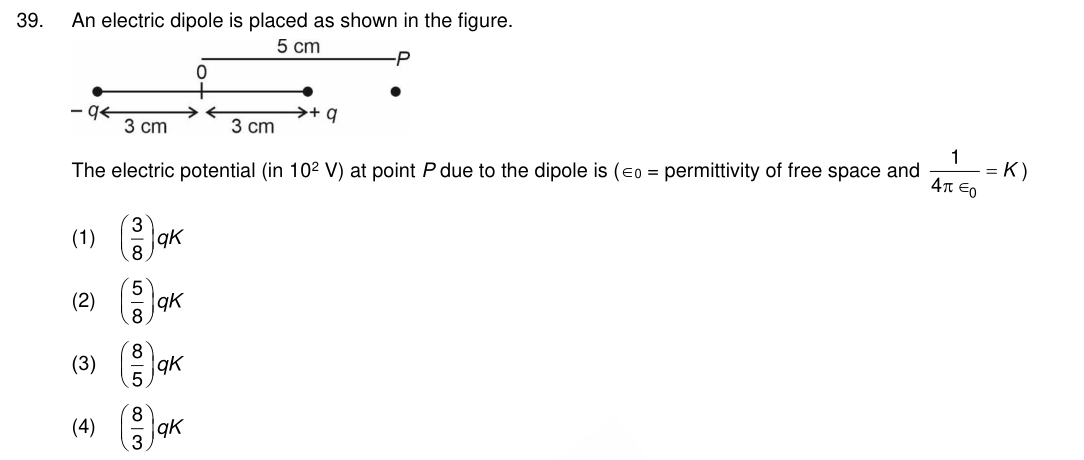
Save for spaced revision (free account)PhysicsNEET 2023show ▾An electric dipole is placed as shown in the figure. The electric potential (in V) at point P due to the dipole is ( = permittivity of free space and ):
PhysicsNEET 2022show ▾The angle between the electric lines of force and the equipotential surface is:
- A.180°
- B.0°
- C.45°
- D.90°✓
The worked solution is part of a paid pack.
PhysicsNEET 2021show ▾Twenty-seven drops of the same size are charged at 200 V each. They combine to form a bigger drop. Calculate the potential of the bigger drop.
- A.660 V
- B.1320 V
- C.1520 V
- D.1800 V✓
The worked solution is part of a paid pack.
PhysicsNEET 2020show ▾A short electric dipole has a dipole moment of C m. The electric potential due to the dipole at a point at a distance of 0.6 m from the centre of the dipole, situated on a line making an angle of with the dipole axis, is: ()
- A.50 V
- B.200 V✓
- C.400 V
- D.Zero
The worked solution is part of a paid pack.
PhysicsNEET 2020show ▾In a certain region of space with volume , the electric potential is found to be 5 V throughout. The magnitude of the electric field in this region is:
- A.Zero✓
- B.0.5 N/C
- C.1 N/C
- D.5 N/C
The worked solution is part of a paid pack.
2. Conductors and dielectrics
Exam focus: A conductor in equilibrium is an equipotential throughout, but that doesn't mean its surface charge density is uniform — charge concentrates where curvature is sharpest, which is the entire physical basis for how a lightning rod works.
Electrostatic Potential and Capacitance — Full Chapter
Competition Wallah
No clean single-concept lecture on conductors/dielectrics alone from a preferred channel could be verified, so this full-chapter NEET revision video is used, which does cover conductors and dielectrics along with the rest of the chapter.
PhysicsNEET 2025show ▾The plates of a parallel plate capacitor are separated by . Two slabs of different dielectric constants and , with thicknesses and respectively, are inserted in the capacitor. Due to this, the capacitance becomes two times larger than when there is nothing between the plates. If , the value of is:
- A.2.66✓
- B.2.33
- C.1.60
- D.1.33
Solution
Effective gap (air). Capacitance doubling means this equals : . With : .
Open this question on its own page →
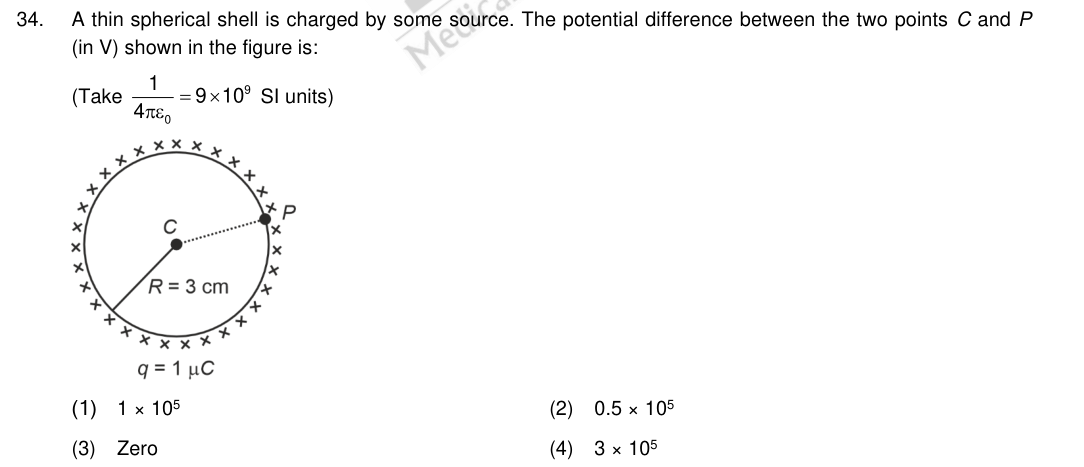
Save for spaced revision (free account)PhysicsNEET 2024show ▾A thin spherical shell is charged by some source. The potential difference between the two points C and P (in V) shown in the figure is: (Take SI units.)
- A.
- B.
- C.Zero✓
- D.
Solution
Inside a charged spherical shell the field is zero, so the potential is the same at every interior point (and equal to the surface value). The potential difference between C and P is zero.
Open this question on its own page →
Save for spaced revision (free account)PhysicsNEET 2022show ▾Two hollow conducting spheres of radii and () have equal charges. The potential would be:
- A.Dependent on the material property of the sphere
- B.More on the bigger sphere
- C.More on the smaller sphere✓
- D.Equal on both the spheres
The worked solution is part of a paid pack.
PhysicsNEET 2021show ▾Two charged spherical conductors of radius and are connected by a wire. Then the ratio of surface charge densities of the spheres () is:
PhysicsNEET 2021show ▾Polar molecules are the molecules:
- A.Having zero dipole moment
- B.That acquire a dipole moment only in the presence of an electric field due to displacement of charges
- C.That acquire a dipole moment only when a magnetic field is absent
- D.Having a permanent electric dipole moment✓
The worked solution is part of a paid pack.
3. Capacitors: series, parallel, energy stored
Exam focus: In series, capacitors share the same charge, not voltage; in parallel they share the same voltage, not charge — the opposite pairing from resistor networks. Adding a dielectric to an isolated, constant-charge capacitor actually lowers its stored energy as C rises.
Series and Parallel Combination of Capacitors
Physics Wallah - Alakh Pandey
Covers the basics of series/parallel capacitor combinations well; titled 'BASICS' so energy-stored derivations, addressed in an adjacent lecture in the same series, may be only lightly covered here.
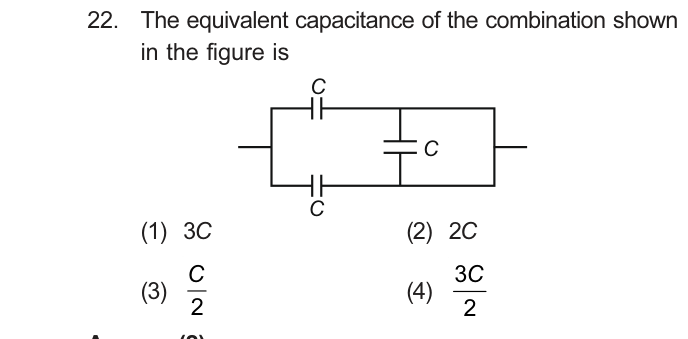
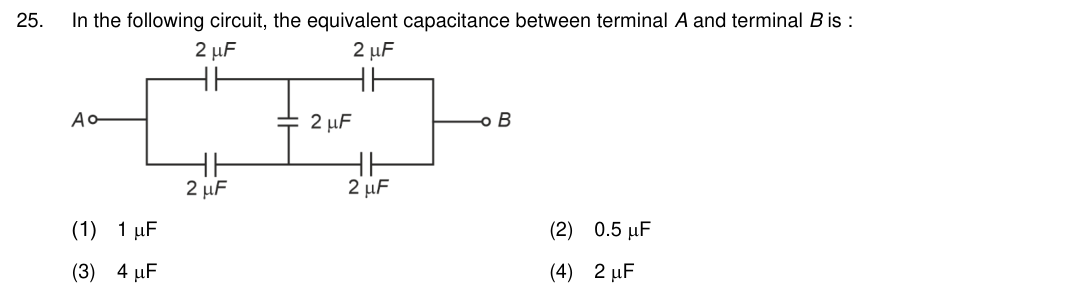
PhysicsNEET 2024show ▾In the following circuit, the equivalent capacitance between terminal A and terminal B is:
- A.
- B.
- C.
- D.✓
Solution
The upper and lower branches each have two capacitors in series, so the midpoints of both sit at the same potential; the central carries no charge and can be removed. Each branch is , and the two in parallel give .
Open this question on its own page →
Save for spaced revision (free account)PhysicsNEET 2024show ▾If the plates of a parallel plate capacitor connected to a battery are moved closer to each other, then:
A. the charge stored in it increases.
B. the energy stored in it decreases.
C. its capacitance increases.
D. the ratio of charge to its potential remains the same.
E. the product of charge and voltage increases.
Choose the most appropriate answer from the options given below:
- A.A, C and E only✓
- B.B, D and E only
- C.A, B and C only
- D.A, B and E only
Solution
At constant (battery connected), rises as falls, so rises and rises; increases; increases. A, C and E are correct; B and D are false.
Open this question on its own page →
Save for spaced revision (free account)