The ideal gas equation — equivalently , with the Boltzmann constant — unifies Boyle's law, Charles's law and Avogadro's law into one relation obeyed by an idealised gas of point molecules that exert no force on each other except during collision. Real gases approach this behaviour at low pressure and high temperature, where molecular volume and mutual a
Kinetic Theory
Class 1110 previous-year questions from this chapter every option and the correct answer, free · where the marks are
1. Ideal gas equation and kinetic interpretation of pressure
Exam focus: At a fixed temperature, rms speed depends only on molar mass — lighter molecules move faster, not slower, which is why hydrogen effuses faster than oxygen at the same temperature.
Kinetic Theory of Gases: Ideal Gas Equation and Pressure
Physics Wallah - Alakh Pandey
Covers the ideal gas equation, Boyle's/Charles' laws and the kinetic interpretation of pressure; also bundles in mean free path, used separately for that subtopic below.
PhysicsNEET 2025show ▾An oxygen cylinder of volume 30 litre has 18.20 moles of oxygen. After some oxygen is withdrawn from the cylinder, its gauge pressure drops to 11 atmospheres at a temperature of C. The mass of the oxygen withdrawn from the cylinder is nearly equal to: [Given , molecular mass of = 32, 1 atm pressure ]
- A.0.125 kg
- B.0.144 kg
- C.0.116 kg✓
- D.0.156 kg
Solution
Final moles mol (gauge 11 atm means absolute 12 atm). Withdrawn mol kg.
Open this question on its own page →
Save for spaced revision (free account)PhysicsNEET 2025show ▾A container has two chambers of volumes litres and litres separated by a partition made of a thermal insulator. The chambers contain and moles of ideal gas at pressures atm and atm, respectively. When the partition is removed, the mixture attains an equilibrium pressure of:
- A.1.3 atm
- B.1.6 atm✓
- C.1.4 atm
- D.1.8 atm
Solution
Temperature is the same throughout (no heat exchange with outside, ideal gases). Final and . Using : atm.
Open this question on its own page →
Save for spaced revision (free account)PhysicsNEET 2024show ▾The following graph represents the – curves of an ideal gas (where is the temperature and the volume) at three pressures , and , compared with those of Charles's law represented as dotted lines. Then the correct relation is:
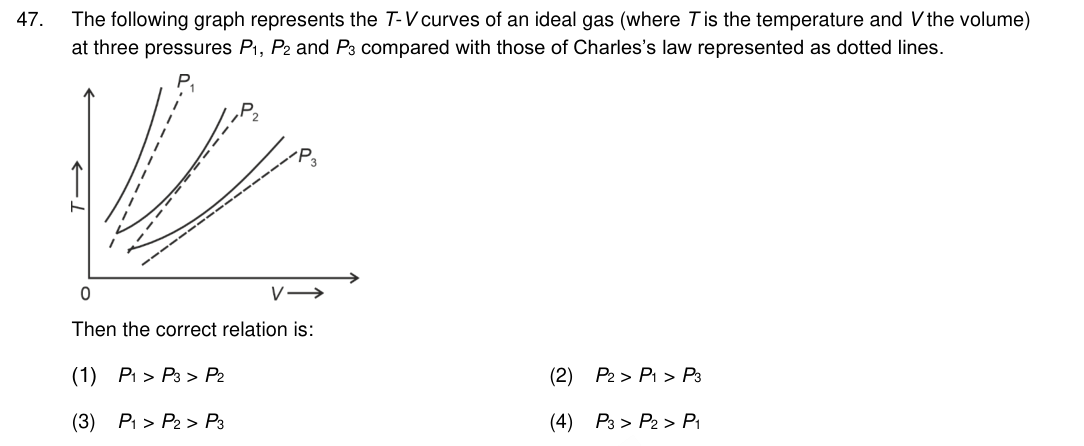
- A.
- B.
- C.✓
- D.
Solution
For an ideal gas at fixed pressure, : the – line through the origin has slope , so the steepest line corresponds to the lowest pressure. Reading the slopes in the figure gives .
Open this question on its own page →
Save for spaced revision (free account)PhysicsNEET 2023show ▾The temperature of a gas is C. To what temperature should the gas be heated so that the rms speed is increased by 3 times?
- A.669 °C
- B.3295 °C✓
- C.3097 K
- D.223 K
The worked solution is part of a paid pack.
PhysicsNEET 2022show ▾The volume occupied by the molecules contained in 4.5 kg of water at STP, if the intermolecular forces vanish away, is:
PhysicsNEET 2021show ▾Match Column-I and Column-II and choose the correct match from the given choices.
Column-I Column-II (A) Root mean square speed of gas molecules (P) (B) Pressure exerted by ideal gas (Q) (C) Average kinetic energy of a molecule (R) (D) Total internal energy of 1 mole of a diatomic gas (S)
- A.(A)-(R), (B)-(P), (C)-(S), (D)-(Q)
- B.(A)-(Q), (B)-(R), (C)-(S), (D)-(P)
- C.(A)-(Q), (B)-(P), (C)-(S), (D)-(R)✓
- D.(A)-(R), (B)-(Q), (C)-(P), (D)-(S)
The worked solution is part of a paid pack.
PhysicsNEET 2020show ▾A cylinder contains hydrogen gas at a pressure of 249 kPa and temperature 27 °C. Its density is: ()
2. Degrees of freedom, law of equipartition, specific heats
Exam focus: Each degree of freedom contributes ½kT, so Cv = (f/2)R: monatomic gas has f=3 (Cv=3/2R), diatomic has f=5 at ordinary temperatures (Cv=5/2R), and only gains its two vibrational modes — becoming f=7 — at high temperature.
Degrees of Freedom and the Law of Equipartition of Energy
Magnet Brains
Focused single-concept lecture on degrees of freedom and equipartition, which is used to derive specific heats of gases.
PhysicsNEET 2020show ▾The average thermal energy for a mono-atomic gas is: ( is the Boltzmann constant and is the absolute temperature)
PhysicsNEET 2019show ▾An increase in the temperature of a gas filled in a container would lead to:
- A.Increase in its mass
- B.Increase in its kinetic energy✓
- C.Decrease in its pressure
- D.Decrease in intermolecular distance
The worked solution is part of a paid pack.
3. Mean free path
Exam focus: Mean free path depends on the number density of molecules, hence inversely on pressure at fixed temperature, not on molecular speed — doubling pressure at constant T halves it, but raising T at constant volume leaves it unchanged.
Mean Free Path
Magnet Brains
Dedicated single-concept lecture on mean free path.