The laws of reflection state that the angle of incidence equals the angle of reflection, and that the incident ray, the reflected ray, and the normal at the point of incidence all lie in the same plane. Refraction obeys Snell's law: , where the angles are measured from the normal in media of refractive index and . Light bends towards the norm
Ray Optics and Optical Instruments
Class 1219 previous-year questions from this chapter every option and the correct answer, free · where the marks are
1. Reflection and refraction, mirror and lens formulae
Exam focus: The biggest source of errors here is sign convention: a concave mirror has negative f, a convex mirror positive f — a convex mirror's image is always virtual and upright regardless of object distance, and getting the sign backwards flips every later answer.
Complete Ray Optics — Mirror and Lens Formulae, Sign Convention
VEDANTU NEET MADE EJEE
A complete Ray Optics one-shot; reflection, the mirror formula, refraction, the lens formula, sign convention and magnification form its core, but it also runs into adjacent ray-optics topics (TIR, prisms, optical instruments) beyond just this subtopic.
PhysicsNEET 2025show ▾In a certain camera, a combination of four similar thin convex lenses is arranged axially in contact. Then the power of the combination and the total magnification, in comparison to the power () and magnification () of each lens, will be, respectively:
- A. and
- B. and
- C. and ✓
- D. and
Solution
Powers of thin lenses in contact add: . Magnifications multiply: .
Open this question on its own page →
Save for spaced revision (free account)PhysicsNEET 2023show ▾Two thin lenses are of the same focal length (), but one is convex and the other is concave. When they are placed in contact with each other, the equivalent focal length of the combination will be:
- A.Zero
- B.
- C.
- D.Infinite✓
The worked solution is part of a paid pack.
PhysicsNEET 2023show ▾In the figure shown, what is the equivalent focal length of the combination of lenses? (Assume that all layers are thin.)
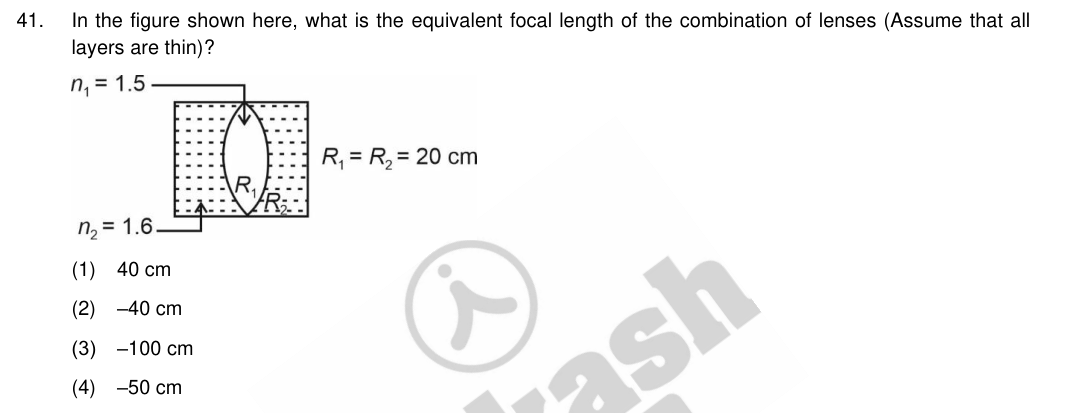
- A.40 cm
- B.–40 cm
- C.–100 cm✓
- D.–50 cm
The worked solution is part of a paid pack.
PhysicsNEET 2022show ▾A light ray falls on a glass surface of refractive index at an angle of . The angle between the refracted and reflected rays would be:
- A.120°
- B.30°
- C.60°
- D.90°✓
The worked solution is part of a paid pack.
PhysicsNEET 2022show ▾A biconvex lens has radii of curvature 20 cm each. If the refractive index of the material of the lens is 1.5, the power of the lens is:
- A.Infinity
- B.+2 D
- C.+20 D
- D.+5 D✓
The worked solution is part of a paid pack.
PhysicsNEET 2021show ▾A point object is placed at a distance of 60 cm from a convex lens of focal length 30 cm. If a plane mirror were put perpendicular to the principal axis of the lens and at a distance of 40 cm from it, the final image would be formed at a distance of:
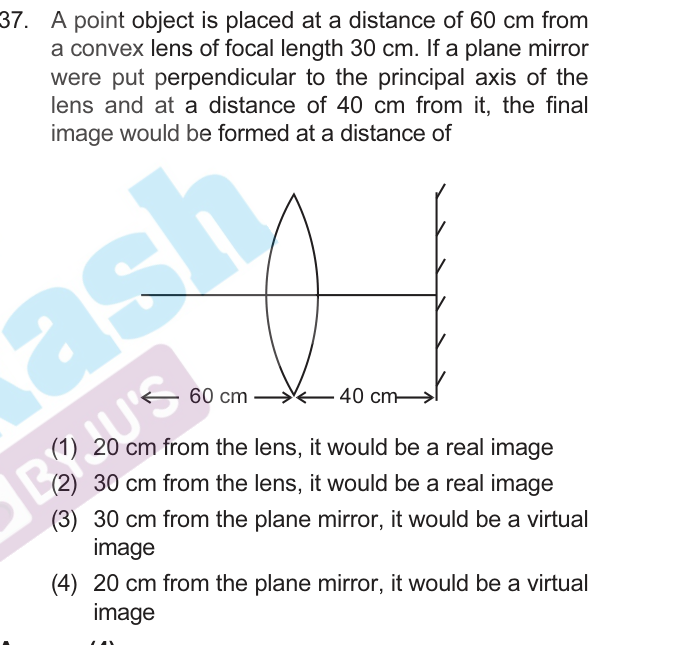
- A.20 cm from the lens; it would be a real image
- B.30 cm from the lens; it would be a real image
- C.30 cm from the plane mirror; it would be a virtual image
- D.20 cm from the plane mirror; it would be a virtual image✓
The worked solution is part of a paid pack.
PhysicsNEET 2021show ▾A convex lens A of focal length 20 cm and a concave lens B of focal length 5 cm are kept along the same axis with a distance between them. If a parallel beam of light falling on A leaves B as a parallel beam, then the distance in cm will be:
PhysicsNEET 2019show ▾Two similar thin equiconvex lenses, of focal length each, are kept coaxially in contact with each other such that the focal length of the combination is . When the space between the two lenses is filled with glycerine (which has the same refractive index, , as the glass) then the equivalent focal length is . The ratio will be:
2. Total internal reflection and prisms
Exam focus: Total internal reflection needs two conditions together: light going from a denser to a rarer medium, and the angle of incidence exceeding the critical angle (sin C = 1/n) — higher refractive index gives a smaller critical angle, which is why diamond traps light so well.
Total Internal Reflection and Prisms
Competition Wallah
Second half of a two-part Ray Optics NEET crash-course one-shot; TIR and refraction through prisms are covered as sections within a broader set of ray-optics topics.
PhysicsNEET 2024show ▾A light ray enters through a right-angled prism at point with the angle of incidence as shown in the figure. It travels through the prism parallel to its base and emerges along the face . The refractive index of the prism is:
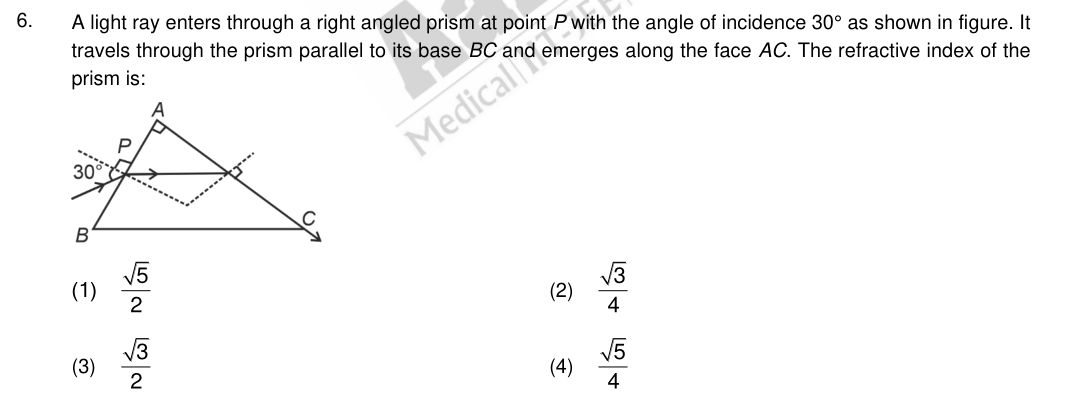
- A.✓
- B.
- C.
- D.
Solution
Let the prism angles at B and C be and with . The ray inside is parallel to BC, so its angle of refraction at AB is and its angle of incidence at AC is . Emerging along AC means is the critical angle: . At P, , so . Squaring and adding: .
Open this question on its own page →
Save for spaced revision (free account)PhysicsNEET 2023show ▾Light travels a distance in time in air and in time in another denser medium. What is the critical angle for this medium?
PhysicsNEET 2022show ▾Two transparent media A and B are separated by a plane boundary. The speeds of light in those media are m/s and m/s, respectively. The critical angle for a ray of light for these two media is:
PhysicsNEET 2021show ▾Find the value of the angle of emergence from the prism. The refractive index of the glass is .
- A.60°✓
- B.30°
- C.45°
- D.90°
The worked solution is part of a paid pack.
PhysicsNEET 2020show ▾A ray is incident at an angle of incidence on one surface of a small-angle prism (with angle of prism ) and emerges normally from the opposite surface. If the refractive index of the material of the prism is , then the angle of incidence is nearly equal to:
PhysicsNEET 2019show ▾Pick the wrong answer in the context of a rainbow.
- A.When light rays undergo two internal reflections in a water drop, a secondary rainbow is formed
- B.The order of colours is reversed in the secondary rainbow
- C.An observer can see a rainbow when facing towards the sun✓
- D.A rainbow is a combined effect of dispersion, refraction and reflection of sunlight
The worked solution is part of a paid pack.
PhysicsNEET 2019show ▾In total internal reflection, when the angle of incidence is equal to the critical angle for a pair of media in contact, what will the angle of refraction be?
- A.
- B.
- C.Equal to the angle of incidence
- D.✓
The worked solution is part of a paid pack.
3. Optical instruments: microscope and telescope
Exam focus: A microscope's magnifying power rises as its lenses' focal lengths get shorter, but a telescope's, fo/fe, rises as the OBJECTIVE's focal length gets longer — opposite dependence, which is why microscope objectives are tiny and telescope objectives are built as large as possible.
Optical Instruments: Microscope and Telescope
Competition Wallah
Full chapter crash course; microscope and telescope are covered in the instruments section together with the rest of the chapter, rather than as an isolated video.
PhysicsNEET 2025show ▾A microscope has an objective of focal length 2 cm, an eyepiece of focal length 4 cm and a tube length of 40 cm. If the distance of distinct vision of the eye is 25 cm, the magnification of the microscope is:
- A.100
- B.125✓
- C.150
- D.250
Solution
; with the commonly used approximation , which is the marked answer.
Open this question on its own page →
Save for spaced revision (free account)PhysicsNEET 2024show ▾A small telescope has an objective of focal length 140 cm and an eyepiece of focal length 5.0 cm. The magnifying power of the telescope for viewing a distant object is:
- A.28✓
- B.17
- C.32
- D.34
Solution
For a distant object, .
Open this question on its own page →
Save for spaced revision (free account)PhysicsNEET 2021show ▾A lens of large focal length and large aperture is best suited as an objective of an astronomical telescope since:
- A.A large aperture contributes to the quality and visibility of the images
- B.A large area of the objective ensures better light-gathering power
- C.A large aperture provides a better resolution
- D.All of the above✓
The worked solution is part of a paid pack.
PhysicsNEET 2020show ▾Assume that light of wavelength 600 nm is coming from a star. The limit of resolution of a telescope whose objective has a diameter of 2 m is:
- A. rad✓
- B. rad
- C. rad
- D. rad
The worked solution is part of a paid pack.