The internal energy of a thermodynamic system is the sum of the kinetic and potential energies of all its constituent molecules — for an ideal gas, where intermolecular forces are absent, depends on temperature alone. Crucially, is a state function: it depends only on the system's current state, not on the path by which that state was reached, so between two given st
Thermodynamics
Class 116 previous-year questions from this chapter every option and the correct answer, free · where the marks are
1. First law, work and internal energy
Exam focus: Internal energy is a state function — for an ideal gas it depends on temperature alone — while heat and work are path-dependent, so two different processes between the same states can have very different Q and W despite identical ΔU.
First Law of Thermodynamics: Work and Internal Energy
Physics Wallah - Alakh Pandey
Covers the zeroth and first laws of thermodynamics with work/internal energy.
PhysicsNEET 2025show ▾Two gases A and B are filled at the same pressure in separate cylinders with movable pistons of radius and , respectively. On supplying an equal amount of heat to both the systems reversibly under constant pressure, the pistons of gas A and B are displaced by 16 cm and 9 cm, respectively. If the change in their internal energy is the same, then the ratio is equal to:
- A.
- B.✓
- C.
- D.
Solution
Same heat, same , so the work done () is the same: .
Open this question on its own page →
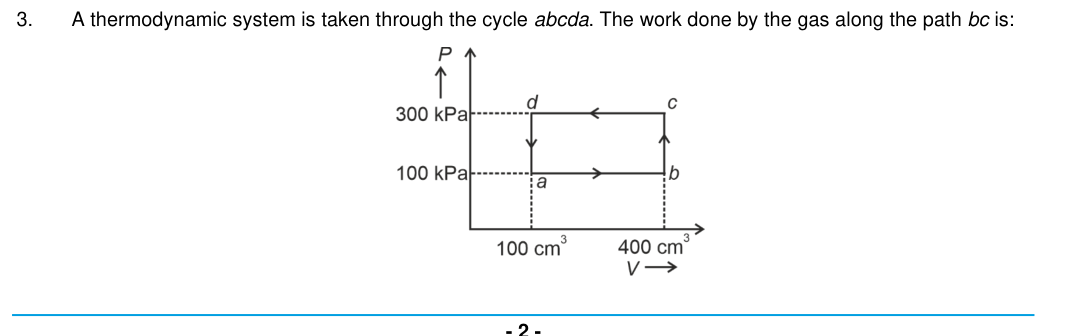
Save for spaced revision (free account)PhysicsNEET 2024show ▾A thermodynamic system is taken through the cycle shown in the – diagram. The work done by the gas along the path is:
- A.30 J
- B.–90 J
- C.–60 J
- D.Zero✓
Solution
Path runs vertically on the – diagram: the volume stays at 400 cm while the pressure rises. With , the work done by the gas is zero.
Open this question on its own page →
Save for spaced revision (free account)2. Thermodynamic processes: isothermal, adiabatic, isobaric, isochoric
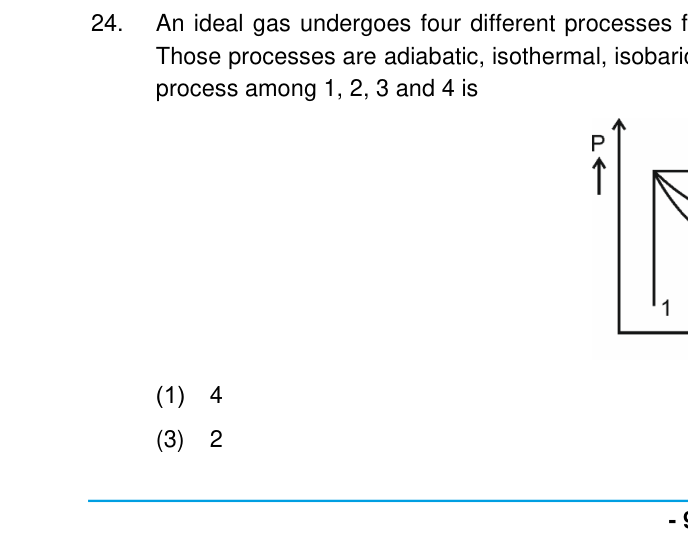
Exam focus: On a P-V diagram, an adiabatic curve through a point is always steeper than the isothermal curve through that same point, because γ > 1 — a fast way to identify which curve is which without reading labels.
Thermodynamic Processes: Isothermal, Isochoric, Isobaric, Adiabatic
Sri Chaitanya Academy NEET
Directly covers all four named processes for NEET; not a strongly-preferred channel, but Sri Chaitanya is a large, well-established Indian NEET/JEE coaching institute.
PhysicsNEET 2022show ▾An ideal gas undergoes four different processes from the same initial state as shown in the figure below. Those processes are adiabatic, isothermal, isobaric and isochoric. The curve which represents the adiabatic process among 1, 2, 3 and 4 is:
PhysicsNEET 2020show ▾Two cylinders A and B of equal capacity are connected to each other via a stop cock. A contains an ideal gas at standard temperature and pressure. B is completely evacuated. The entire system is thermally insulated. The stop cock is suddenly opened. The process is:
- A.Isothermal
- B.Adiabatic✓
- C.Isochoric
- D.Isobaric
The worked solution is part of a paid pack.
PhysicsNEET 2019show ▾In which of the following processes is heat neither absorbed nor released by a system?
- A.Isothermal
- B.Adiabatic✓
- C.Isobaric
- D.Isochoric
The worked solution is part of a paid pack.
3. Second law, heat engines, Carnot cycle
Exam focus: Carnot efficiency, η = 1 − T2/T1 with temperatures in kelvin, depends only on the two reservoir temperatures, never on the working substance — no gas swap raises a reversible engine's efficiency between fixed temperatures.
Carnot's Heat Engine, Working, Graph and Refrigerator
Physics Wallah - Alakh Pandey
Covers heat engines, the Carnot cycle graph, and refrigerators; second-law statements are introduced alongside these, though not named explicitly in the title.
PhysicsNEET 2023show ▾A Carnot engine has an efficiency of 50% when its source is at a temperature of C. The temperature of the sink is:
- A.27 °C✓
- B.15 °C
- C.100 °C
- D.200 °C
The worked solution is part of a paid pack.