The human excretory system consists of a pair of kidneys, a pair of ureters, a single urinary bladder and a urethra. The kidneys are reddish-brown, bean-shaped organs lying between the last thoracic and third lumbar vertebrae, close to the dorsal body wall; each has a notch on its concave side, the hilum, through which the renal artery enters and the renal vein and ureter leave
Excretory Products and their Elimination
Class 1110 previous-year questions from this chapter every option and the correct answer, free · where the marks are
1. Human excretory system and nephron
Exam focus: Not all nephrons are equal: about 85% are cortical nephrons with short loops of Henle, but the remaining 15%, the juxtamedullary ones, have loops that dive deep into the medulla — and it is specifically those long loops that build the gradient letting humans excrete hypertonic urine, a proportion-and-function pairing NEET tests together.
Excretory Products and Their Elimination — Full Chapter (Excretory System and Nephron)
Vedantu NEET English
Full-chapter one-shot covering nephron structure, urine formation/regulation, and dialysis; not split per subtopic.
BotanyNEET 2025show ▾Which of the following diagrams (shown) is correct with regard to the proximal (P) and distal (D) tubule of the nephron?
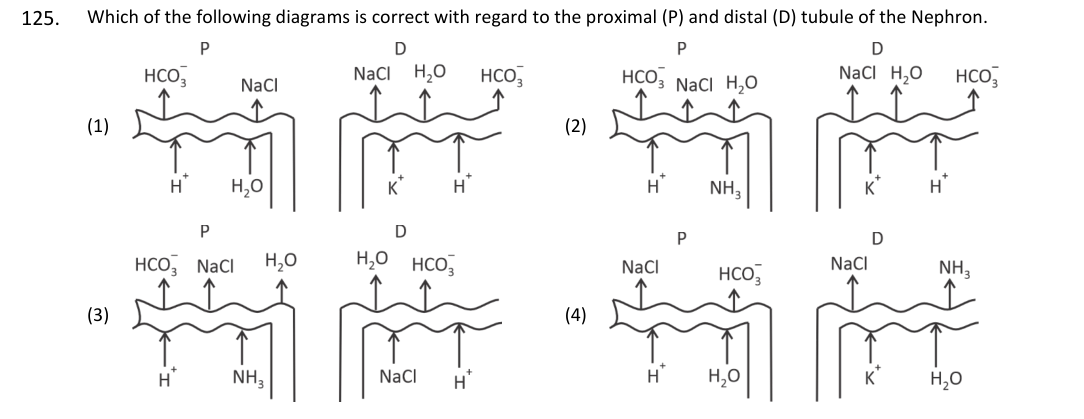
- A.Diagram (1)
- B.Diagram (2)✓
- C.Diagram (3)
- D.Diagram (4)
Solution
The proximal convoluted tubule has a simple cuboidal brush-border epithelium (microvilli on the lumen side) for reabsorption; the distal tubule is cuboidal without a brush border. The diagram showing microvilli on P and none on D is correct.
Open this question on its own page →
Save for spaced revision (free account)ZoologyNEET 2024show ▾Given below are two statements:
Statement I: In the nephron, the descending limb of the loop of Henle is impermeable to water and permeable to electrolytes.
Statement II: The proximal convoluted tubule is lined by simple columnar brush-border epithelium and increases the surface area for reabsorption.
In the light of the above statements, choose the correct answer from the options given below:
- A.Both Statement I and Statement II are false✓
- B.Statement I is true but Statement II is false
- C.Statement I is false but Statement II is true
- D.Both Statement I and Statement II are true
Solution
The descending limb of the loop of Henle is permeable to water but nearly impermeable to electrolytes — the reverse of Statement I. The PCT is lined by simple cuboidal brush-border epithelium, not columnar — Statement II is also false.
Open this question on its own page →
Save for spaced revision (free account)ZoologyNEET 2024show ▾Choose the correct statement regarding the juxtamedullary nephron:
- A.The renal corpuscle of a juxtamedullary nephron lies in the outer portion of the renal medulla.
- B.The loop of Henle of a juxtamedullary nephron runs deep into the medulla.✓
- C.Juxtamedullary nephrons outnumber the cortical nephrons.
- D.Juxtamedullary nephrons are located in the columns of Bertini.
Solution
Juxtamedullary nephrons have their renal corpuscles close to the cortex–medulla junction and long loops of Henle that run deep into the medulla, which lets them concentrate urine. Cortical nephrons are far more numerous.
Open this question on its own page →
Save for spaced revision (free account)ZoologyNEET 2023show ▾Given below are two statements: one is labelled as Assertion A and the other is labelled as Reason R.
Assertion A: Nephrons are of two types, cortical and juxtamedullary, based on their relative position in the cortex and medulla.
Reason R: Juxtamedullary nephrons have a short loop of Henle whereas cortical nephrons have a longer loop of Henle.
In the light of the above statements, choose the correct answer from the options given below:
- A.Both A and R are true and R is the correct explanation of A.
- B.Both A and R are true but R is NOT the correct explanation of A.
- C.A is true but R is false.✓
- D.A is false but R is true.
The worked solution is part of a paid pack.
ZoologyNEET 2022show ▾Nitrogenous waste is excreted in the form of pellet or paste by:
- A.Pavo✓
- B.Ornithorhynchus
- C.Salamandra
- D.Hippocampus
The worked solution is part of a paid pack.
2. Urine formation and its regulation
Exam focus: The huge gap between GFR (about 125 mL/minute, 180 L/day filtered) and actual urine output (1-1.5 L/day) exists because roughly 99% of the filtrate is reabsorbed — most of it "obligatory" reabsorption in the PCT that happens regardless of hydration, while the small remainder in the DCT and collecting duct is "facultative," switched on by ADH only when the body needs to conserve water.
Excretory Products and Their Elimination — Full Chapter (Urine Formation and Regulation)
Vedantu NEET English
Same chapter one-shot; urine formation and its regulation are covered within it.
ZoologyNEET 2023show ▾Which of the following statements are correct?
A. An excessive loss of body fluid from the body switches off osmoreceptors.
B. ADH facilitates water reabsorption to prevent diuresis.
C. ANF causes vasodilation.
D. ADH causes an increase in blood pressure.
E. ADH is responsible for a decrease in GFR.
Choose the correct answer from the options given below:
- A.A and B only
- B.B, C and D only✓
- C.A, B and E only
- D.C, D and E only
The worked solution is part of a paid pack.
ZoologyNEET 2021show ▾Erythropoietin hormone, which stimulates RBC formation, is produced by:
- A.Alpha cells of the pancreas
- B.The cells of the rostral adenohypophysis
- C.The cells of the bone marrow
- D.Juxtaglomerular cells of the kidney✓
The worked solution is part of a paid pack.
ZoologyNEET 2020show ▾Which of the following would help in the prevention of diuresis?
- A.More water reabsorption due to under-secretion of ADH
- B.Reabsorption of and water from the renal tubules due to aldosterone✓
- C.Atrial natriuretic factor causes vasoconstriction
- D.Decrease in the secretion of renin by JG cells
The worked solution is part of a paid pack.
ZoologyNEET 2019show ▾Which of the following factors is responsible for the formation of concentrated urine?
- A.Low levels of antidiuretic hormone
- B.Maintaining hyperosmolarity towards the inner medullary interstitium in the kidneys✓
- C.Secretion of erythropoietin by the juxtaglomerular complex
- D.Hydrostatic pressure during glomerular filtration
The worked solution is part of a paid pack.
3. Disorders and dialysis
Exam focus: Haemodialysis works by diffusion down a gradient, not filtration under pressure: the dialysing fluid is deliberately kept similar to normal blood plasma but without nitrogenous wastes, so urea and other wastes diffuse out while useful ions and glucose are left largely undisturbed — the fluid's exact composition, not just "it removes urea," is what NEET options probe.
Excretory Products and Their Elimination — Full Chapter (Disorders and Dialysis)
Vedantu NEET English
Same chapter one-shot; disorders and dialysis are covered near the end.
ZoologyNEET 2019show ▾Use of an artificial kidney during hemodialysis may result in:
(a) Nitrogenous waste build-up in the body
(b) Non-elimination of excess potassium ions
(c) Reduced absorption of calcium ions from the gastro-intestinal tract
(d) Reduced RBC production
Which of the following options is most appropriate?
- A.(a) and (b) are correct
- B.(b) and (c) are correct
- C.(c) and (d) are correct✓
- D.(a) and (d) are correct
The worked solution is part of a paid pack.