Chapter 39 of 2363 min read
Ideal gas equation and kinetic interpretation of pressure
Why this is asked: At a fixed temperature, rms speed depends only on molar mass — lighter molecules move faster, not slower, which is why hydrogen effuses faster than oxygen at the same temperature.
This chapter is part of a paid pack
A sample of the book is free to read — the rest, including this chapter, unlocks with full access.
See pricingTest yourself
- •A container has two chambers of volumes litres and litres separated by a partition made of a thermal insulator. The chambers contain and moles of ideal gas at pressures atm and atm, respectively. When the partition is removed, the mixture attains an equilibrium pressure of:
- •An oxygen cylinder of volume 30 litre has 18.20 moles of oxygen. After some oxygen is withdrawn from the cylinder, its gauge pressure drops to 11 atmospheres at a temperature of C. The mass of the oxygen withdrawn from the cylinder is nearly equal to: [Given , molecular mass of = 32, 1 atm pressure ]
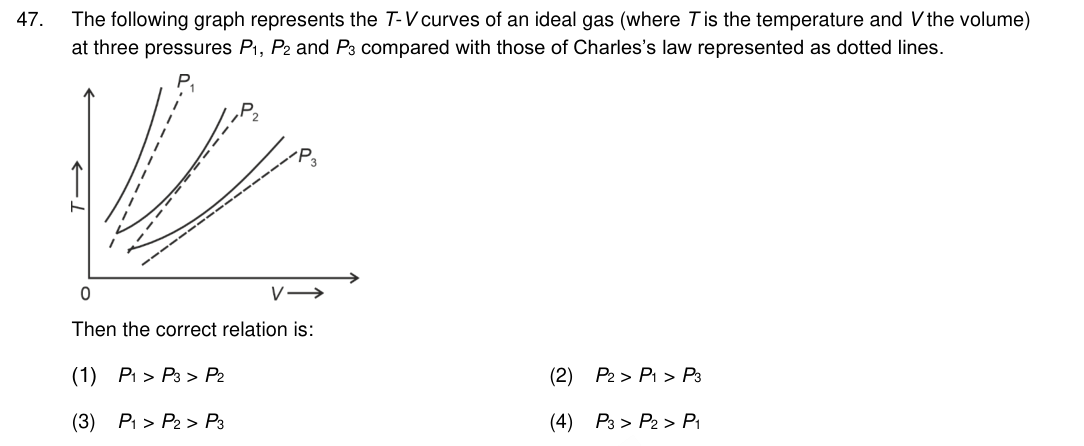
- •The following graph represents the – curves of an ideal gas (where is the temperature and the volume) at three pressures , and , compared with those of Charles's law represented as dotted lines. Then the correct relation is:
Open this in the full syllabus view · Physics