Match List I (reactions, shown as structures) with List II (reagents/conditions):
I. (reagent shown in figure) · II. · III. , IV. (i) (ii) –
Choose the correct answer from the options given below:
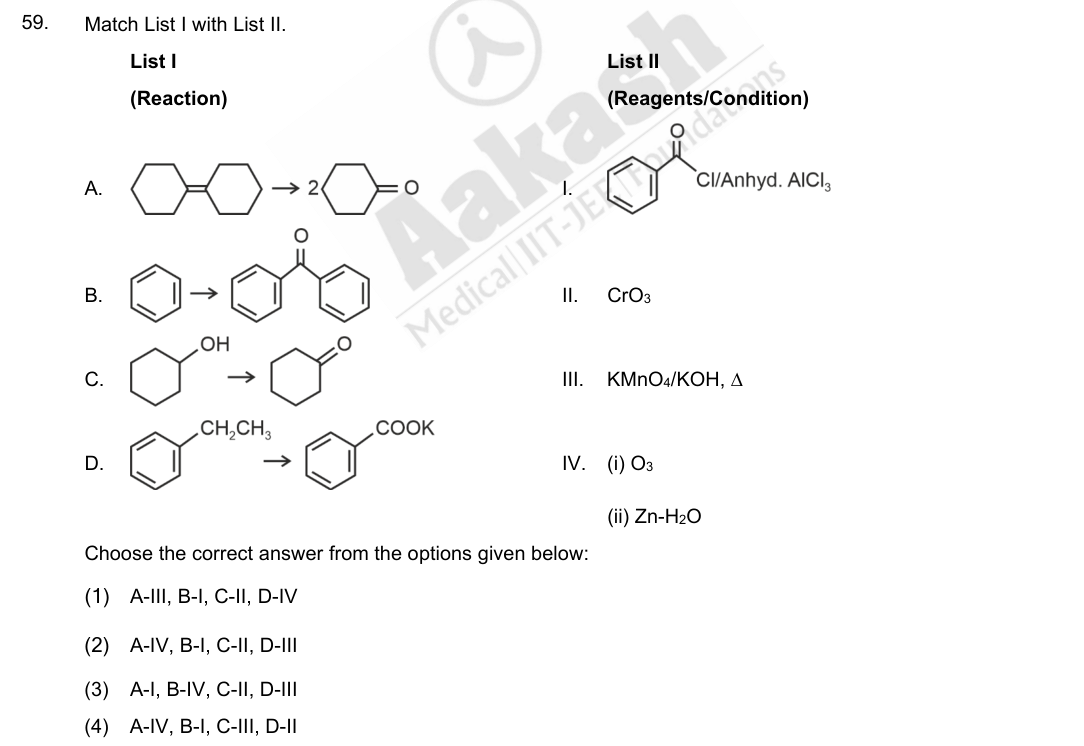
Match List I (reactions, shown as structures) with List II (reagents/conditions):
I. (reagent shown in figure) · II. · III. , IV. (i) (ii) –
Choose the correct answer from the options given below:
Solution
A: cleaving a C=C to two ketones is ozonolysis, (i) (ii) Zn– (IV). B: benzophenone from benzene is Friedel–Crafts acylation with benzoyl chloride/ (I). C: cyclohexanol to cyclohexanone uses (II). D: ethylbenzene to benzoate needs , III). A-IV, B-I, C-II, D-III.
From Chemistry › Hydrocarbons › Alkenes and alkynes: addition reactions, Markovnikov — lectures, notes and every past question on it.
Last revised . Found a mistake? Tell us — corrections are the fastest thing we act on.