Alkanes are saturated hydrocarbons of general formula , built from carbon–carbon and carbon–hydrogen single (sigma) bonds around carbons. Because a sigma bond is symmetric about its axis, the two ends of a C–C bond can rotate against each other with little hindrance, generating a continuous series of spatial arrangements called conformations (or conformers), be
Hydrocarbons
Class 1120 previous-year questions from this chapter every option and the correct answer, free · where the marks are
1. Alkanes: conformations and reactions
Exam focus: Ethane's anti-staggered conformation is the most stable (zero torsional strain) and the fully eclipsed one the least — tested via potential-energy-vs-dihedral-angle graphs, not just the word "staggered." In free-radical halogenation, bromination is far more selective for 3° C–H than chlorination — "both give the same product ratio" is the trap.
Alkanes: Conformations and Reactions
Next Toppers - 11th Science
Dedicated alkanes chapter revision; not a strongly-preferred channel, but content is on-topic and thorough.
ChemistryNEET 2025show ▾How many products (including stereoisomers) are expected from the monochlorination of the compound shown?

- A.2
- B.3
- C.5
- D.6✓
Solution
Monochlorination of 2-methylbutane at each distinct hydrogen: C-1 (the two equivalent methyls) gives 1-chloro-2-methylbutane, chiral at C-2 (2 enantiomers); C-2 gives 2-chloro-2-methylbutane (1); C-3 gives 2-chloro-3-methylbutane, chiral (2); C-4 gives 1-chloro-3-methylbutane (1). Total .
Open this question on its own page →
Save for spaced revision (free account)ChemistryNEET 2024show ▾Given below are two statements:
Statement I: The boiling points of the three isomeric pentanes follow the order n-pentane > isopentane > neopentane.
Statement II: When branching increases, the molecule attains the shape of a sphere. This results in a smaller surface area for contact, due to which the intermolecular forces between the spherical molecules are weak, thereby lowering the boiling point.
In the light of the above statements, choose the most appropriate answer from the options given below:
- A.Both Statement I and Statement II are incorrect
- B.Statement I is correct but Statement II is incorrect
- C.Statement I is incorrect but Statement II is correct
- D.Both Statement I and Statement II are correct✓
Solution
Branching makes a molecule more compact and spherical, reducing surface contact and hence the van der Waals forces, so boiling point falls from n-pentane to isopentane to neopentane. Both statements are correct and II explains I.
Open this question on its own page →
Save for spaced revision (free account)ChemistryNEET 2023show ▾The weight (g) of two moles of the organic compound obtained by heating sodium ethanoate with sodium hydroxide in the presence of calcium oxide is:
ChemistryNEET 2021show ▾
Consider the above reaction and identify the missing reagent/chemical.
- A.
- B.Red phosphorus
- C.CaO✓
- D.DIBAL-H
The worked solution is part of a paid pack.
ChemistryNEET 2021show ▾The dihedral angle of the least stable conformer of ethane is:
- A.120°
- B.180°
- C.60°
- D.0°✓
The worked solution is part of a paid pack.
ChemistryNEET 2020show ▾Which of the following alkanes cannot be made in good yield by the Wurtz reaction?
- A.n-Hexane
- B.2,3-Dimethylbutane
- C.n-Heptane✓
- D.n-Butane
The worked solution is part of a paid pack.
2. Alkenes and alkynes: addition reactions, Markovnikov
Exam focus: The peroxide (anti-Markovnikov) effect works only for HBr — not HCl or HI — because only the bromine free-radical chain steps are both energetically favourable; with HCl and HI, normal Markovnikov addition holds regardless of peroxide. That HBr-only exclusivity, not just "peroxide flips the rule," is what NEET actually tests.
Hydrocarbons — Full Chapter (incl. Alkene/Alkyne Addition and Markovnikov's Rule)
Competition Wallah
A full-chapter one-shot covering all of Class 11 Hydrocarbons (alkanes, alkenes, alkynes, aromatics). It does include electrophilic addition to alkenes/alkynes and Markovnikov's rule with the peroxide effect, but as one segment inside a much longer video.
ChemistryNEET 2025show ▾Which one of the following compounds (shown) does not decolourise bromine water?

- A.Structure (1)✓
- B.Structure (2)
- C.Structure (3)
- D.Structure (4)
Solution
Bromine water is decolourised by addition to C=C (styrene) and by electrophilic bromination of activated rings (phenol, aniline give tribromo products). Cyclohexane (1) is saturated and unactivated, so it does not react.
Open this question on its own page →
Save for spaced revision (free account)ChemistryNEET 2024show ▾Match List I (reactions, shown as structures) with List II (reagents/conditions):
I. (reagent shown in figure) · II. · III. , IV. (i) (ii) –
Choose the correct answer from the options given below:
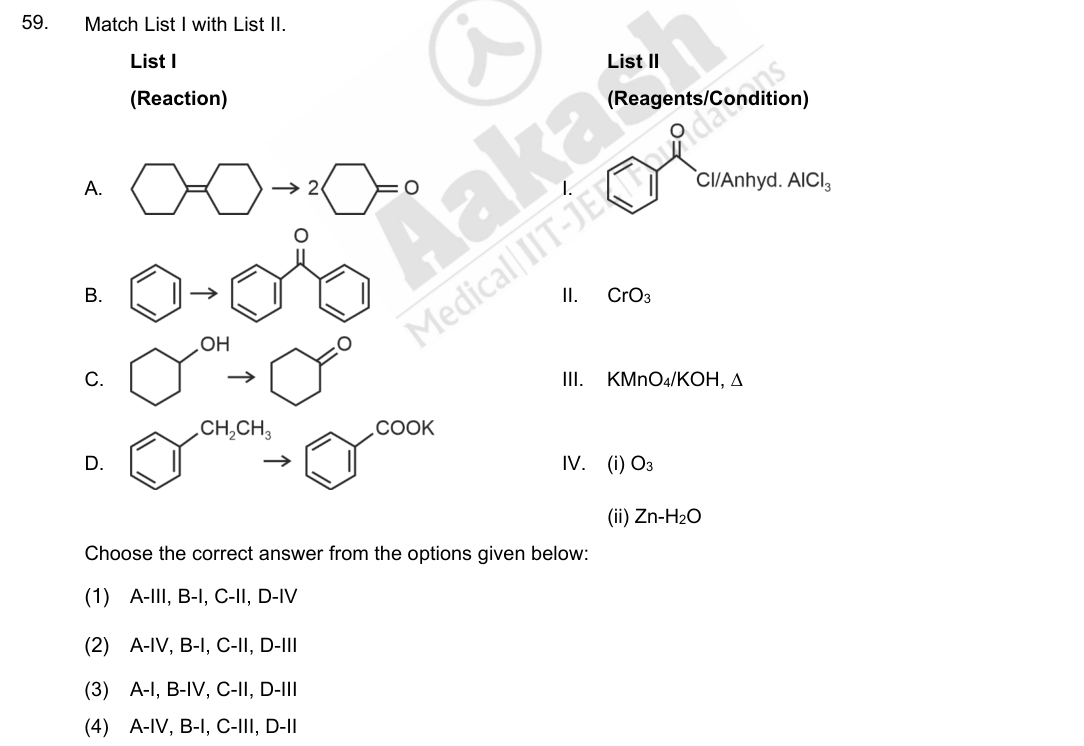
- A.A-III, B-I, C-II, D-IV
- B.A-IV, B-I, C-II, D-III✓
- C.A-I, B-IV, C-II, D-III
- D.A-IV, B-I, C-III, D-II
Solution
A: cleaving a C=C to two ketones is ozonolysis, (i) (ii) Zn– (IV). B: benzophenone from benzene is Friedel–Crafts acylation with benzoyl chloride/ (I). C: cyclohexanol to cyclohexanone uses (II). D: ethylbenzene to benzoate needs , III). A-IV, B-I, C-II, D-III.
Open this question on its own page →
Save for spaced revision (free account)ChemistryNEET 2022show ▾Compound X on reaction with followed by gives formaldehyde and 2-methylpropanal as products. The compound X is:
- A.Pent-2-ene
- B.3-Methylbut-1-ene✓
- C.2-Methylbut-1-ene
- D.2-Methylbut-2-ene
The worked solution is part of a paid pack.
ChemistryNEET 2021show ▾The major product of the following chemical reaction is:
ChemistryNEET 2020show ▾An alkene on ozonolysis gives methanal as one of the products. Its structure is:
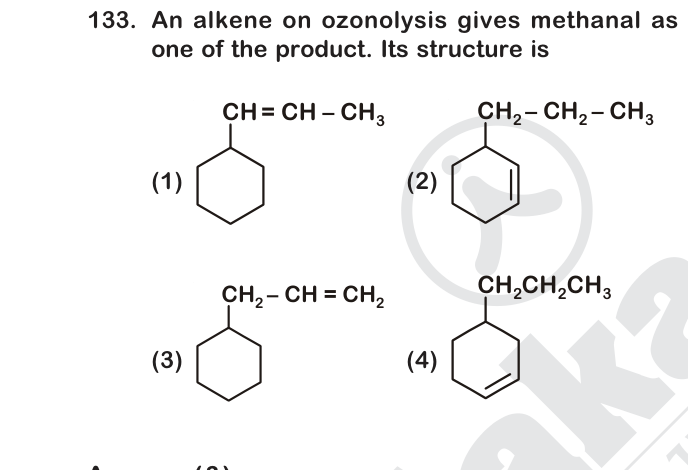
- A.1-Propylidenecyclohexane
- B.3-Allylcyclohexene
- C.Allylcyclohexane✓
- D.3-Propylcyclohexene
The worked solution is part of a paid pack.
ChemistryNEET 2019show ▾The number of sigma () and pi () bonds in pent-2-en-4-yne () is:
- A.10 bonds and 3 bonds✓
- B.8 bonds and 5 bonds
- C.11 bonds and 2 bonds
- D.13 bonds and no bonds
The worked solution is part of a paid pack.
ChemistryNEET 2019show ▾An alkene A, on ozonolysis (reaction with followed by Zn/), gives propanone and ethanal in equimolar amounts (A is 2-methylbut-2-ene). Addition of HCl to A gives B as the major product (Markovnikov addition). The structure of B is:
ChemistryNEET 2019show ▾The most suitable reagent for converting but-2-yne () into cis-2-butene is:
- A.Na / liquid
- B., Pd/C, quinoline (Lindlar's catalyst)✓
- C.Zn/HCl
- D.,
The worked solution is part of a paid pack.
3. Aromatic hydrocarbons: electrophilic substitution, directing effects
Exam focus: Halogens are the one substituent that's ortho/para-directing yet still deactivating — their lone pair donates into the ring by resonance (directing) while their electronegativity withdraws inductively (deactivating), a combination no other common group shows. Friedel–Crafts reactions also simply fail on an already strongly deactivated ring, such as nitrobenzene, no matter how much catalyst is used.
Hydrocarbons — Full Chapter (incl. Aromatic Hydrocarbons and Electrophilic Substitution)
PW Class 11 Science
Bundled inside the full Hydrocarbons chapter one-shot rather than a video dedicated solely to aromatic hydrocarbons/EAS.
ChemistryNEET 2025show ▾Which one of the following reactions (shown in the figure) does not give benzene as the product?

- A.Reaction (1)
- B.Reaction (2)
- C.Reaction (3)
- D.Reaction (4)✓
Solution
Sodium benzoate with soda lime decarboxylates to benzene; n-hexane over at 773 K aromatises to benzene; ethyne passed through a red-hot iron tube trimerises to benzene. Benzenediazonium chloride warmed with water gives phenol, not benzene — reaction (4).
Open this question on its own page →
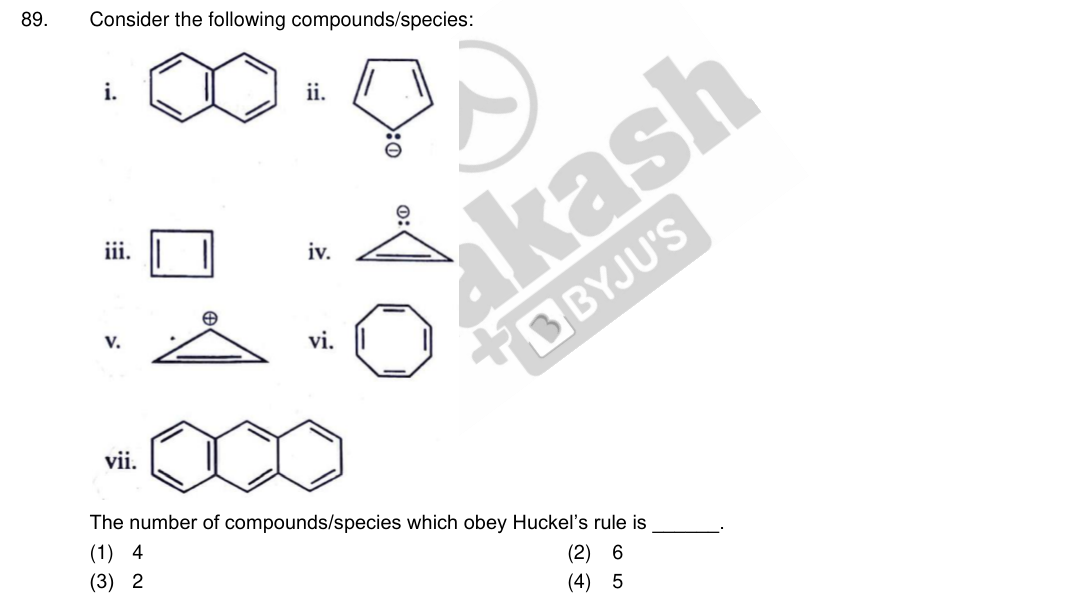
Save for spaced revision (free account)ChemistryNEET 2023show ▾Consider the compounds/species shown in the figure. The number of compounds/species which obey Hückel's rule is ______.
ChemistryNEET 2023show ▾Identify the product in the reaction shown in the figure.
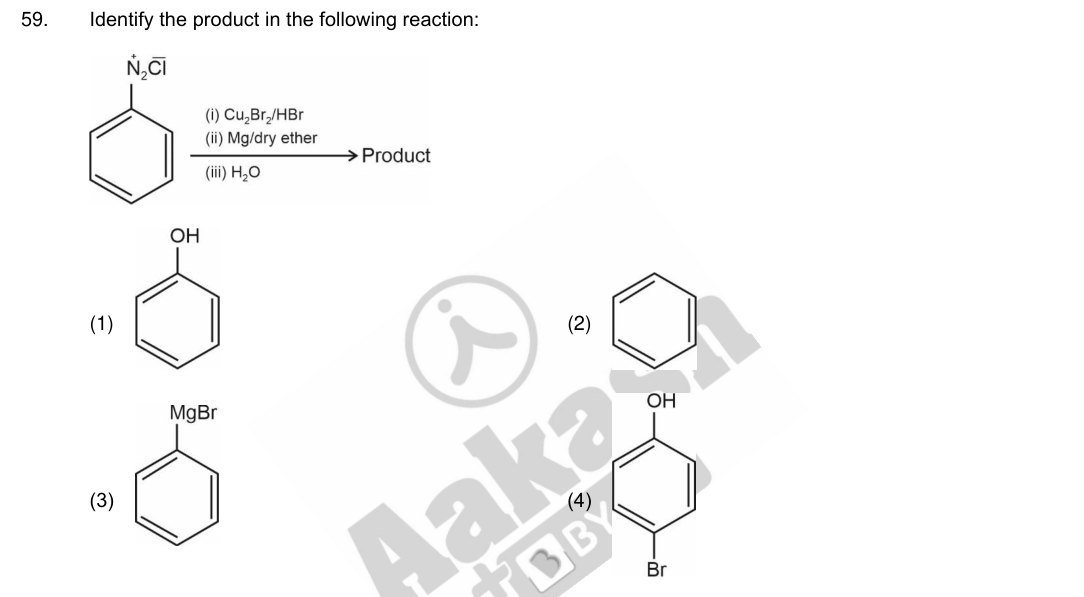
- A.Structure (1)
- B.Structure (2)✓
- C.Structure (3)
- D.Structure (4)
The worked solution is part of a paid pack.
ChemistryNEET 2022show ▾Which compound amongst the following is not an aromatic compound?
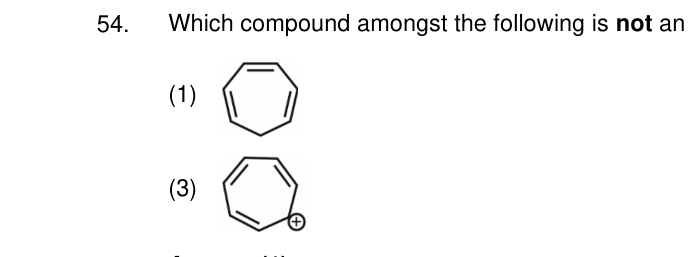
- A.Structure (1)✓
- B.Structure (2)
- C.Structure (3)
- D.Structure (4)
The worked solution is part of a paid pack.
ChemistryNEET 2020show ▾Identify compound X in the following sequence of reactions.
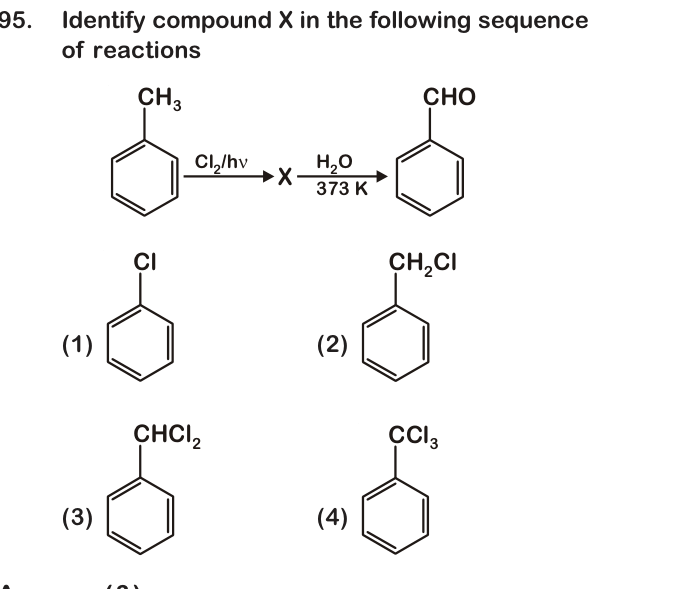
- A.Chlorobenzene
- B.Benzyl chloride ()
- C.Benzal chloride ()✓
- D.Benzotrichloride ()
The worked solution is part of a paid pack.
ChemistryNEET 2019show ▾Among the following, the reaction that proceeds through electrophilic substitution is:
- A.Benzenediazonium chloride + chlorobenzene + (Sandmeyer reaction)
- B.Benzene + , chlorobenzene + HCl (Friedel–Crafts halogenation)✓
- C.Benzene + , UV light benzene hexachloride (free-radical addition)
- D.Benzyl alcohol + HCl, heat benzyl chloride +
The worked solution is part of a paid pack.