The Watson–Crick model (1953) describes DNA as a double helix: two polynucleotide strands wound around a common axis in an antiparallel orientation (one strand runs , the other ), with the sugar–phosphate backbone outside and nitrogenous bases paired inside, held by hydrogen bonds. Pairing is specific — adenine with thymine (two hydrogen bonds) and **guanine with
Molecular Basis of Inheritance
Class 1245 previous-year questions from this chapter every option and the correct answer, free · where the marks are
1. DNA structure and replication
Exam focus: Meselson and Stahl's density-gradient experiment on E. coli, tracking 15N and 14N through generations, is the direct proof that replication is semiconservative — each new DNA molecule keeps exactly one parental strand — and NEET likes to ask which generation produces which density band.
Mechanism of DNA Replication
Vedantu Biotonic for NEET
Semiconservative replication, the Meselson–Stahl evidence, and the replication-fork machinery — opens with a recap of Watson–Crick structure.
ZoologyNEET 2025show ▾Histones are enriched with:
- A.Lysine and arginine✓
- B.Leucine and lysine
- C.Phenylalanine and leucine
- D.Phenylalanine and arginine
Solution
Histones are rich in the basic amino acids lysine and arginine; their positive charge binds the negatively charged DNA.
Open this question on its own page →
Save for spaced revision (free account)BotanyNEET 2025show ▾Match List I with List II.
List I List II A. Alfred Hershey and Martha Chase I. Streptococcus pneumoniae B. Euchromatin II. Densely packed and dark-stained C. Frederick Griffith III. Loosely packed and light-stained D. Heterochromatin IV. Confirmation of DNA as genetic material
Choose the correct answer from the options given below:
- A.A-II, B-IV, C-I, D-III
- B.A-IV, B-II, C-I, D-III
- C.A-IV, B-III, C-I, D-II✓
- D.A-III, B-II, C-IV, D-I
Solution
Hershey and Chase confirmed DNA as the genetic material (IV); euchromatin is loosely packed and lightly stained (III); Griffith worked with Streptococcus pneumoniae (I); heterochromatin is densely packed and dark (II).
Open this question on its own page →
Save for spaced revision (free account)BotanyNEET 2025show ▾Given below are two statements:
Statement I: In the RNA world, RNA is considered the first genetic material, evolved to carry out essential life processes. RNA acts as a genetic material and also as a catalyst for some important biochemical reactions in living systems. Being reactive, RNA is unstable.
Statement II: DNA evolved from RNA and is a more stable genetic material. Its double-helical strands, being complementary, resist changes by evolving a repairing mechanism.
In the light of the above statements, choose the most appropriate answer from the options given below:
- A.Both Statement I and Statement II are correct✓
- B.Both Statement I and Statement II are incorrect
- C.Statement I is correct but Statement II is incorrect
- D.Statement I is incorrect but Statement II is correct
Solution
NCERT presents exactly this account of the RNA world: RNA was the first genetic material and a catalyst, but being reactive it was unstable, and the more stable double-stranded DNA with its repair mechanisms evolved from it. Both statements are correct.
Open this question on its own page →
Save for spaced revision (free account)BotanyNEET 2024show ▾Which of the following statements is correct regarding the process of replication in E. coli?
- A.The DNA-dependent RNA polymerase catalyses polymerisation in one direction, that is 5′ → 3′
- B.The DNA-dependent DNA polymerase catalyses polymerisation in the 5′ → 3′ as well as the 3′ → 5′ direction
- C.The DNA-dependent DNA polymerase catalyses polymerisation in the 5′ → 3′ direction✓
- D.The DNA-dependent DNA polymerase catalyses polymerisation in one direction, that is 3′ → 5′
Solution
DNA-dependent DNA polymerase adds nucleotides only in the 5′→3′ direction — on the leading strand continuously and on the lagging strand as Okazaki fragments. The 3′→5′ direction is never synthesised.
Open this question on its own page →
Save for spaced revision (free account)BotanyNEET 2024show ▾Match List I with List II.
List I List II A. Frederick Griffith I. Genetic code B. François Jacob & Jacques Monod II. Semi-conservative mode of DNA replication C. Har Gobind Khorana III. Transformation D. Meselson & Stahl IV. Lac operon
Choose the correct answer from the options given below:
- A.A-III, B-IV, C-I, D-II✓
- B.A-II, B-III, C-IV, D-I
- C.A-IV, B-I, C-II, D-III
- D.A-III, B-II, C-I, D-IV
Solution
Griffith showed transformation (III); Jacob and Monod described the lac operon (IV); Khorana helped decipher the genetic code (I); Meselson and Stahl proved semi-conservative replication (II).
Open this question on its own page →
Save for spaced revision (free account)BotanyNEET 2023show ▾Unequivocal proof that DNA is the genetic material was first proposed by:
- A.Frederick Griffith
- B.Alfred Hershey and Martha Chase✓
- C.Avery, MacLeod and McCarty
- D.Wilkins and Franklin
The worked solution is part of a paid pack.
ZoologyNEET 2023show ▾Given below are two statements:
Statement I: In prokaryotes, the positively charged DNA is held with some negatively charged proteins in a region called the nucleoid.
Statement II: In eukaryotes, the negatively charged DNA is wrapped around the positively charged histone octamer to form the nucleosome.
In the light of the above statements, choose the correct answer from the options given below:
- A.Both Statement I and Statement II are true.
- B.Both Statement I and Statement II are false.
- C.Statement I is correct but Statement II is false.
- D.Statement I is incorrect but Statement II is true.✓
The worked solution is part of a paid pack.
ZoologyNEET 2022show ▾Ten E. coli cells with N-dsDNA are incubated in a medium containing N nucleotides. After 60 minutes, how many E. coli cells will have DNA totally free from N?
- A.80 cells
- B.20 cells
- C.40 cells
- D.60 cells✓
The worked solution is part of a paid pack.
ZoologyNEET 2022show ▾If the length of a DNA molecule is 1.1 metres, what will be the approximate number of base pairs?
- A. bp
- B. bp✓
- C. bp
- D. bp
The worked solution is part of a paid pack.
BotanyNEET 2022show ▾Read the following statements and choose the set of correct statements:
(a) Euchromatin is loosely packed chromatin
(b) Heterochromatin is transcriptionally active
(c) The histone octamer is wrapped by negatively charged DNA in a nucleosome
(d) Histones are rich in lysine and arginine
(e) A typical nucleosome contains 400 bp of DNA helix
Choose the correct answer from the options given below:
- A.(a), (c), (e) only
- B.(b), (d), (e) only
- C.(a), (c), (d) only✓
- D.(b), (e) only
The worked solution is part of a paid pack.
ZoologyNEET 2021show ▾If adenine makes up 30% of a DNA molecule, what will be the percentage of thymine, guanine and cytosine in it?
- A.T : 20; G : 30; C : 20
- B.T : 20; G : 20; C : 30
- C.T : 30; G : 20; C : 20✓
- D.T : 20; G : 25; C : 25
The worked solution is part of a paid pack.
ZoologyNEET 2021show ▾Which one of the following statements about histones is wrong?
- A.Histones are organised to form a unit of 8 molecules
- B.The pH of histones is slightly acidic✓
- C.Histones are rich in the amino acids lysine and arginine
- D.Histones carry a positive charge in the side chain
The worked solution is part of a paid pack.
BotanyNEET 2020show ▾If the distance between two consecutive base pairs is 0.34 nm and the total number of base pairs of a DNA double helix in a typical mammalian cell is bp, then the length of the DNA is approximately:
- A.2.0 metres
- B.2.5 metres
- C.2.2 metres✓
- D.2.7 metres
The worked solution is part of a paid pack.
BotanyNEET 2020show ▾Which of the following statements is correct?
- A.Adenine pairs with thymine through two H-bonds✓
- B.Adenine pairs with thymine through one H-bond
- C.Adenine pairs with thymine through three H-bonds
- D.Adenine does not pair with thymine
The worked solution is part of a paid pack.
BotanyNEET 2019show ▾Purines found both in DNA and RNA are:
- A.Adenine and thymine
- B.Adenine and guanine✓
- C.Guanine and cytosine
- D.Cytosine and thymine
The worked solution is part of a paid pack.
2. Transcription, genetic code, translation
Exam focus: The genetic code is degenerate — most amino acids answer to more than one codon — but not evenly: methionine (AUG) and tryptophan (UGG) are the two exceptions with only a single codon each, which is exactly why AUG can double as both the start signal and an amino-acid codon without ambiguity.
Transcription and the Genetic Code
Vedantu Biotonic for NEET
The transcription unit, RNA polymerase's job, and the genetic code's properties (degenerate, unambiguous, universal). Translation is the next lecture in this series.
BotanyNEET 2025show ▾Given below are two statements:
Statement I: Transfer RNAs and ribosomal RNA do not interact with mRNA.
Statement II: RNA interference (RNAi) takes place in all eukaryotic organisms as a method of cellular defence.
In the light of the above statements, choose the most appropriate answer from the options given below:
- A.Both Statement I and Statement II are correct
- B.Both Statement I and Statement II are incorrect
- C.Statement I is correct but Statement II is incorrect
- D.Statement I is incorrect but Statement II is correct✓
Solution
tRNA and rRNA both interact with mRNA during translation, so I is false. RNA interference is a cellular-defence mechanism found in all eukaryotes, so II is correct.
Open this question on its own page →
Save for spaced revision (free account)BotanyNEET 2025show ▾Which of the following are the post-transcriptional events in a eukaryotic cell?
A. Transport of pre-mRNA to the cytoplasm prior to splicing.
B. Removal of introns and joining of exons.
C. Addition of a methyl group at the 5′ end of hnRNA.
D. Addition of adenine residues at the 3′ end of hnRNA.
E. Base pairing of two complementary RNAs.
Choose the correct answer from the options given below:
- A.A, B, C only
- B.B, C, D only✓
- C.B, C, E only
- D.C, D, E only
Solution
hnRNA is capped with a methyl-guanosine at the 5′ end (C), polyadenylated at the 3′ end (D), and spliced to remove introns and join exons (B) — all before it leaves the nucleus. So B, C and D.
Open this question on its own page →
Save for spaced revision (free account)ZoologyNEET 2025show ▾Who proposed that the genetic code for amino acids should be made up of three nucleotides?
- A.George Gamow✓
- B.Francis Crick
- C.Jacques Monod
- D.Franklin Stahl
Solution
George Gamow, a physicist, argued that a code for 20 amino acids using four bases must be a triplet code, since combinations suffice while do not.
Open this question on its own page →
Save for spaced revision (free account)ZoologyNEET 2025show ▾Which factor is important for the termination of transcription?
- A.alpha)
- B.sigma)
- C.rho)✓
- D.gamma)
Solution
In prokaryotes the rho factor binds the growing RNA and terminates transcription; the sigma factor is needed for initiation.
Open this question on its own page →
Save for spaced revision (free account)ZoologyNEET 2024show ▾Which one is the correct product of DNA-dependent RNA polymerase on the given template?
3′-TACATGGCAAATATCCATTCA-5′
- A.5′-AUGUAAAGUUUAUAGGUAAGU-3′
- B.5′-AUGUACCGUUUAUAGGGAAGU-3′
- C.5′-ATGTACCGTTTATAGGTAAGT-3′
- D.5′-AUGUACCGUUUAUAGGUAAGU-3′✓
Solution
RNA polymerase reads the template 3′→5′ and builds a complementary RNA 5′→3′ with U in place of T: 3′-TACATGGCAAATATCCATTCA-5′ gives 5′-AUGUACCGUUUAUAGGUAAGU-3′.
Open this question on its own page →
Save for spaced revision (free account)ZoologyNEET 2024show ▾Match List I with List II.
List I List II A. RNA polymerase III I. snRNPs B. Termination of transcription II. Promoter C. Splicing of exons III. Rho factor D. TATA box IV. snRNAs, tRNA
Choose the correct answer from the options given below:
- A.A-III, B-II, C-IV, D-I
- B.A-III, B-IV, C-I, D-II
- C.A-IV, B-III, C-I, D-II✓
- D.A-II, B-IV, C-I, D-III
Solution
RNA polymerase III transcribes tRNA, 5S rRNA and snRNAs (IV); rho factor terminates transcription in prokaryotes (III); snRNPs carry out splicing (I); the TATA box is part of the promoter (II).
Open this question on its own page →
Save for spaced revision (free account)BotanyNEET 2024show ▾A transcription unit in DNA is defined primarily by three regions in the DNA, and these are, with respect to the upstream and downstream ends:
- A.Structural gene, Transposons, Operator gene
- B.Inducer, Repressor, Structural gene
- C.Promoter, Structural gene, Terminator✓
- D.Repressor, Operator gene, Structural gene
Solution
A transcription unit runs, in the 5′→3′ direction of the coding strand, from a promoter through the structural gene to a terminator. Repressors, operators and inducers belong to regulation, not to the definition of the unit.
Open this question on its own page →
Save for spaced revision (free account)ZoologyNEET 2023show ▾Which one of the following is the sequence on the corresponding coding strand, if the sequence on the mRNA formed is 5′-AUCGAUCGAUCGAUCGAUCGAUCG AUCG-3′?
- A.5′-UAGCUAGCUAGCUAGCUAGCUAGCUAGC-3′
- B.3′-UAGCUAGCUAGCUAGCUAGCUAGCUAGC-5′
- C.5′-ATCGATCGATCGATCGATCGATCGATCG-3′✓
- D.3′-ATCGATCGATCGATCGATCGATCGATCG-5′
The worked solution is part of a paid pack.
BotanyNEET 2023show ▾What is the role of RNA polymerase III in the process of transcription in eukaryotes?
- A.Transcription of rRNAs (28S, 18S and 5.8S)
- B.Transcription of tRNA, 5S rRNA and snRNA✓
- C.Transcription of the precursor of mRNA
- D.Transcription of only snRNAs
The worked solution is part of a paid pack.
BotanyNEET 2022show ▾The process of translation of mRNA to proteins begins as soon as:
- A.The tRNA is activated and the larger subunit of the ribosome encounters mRNA
- B.The small subunit of the ribosome encounters mRNA✓
- C.The larger subunit of the ribosome encounters mRNA
- D.Both the subunits join together to bind with mRNA
The worked solution is part of a paid pack.
ZoologyNEET 2021show ▾Which is the only enzyme that has the capability to catalyse initiation, elongation and termination in the process of transcription in prokaryotes?
- A.DNA-dependent DNA polymerase
- B.DNA-dependent RNA polymerase✓
- C.DNA ligase
- D.DNase
The worked solution is part of a paid pack.
ZoologyNEET 2021show ▾Which of the following RNAs is not required for the synthesis of protein?
- A.mRNA
- B.tRNA
- C.rRNA
- D.siRNA✓
The worked solution is part of a paid pack.
BotanyNEET 2021show ▾Complete the flow chart on the central dogma.
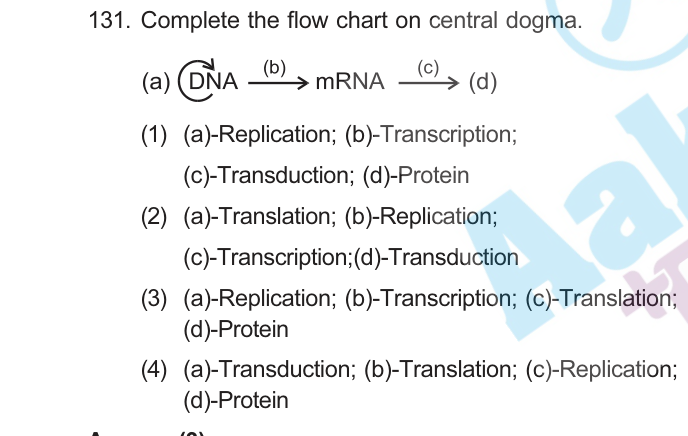
- A.(a)-Replication; (b)-Transcription; (c)-Transduction; (d)-Protein
- B.(a)-Translation; (b)-Replication; (c)-Transcription; (d)-Transduction
- C.(a)-Replication; (b)-Transcription; (c)-Translation; (d)-Protein✓
- D.(a)-Transduction; (b)-Translation; (c)-Replication; (d)-Protein
The worked solution is part of a paid pack.
BotanyNEET 2021show ▾Identify the correct statement.
- A.In capping, methyl guanosine triphosphate is added to the 3′ end of hnRNA
- B.RNA polymerase binds with rho factor to terminate the process of transcription in bacteria✓
- C.The coding strand in a transcription unit is copied to an mRNA
- D.Split gene arrangement is characteristic of prokaryotes
The worked solution is part of a paid pack.
BotanyNEET 2021show ▾What is the role of RNA polymerase III in the process of transcription in eukaryotes?
- A.Transcribes rRNAs (28S, 18S and 5.8S)
- B.Transcribes tRNA, 5S rRNA and snRNA✓
- C.Transcribes the precursor of mRNA
- D.Transcribes only snRNAs
The worked solution is part of a paid pack.
ZoologyNEET 2021show ▾Statement I: The codon 'AUG' codes for methionine and phenylalanine.
Statement II: 'AAA' and 'AAG' both codons code for the amino acid lysine.
In the light of the above statements, choose the correct answer from the options given below:
- A.Both Statement I and Statement II are true
- B.Both Statement I and Statement II are false
- C.Statement I is correct but Statement II is false
- D.Statement I is incorrect but Statement II is true✓
The worked solution is part of a paid pack.
BotanyNEET 2020show ▾Name the enzyme that facilitates the opening of the DNA helix during transcription.
- A.DNA ligase
- B.DNA helicase
- C.DNA polymerase
- D.RNA polymerase✓
The worked solution is part of a paid pack.
BotanyNEET 2020show ▾The first phase of translation is:
- A.Binding of mRNA to the ribosome
- B.Recognition of the DNA molecule
- C.Aminoacylation of tRNA✓
- D.Recognition of an anti-codon
The worked solution is part of a paid pack.
BotanyNEET 2019show ▾Which of the following features of the genetic code allows bacteria to produce human insulin by recombinant DNA technology?
- A.The genetic code is not ambiguous
- B.The genetic code is redundant (degenerate)
- C.The genetic code is nearly universal✓
- D.The genetic code is specific
The worked solution is part of a paid pack.
BotanyNEET 2019show ▾Under which of the following changes will there be NO change in the reading frame of the mRNA ?
- A.Insertion of G at the 5th position
- B.Deletion of G from the 5th position
- C.Insertion of A and G at the 4th and 5th positions respectively
- D.Deletion of GGU from the 7th, 8th and 9th positions✓
The worked solution is part of a paid pack.
3. Gene regulation: lac operon; Human Genome Project, DNA fingerprinting
Exam focus: The lac operon is off by default — the repressor sits on the operator and blocks transcription — and lactose itself (as allolactose) is the inducer that removes the repressor, switching on one polycistronic mRNA for all three structural genes at once, unlike any eukaryotic gene.
Lac Operon, Human Genome Project and DNA Fingerprinting
Vedantu NEET English
A single lecture explicitly built around lac-operon gene regulation, the Human Genome Project, and DNA fingerprinting — a close, direct match.
BotanyNEET 2025show ▾Which chromosome in the human genome has the highest number of genes?
- A.Chromosome X
- B.Chromosome Y
- C.Chromosome 1✓
- D.Chromosome 10
Solution
Chromosome 1, the largest human chromosome, carries the most genes (about 2,968); the Y chromosome has the fewest (about 231).
Open this question on its own page →
Save for spaced revision (free account)BotanyNEET 2024show ▾The lactose present in the growth medium of bacteria is transported into the cell by the action of:
- A.Acetylase
- B.Permease✓
- C.Polymerase
- D.Beta-galactosidase
Solution
Lactose enters E. coli through lac permease, the product of the y gene; galactosidase (z) then hydrolyses it inside the cell.
Open this question on its own page →
Save for spaced revision (free account)ZoologyNEET 2023show ▾Match List I with List II.
List I List II A. Gene a galactosidase B. Gene y II. Transacetylase C. Gene i III. Permease D. Gene z IV. Repressor protein
Choose the correct answer from the options given below:
- A.A-II, B-I, C-IV, D-III
- B.A-II, B-III, C-IV, D-I✓
- C.A-III, B-IV, C-I, D-II
- D.A-III, B-I, C-IV, D-II
The worked solution is part of a paid pack.
BotanyNEET 2023show ▾Expressed Sequence Tags (ESTs) refer to:
- A.All genes that are expressed as RNA.✓
- B.All genes that are expressed as proteins.
- C.All genes, whether expressed or unexpressed.
- D.Certain important expressed genes.
The worked solution is part of a paid pack.
BotanyNEET 2022show ▾If a geneticist uses the blind approach for sequencing the whole genome of an organism, followed by assignment of function to different segments, the methodology adopted by him is called:
- A.Bioinformatics
- B.Sequence annotation✓
- C.Gene mapping
- D.Expressed sequence tags
The worked solution is part of a paid pack.
BotanyNEET 2022show ▾DNA polymorphism forms the basis of:
- A.Translation
- B.Genetic mapping
- C.DNA fingerprinting
- D.Both genetic mapping and DNA fingerprinting✓
The worked solution is part of a paid pack.
ZoologyNEET 2022show ▾In an E. coli strain the i gene gets mutated and its product cannot bind the inducer molecule. If the growth medium is provided with lactose, what will be the outcome?
- A.RNA polymerase will bind the promoter region
- B.Only the z gene will get transcribed
- C.z, y, a genes will be transcribed
- D.z, y, a genes will not be translated✓
The worked solution is part of a paid pack.
BotanyNEET 2021show ▾DNA fingerprinting involves identifying differences in some specific regions in the DNA sequence, called:
- A.Satellite DNA
- B.Repetitive DNA✓
- C.Single nucleotides
- D.Polymorphic DNA
The worked solution is part of a paid pack.
BotanyNEET 2019show ▾Expressed Sequence Tags (ESTs) refer to:
- A.Genes expressed as RNA✓
- B.Polypeptide expression
- C.DNA polymorphism
- D.Novel DNA sequences
The worked solution is part of a paid pack.
BotanyNEET 2019show ▾Match the following genes of the lac operon with their respective products:
Column I Column II (a) gene (i) -galactosidase (b) gene (ii) Permease (c) gene (iii) Repressor (d) gene (iv) Transacetylase
- A.(a)-(i), (b)-(iii), (c)-(ii), (d)-(iv)
- B.(a)-(iii), (b)-(i), (c)-(ii), (d)-(iv)
- C.(a)-(iii), (b)-(i), (c)-(iv), (d)-(ii)✓
- D.(a)-(iii), (b)-(iv), (c)-(i), (d)-(ii)
The worked solution is part of a paid pack.