When a nucleophile attacks the carbon of a carbonyl group and adds across the bond, the reaction is called nucleophilic addition — the characteristic reaction of aldehydes and ketones. The carbonyl carbon is hybridised and planar, and the bond is strongly polarised, with carbon carrying a partial positive charge () and oxygen a partial negative charge ($\del
Aldehydes, Ketones and Carboxylic Acids
Class 1219 previous-year questions from this chapter every option and the correct answer, free · where the marks are
1. Nucleophilic addition reactions
Exam focus: Reactivity toward nucleophilic addition runs aldehydes above ketones, and an aryl group directly on the carbonyl carbon lowers it further still, since the ring donates electron density into the C=O by resonance and makes that carbon less electrophilic. That steric-plus-electronic combination is what "arrange by reactivity toward HCN/NaHSO₃" questions are actually testing, not a memorised list.
Aldehydes & Ketones: Nucleophilic Addition (HCN, Alcohols)
Physics Wallah - Alakh Pandey
Why the carbonyl carbon is electrophilic, then the HCN- and alcohol-addition mechanisms NEET builds its option sets around.
ChemistryNEET 2025show ▾Identify the suitable reagent for the conversion shown in the figure.
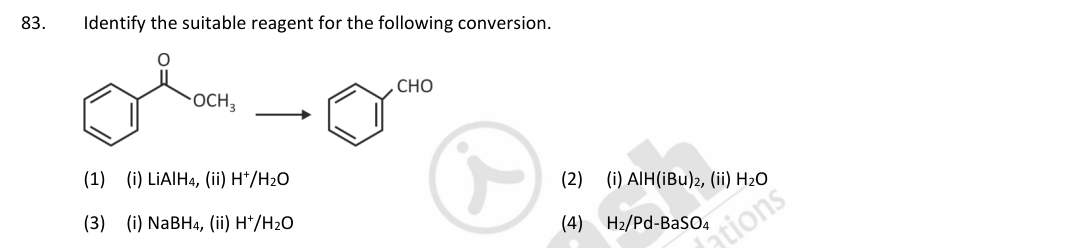
- A.(i) , (ii)
- B.(i) , (ii) ✓
- C.(i) , (ii)
- D.
Solution
Reducing an ester only as far as the aldehyde needs DIBAL-H, , at low temperature followed by water. would go on to benzyl alcohol, does not reduce esters, and is for acid chlorides (Rosenmund).
Open this question on its own page →
Save for spaced revision (free account)ChemistryNEET 2024show ▾Fehling's solution 'A' is:
- A.alkaline copper sulphate
- B.alkaline solution of sodium potassium tartrate (Rochelle's salt)
- C.aqueous sodium citrate
- D.aqueous copper sulphate✓
Solution
Fehling's solution A is aqueous copper(II) sulphate; Fehling's B is alkaline sodium potassium tartrate. They are mixed just before use.
Open this question on its own page →
Save for spaced revision (free account)ChemistryNEET 2024show ▾For the reaction shown in the figure, the product 'P' is:
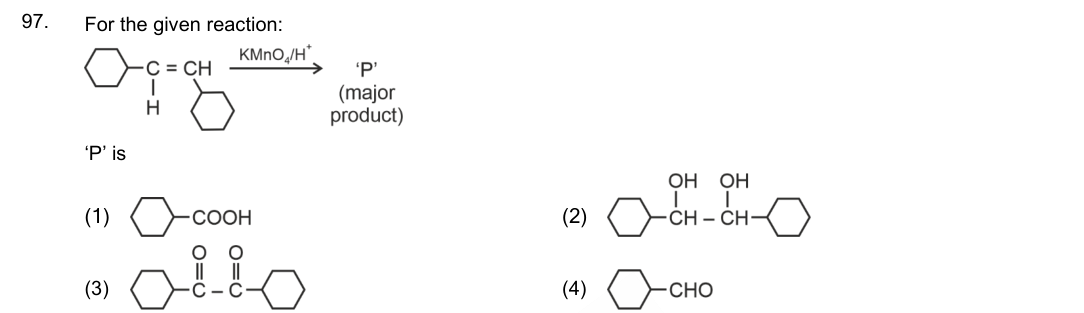
- A.Structure (1)✓
- B.Structure (2)
- C.Structure (3)
- D.Structure (4)
Solution
Hot acidic cleaves the C=C of stilbene completely and oxidises each fragment fully: both ends carry one H, so each becomes benzoic acid — product (1).
Open this question on its own page →
Save for spaced revision (free account)ChemistryNEET 2023show ▾Identify product (A) in the reaction shown in the figure.
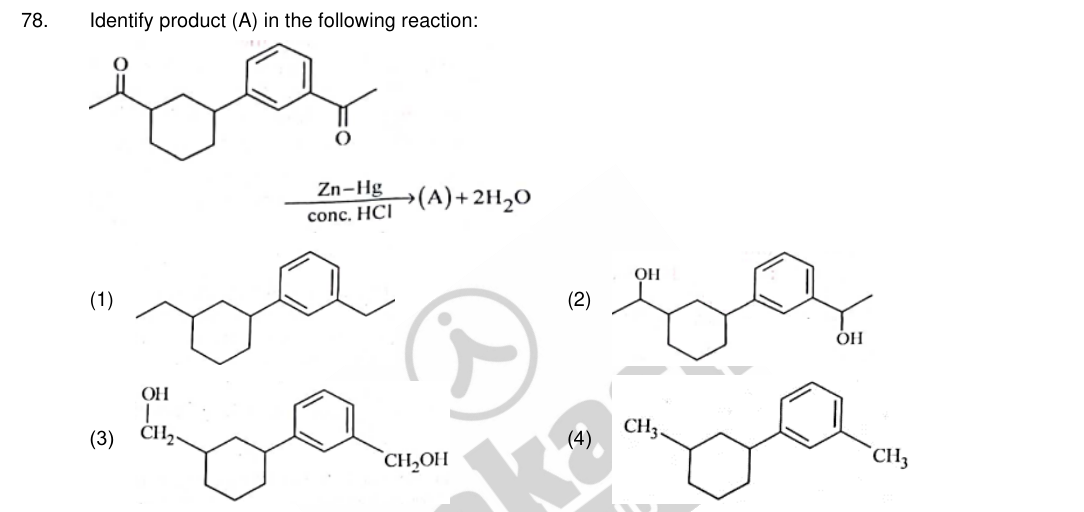
- A.Structure (1)✓
- B.Structure (2)
- C.Structure (3)
- D.Structure (4)
The worked solution is part of a paid pack.
ChemistryNEET 2022show ▾Given below are two statements:
Statement I: The boiling points of aldehydes and ketones are higher than those of hydrocarbons of comparable molecular masses because of weak molecular association in aldehydes and ketones due to dipole–dipole interactions.
Statement II: The boiling points of aldehydes and ketones are lower than those of alcohols of similar molecular masses due to the absence of H-bonding.
In the light of the above statements, choose the most appropriate answer from the options given below:
- A.Statement I is incorrect but Statement II is correct
- B.Both Statement I and Statement II are correct✓
- C.Both Statement I and Statement II are incorrect
- D.Statement I is correct but Statement II is incorrect
The worked solution is part of a paid pack.
ChemistryNEET 2022show ▾Match List-I with List-II.
List-I (Product formed) List-II (Reaction of carbonyl compound with) (a) Cyanohydrin (i) (b) Acetal (ii) (c) Schiff's base (iii) Alcohol (d) Oxime (iv) HCN
Choose the correct answer from the options given below:
- A.(a)-(iv), (b)-(iii), (c)-(ii), (d)-(i)✓
- B.(a)-(iii), (b)-(iv), (c)-(ii), (d)-(i)
- C.(a)-(ii), (b)-(iii), (c)-(iv), (d)-(i)
- D.(a)-(i), (b)-(iii), (c)-(ii), (d)-(iv)
The worked solution is part of a paid pack.
ChemistryNEET 2021show ▾The product formed in the following chemical reaction is:
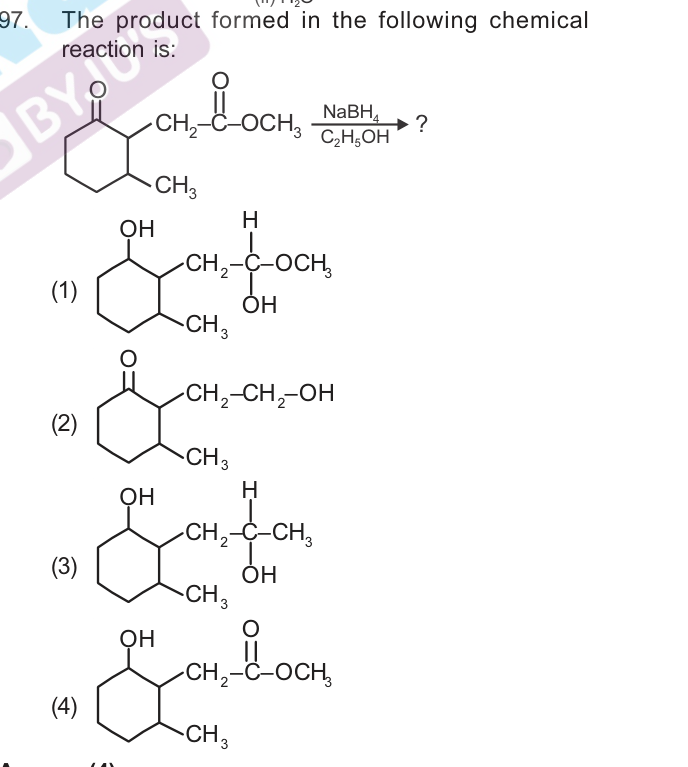
- A.Structure (1)
- B.Structure (2)
- C.Structure (3)
- D.Structure (4)✓
The worked solution is part of a paid pack.
ChemistryNEET 2020show ▾The reaction between acetone and methylmagnesium chloride, followed by hydrolysis, will give:
- A.Isopropyl alcohol
- B.Sec-butyl alcohol
- C.Tert-butyl alcohol✓
- D.Isobutyl alcohol
The worked solution is part of a paid pack.
2. Named reactions: aldol, Cannizzaro, Clemmensen, Wolff–Kishner
Exam focus: Cannizzaro reaction only happens on an aldehyde with no alpha-hydrogen — with an alpha-H present, concentrated base drives aldol condensation instead, so checking for alpha-H is the first move. Clemmensen reduction (Zn-Hg/HCl) and Wolff–Kishner reduction (NH₂NH₂/KOH) both take C=O to CH₂, but the choice between them depends on the rest of the molecule — Clemmensen's acid would attack acid-sensitive groups, Wolff–Kishner's base would attack base-sensitive ones.
Aldehydes, Ketones and Carboxylic Acids — Full Chapter
NCERT Wallah
One-shot chapter covering named reactions (Aldol, Cannizzaro, Clemmensen, Wolff-Kishner) along with the rest of the chapter, not a named-reactions-only video.
ChemistryNEET 2025show ▾Predict the major product 'P' in the sequence of reactions shown in the figure.
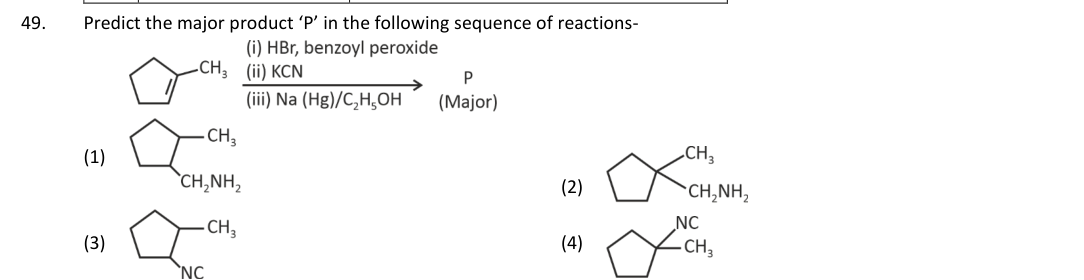
- A.Structure (1)✓
- B.Structure (2)
- C.Structure (3)
- D.Structure (4)
Solution
HBr with peroxide adds anti-Markovnikov, placing Br on the less substituted ring carbon (C-2) of 1-methylcyclopentene. KCN substitutes Br by –CN, and Na/ethanol reduces the nitrile to . P is 1-methyl-2-(aminomethyl)cyclopentane — structure (1).
Open this question on its own page →
Save for spaced revision (free account)ChemistryNEET 2024show ▾The major products A and B formed in the reaction sequence shown in the figure are:
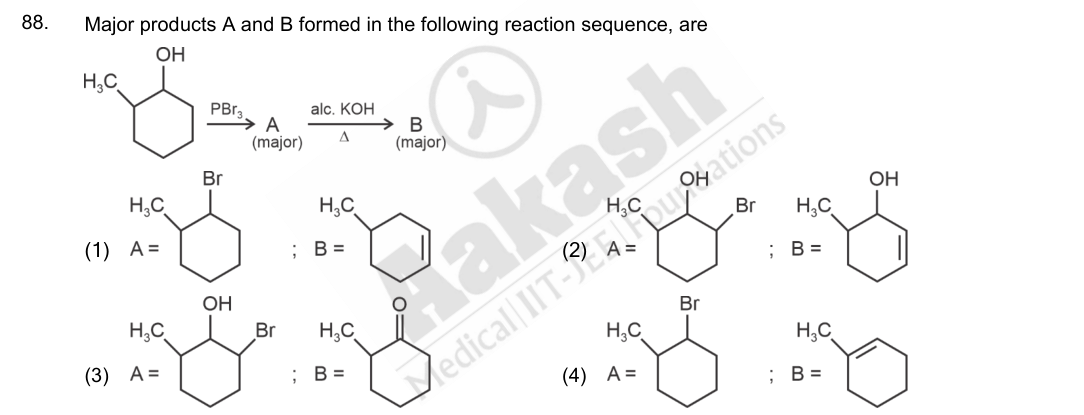
- A.Products (1)
- B.Products (2)
- C.Products (3)
- D.Products (4)✓
Solution
replaces –OH by –Br without rearrangement, giving 1-bromo-2-methylcyclohexane (A). Alcoholic KOH then eliminates HBr by the Saytzeff rule to the more substituted alkene, 1-methylcyclohexene (B) — option (4).
Open this question on its own page →
Save for spaced revision (free account)ChemistryNEET 2023show ▾Complete the reaction sequence shown in the figure. [C] is ________.
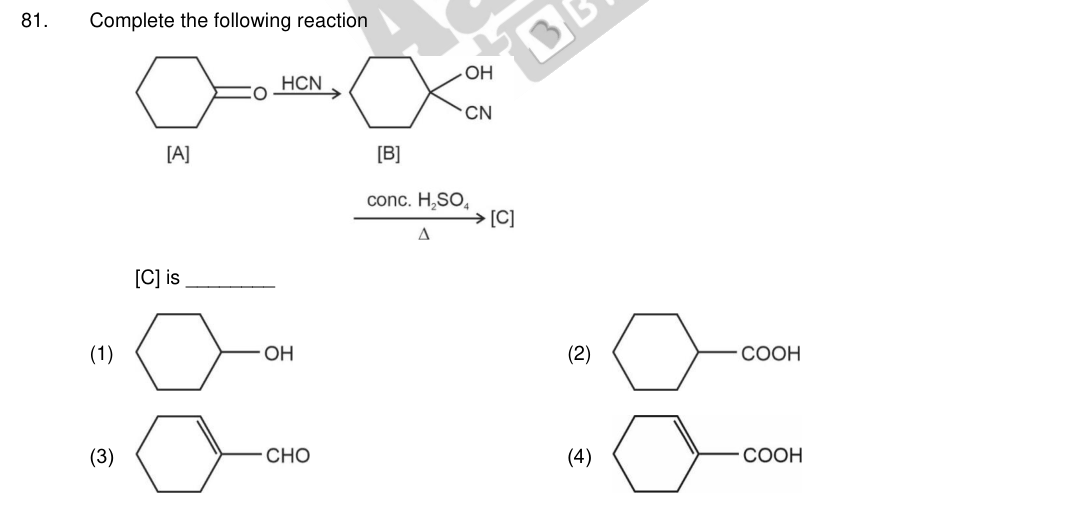
- A.Structure (1)
- B.Structure (2)
- C.Structure (3)
- D.Structure (4)✓
The worked solution is part of a paid pack.
ChemistryNEET 2022show ▾Which one of the following is not formed when acetone reacts with 2-pentanone in the presence of dilute NaOH followed by heating?
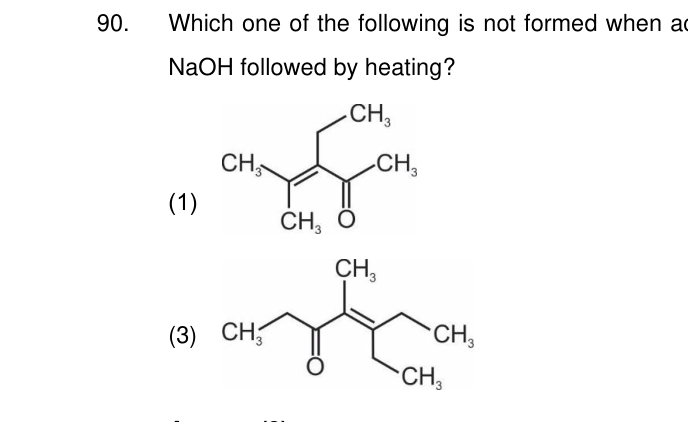
- A.Structure (1)
- B.Structure (2)
- C.Structure (3)✓
- D.Structure (4)
The worked solution is part of a paid pack.
ChemistryNEET 2021show ▾Match List-I with List-II.
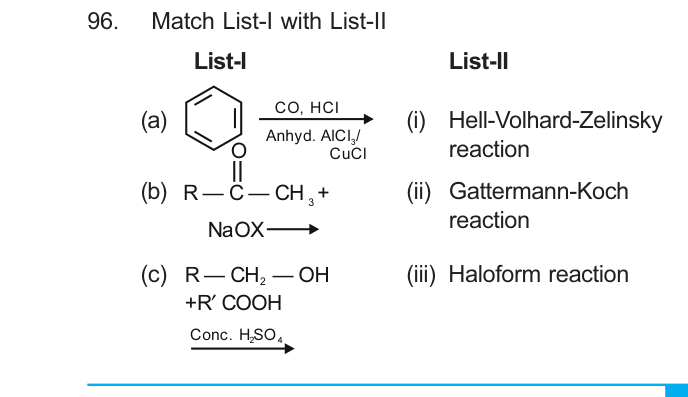
List-I List-II (a) Benzene + CO, HCl / anhyd. /CuCl (i) Hell–Volhard–Zelinsky reaction (b) + NaOX (ii) Gattermann–Koch reaction (c) + R′COOH, conc. (iii) Haloform reaction (d) , (i) /red P (ii) (iv) Esterification
Choose the correct answer from the options given below:
- A.(a)-(iv), (b)-(i), (c)-(ii), (d)-(iii)
- B.(a)-(iii), (b)-(ii), (c)-(i), (d)-(iv)
- C.(a)-(i), (b)-(iv), (c)-(iii), (d)-(ii)
- D.(a)-(ii), (b)-(iii), (c)-(iv), (d)-(i)✓
The worked solution is part of a paid pack.
ChemistryNEET 2021show ▾The intermediate compound X in the following chemical reaction is:
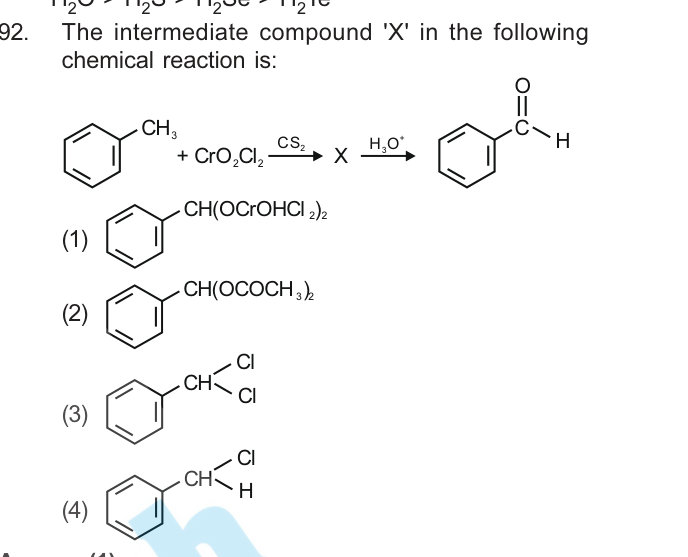
- A.Structure (1)✓
- B.Structure (2)
- C.Structure (3)
- D.Structure (4)
The worked solution is part of a paid pack.
ChemistryNEET 2020show ▾The reaction between benzaldehyde and acetophenone in the presence of dilute NaOH is known as:
- A.Aldol condensation
- B.Cannizzaro's reaction
- C.Cross-Cannizzaro's reaction
- D.Cross-aldol condensation✓
The worked solution is part of a paid pack.
3. Carboxylic acids: acidity and reactions
Exam focus: A carboxylic acid liberates CO₂ gas from NaHCO₃; phenol, despite also being acidic, doesn't, because phenol (pKa around 10) is weaker than carbonic acid while carboxylic acids are stronger — this is the standard test for telling the two functional groups apart experimentally. Electron-withdrawing substituents raise acidity most from the alpha position, fading fast with distance: chloroacetic acid is markedly more acidic than acetic acid, but the boost shrinks quickly as the Cl moves further away.
Aldehydes, Ketones and Carboxylic Acids — Full Chapter
NCERT Wallah
Same full-chapter video; covers carboxylic-acid acidity/reactions bundled with aldehyde/ketone content.
ChemistryNEET 2025show ▾The correct order of decreasing acidity of the following aliphatic acids is:
- A.
- B.
- C.✓
- D.
Solution
Alkyl groups are electron-releasing and destabilise the carboxylate anion, so acidity falls as alkyl substitution grows: .
Open this question on its own page →
Save for spaced revision (free account)ChemistryNEET 2023show ▾Consider the reaction shown in the figure. Identify products A and B.
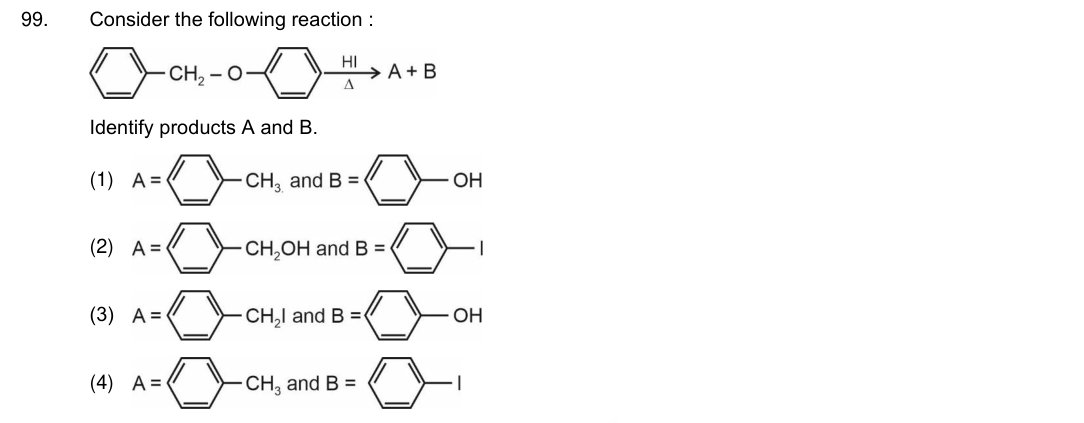
- A.Products (1)
- B.Products (2)
- C.Products (3)✓
- D.Products (4)
The worked solution is part of a paid pack.
ChemistryNEET 2022show ▾
What is Y in the above reaction?
ChemistryNEET 2019show ▾The major product of strongly heating phthalic acid (benzene-1,2-dicarboxylic acid) with is:
- A.Phthalic acid monoamide (o-)
- B.Phthalimide (cyclic imide)✓
- C.o-Toluic acid
- D.o-Phenylenediamine
The worked solution is part of a paid pack.