An alternating current (AC) source drives a voltage that varies sinusoidally with time, , where is the peak (maximum) value and is the angular frequency. Because the positive and negative halves of a full cycle are exactly symmetric, the plain time-average of both current and voltage over a complete cycle is zero — useless for describing AC's e
Alternating Current
Class 1214 previous-year questions from this chapter every option and the correct answer, free · where the marks are
1. AC through R, L, C and LCR circuits
Exam focus: In a pure inductor, current lags voltage by 90°; in a pure capacitor, it leads by 90° — remembered as 'ELI the ICE man' (in L, voltage E leads current I; in C, current I leads voltage E).
Series LCR Circuit — Alternating Current
Magnet Brains
Phasor treatment of a series LCR circuit: impedance, phase angle between V and I, and where the resonance condition comes from.
PhysicsNEET 2025show ▾To an AC power supply of 220 V at 50 Hz, a resistor of capacitor of reactance and an inductor of reactance are connected in series. The corresponding current in the circuit and the phase angle between the current and the voltage are, respectively:
- A.7.8 A and 30°
- B.7.8 A and 45°✓
- C.15.6 A and 30°
- D.15.6 A and 45°
Solution
, so A. .
Open this question on its own page →
Save for spaced revision (free account)PhysicsNEET 2024show ▾ capacitor is connected to a 210 V, 50 Hz source. The peak current in the circuit is nearly (take ):
- A.0.93 A✓
- B.1.20 A
- C.0.35 A
- D.0.58 A
Solution
. Peak current A.
Open this question on its own page →
Save for spaced revision (free account)PhysicsNEET 2023show ▾An AC source is connected to a capacitor . Due to a decrease in its operating frequency:
- A.Capacitive reactance decreases
- B.Displacement current increases
- C.Displacement current decreases✓
- D.Capacitive reactance remains constant
The worked solution is part of a paid pack.
PhysicsNEET 2023show ▾The net impedance of the circuit (as shown in the figure) will be:
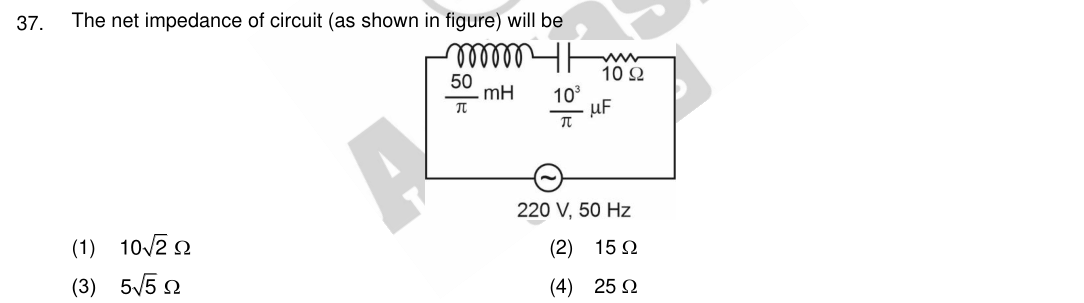
PhysicsNEET 2022show ▾The peak voltage of the ac source is equal to:
- A. times the rms value of the ac source
- B.The value of voltage supplied to the circuit
- C.The rms value of the ac source
- D. times the rms value of the ac source✓
The worked solution is part of a paid pack.
PhysicsNEET 2021show ▾An inductor of inductance , a capacitor of capacitance and a resistor of resistance are connected in series to an ac source of potential difference volts as shown in the figure. The potential differences across L, C and R are 40 V, 10 V and 40 V, respectively. The amplitude of the current flowing through the LCR series circuit is A. The impedance of the circuit is:
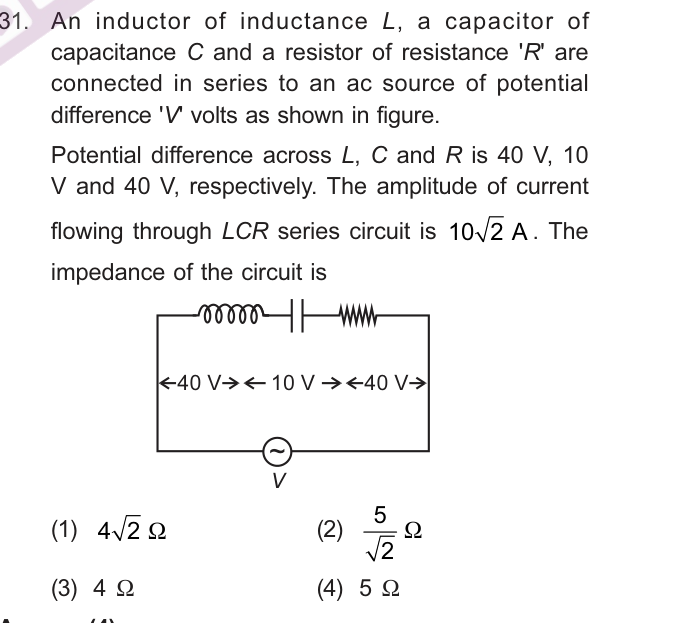
PhysicsNEET 2020show ▾ capacitor is connected to a 200 V, 50 Hz ac supply. The rms value of the current in the circuit is, nearly:
- A.1.7 A
- B.2.05 A
- C.2.5 A✓
- D.25.1 A
The worked solution is part of a paid pack.
PhysicsNEET 2020show ▾A series LCR circuit is connected to an ac voltage source. When L is removed from the circuit, the phase difference between current and voltage is . If instead C is removed from the circuit, the phase difference is again between current and voltage. The power factor of the circuit is:
2. Resonance, power and power factor
Exam focus: At series-LCR resonance, impedance is at its minimum (just R) and current is maximum, with the circuit behaving as purely resistive — don't confuse this with parallel resonance, where impedance peaks instead. A pure L or C dissipates zero average power over a cycle.
AC Resonance, Power and Power Factor
Competition Wallah
Full-chapter NEET crash-course one-shot; resonance, power and power factor are each covered as sections within it, bundled with other AC-circuit topics.
PhysicsNEET 2023show ▾In a series LCR circuit, the inductance is 10 mH, the capacitance is and the resistance is . The frequency at which resonance occurs is:
- A.15.9 rad/s
- B.15.9 kHz
- C.1.59 rad/s
- D.1.59 kHz✓
The worked solution is part of a paid pack.
PhysicsNEET 2022show ▾A series LCR circuit with inductance 10 H, capacitance and resistance is connected to an ac source of voltage volt. If the resonant frequency of the LCR circuit is and the frequency of the ac source is , then:
PhysicsNEET 2021show ▾A series LCR circuit containing a 5.0 H inductor, capacitor and resistor is connected to a 230 V variable-frequency ac source. The angular frequencies of the source at which the power transferred to the circuit is half the power at the resonant angular frequency are likely to be:
- A.25 rad/s and 75 rad/s
- B.50 rad/s and 25 rad/s
- C.46 rad/s and 54 rad/s✓
- D.42 rad/s and 58 rad/s
The worked solution is part of a paid pack.
3. Transformers
Exam focus: An ideal transformer conserves power, not voltage or current individually — a step-up transformer that raises voltage by some factor drops current by that exact same factor, and transformers work only on AC, since they need a changing flux.
Transformers: Step-Up, Step-Down and Energy Losses
Physics Wallah - Alakh Pandey
Single-concept lecture directly matching the subtopic, covering step-up/step-down transformers and energy losses.
PhysicsNEET 2024show ▾In an ideal transformer, the turns ratio is . The ratio is equal to (the symbols carry their usual meaning):
- A.2 : 1✓
- B.1 : 1
- C.1 : 4
- D.1 : 2
Solution
For an ideal transformer . With , , i.e. .
Open this question on its own page →
Save for spaced revision (free account)PhysicsNEET 2023show ▾A 12 V, 60 W lamp is connected to the secondary of a step-down transformer whose primary is connected to AC mains of 220 V. Assuming the transformer to be ideal, what is the current in the primary winding?
- A.0.27 A✓
- B.2.7 A
- C.3.7 A
- D.0.37 A
The worked solution is part of a paid pack.
PhysicsNEET 2021show ▾A step-down transformer connected to an ac mains supply of 220 V is made to operate an 11 V, 44 W lamp. Ignoring power losses in the transformer, what is the current in the primary circuit?
- A.0.2 A✓
- B.0.4 A
- C.2 A
- D.4 A
The worked solution is part of a paid pack.