The photoelectric effect is the emission of electrons from a metal surface when light of sufficiently high frequency falls on it. Every metal has a characteristic work function , the minimum energy needed to free an electron from its surface, and a corresponding threshold frequency , below which no photoelectrons are emitted at all, however intense the inciden
Dual Nature of Radiation and Matter
Class 1216 previous-year questions from this chapter every option and the correct answer, free · where the marks are
1. Photoelectric effect and Einstein's equation
Exam focus: Increasing light intensity increases the number of photoelectrons, not their maximum kinetic energy — that depends only on frequency, KEmax = hν − φ — and below the threshold frequency, no electrons come out no matter how bright the light is.
Photoelectric Effect — Part 1 (Dual Nature of Radiation and Matter)
Physics Wallah - Alakh Pandey
Stopping potential, threshold frequency and Einstein's photoelectric equation built up from Hertz and Lenard's observations, not just handed to you.
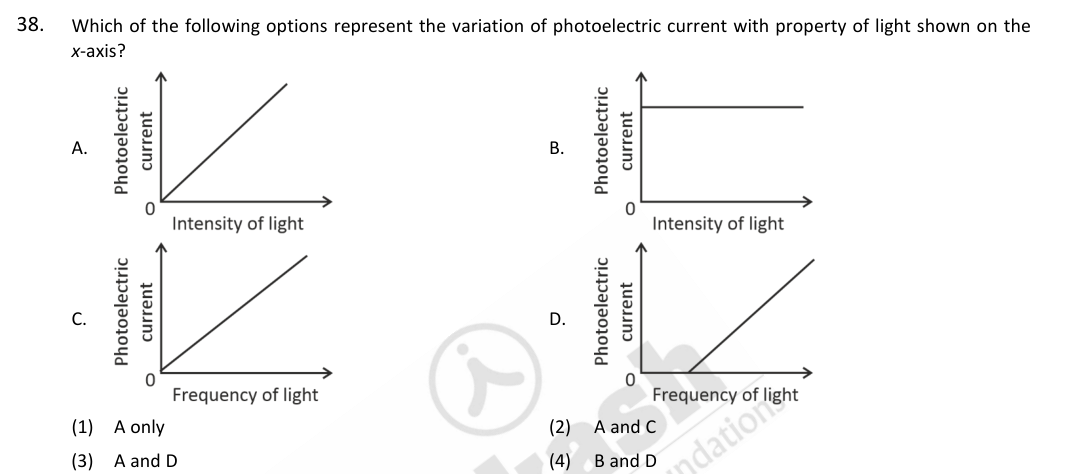
PhysicsNEET 2025show ▾Which of the following options (graphs A–D shown) represent the variation of photoelectric current with the property of light shown on the -axis?
- A.A only✓
- B.A and C
- C.A and D
- D.B and D
Solution
Above the threshold frequency the photoelectric current is proportional to the intensity (graph A, straight line through the origin) and is independent of frequency, so B, C and D are wrong. A only.
Open this question on its own page →
Save for spaced revision (free account)PhysicsNEET 2024show ▾If is the velocity of light in free space, the correct statements about a photon among the following are:
A. The energy of a photon is .
B. The velocity of a photon is .
C. The momentum of a photon is .
D. In a photon–electron collision, both total energy and total momentum are conserved.
E. A photon possesses positive charge.
Choose the correct answer from the options given below:
- A.A, B, C and D only✓
- B.A, C and D only
- C.A, B, D and E only
- D.A and B only
Solution
A photon has energy , moves at , carries momentum , and photon–electron collisions conserve both energy and momentum. A photon is uncharged, so E is false. Hence A, B, C and D only.
Open this question on its own page →
Save for spaced revision (free account)PhysicsNEET 2023show ▾The minimum wavelength of X-rays produced by an electron accelerated through a potential difference of volts is proportional to:
PhysicsNEET 2023show ▾The work functions of caesium (Cs), potassium (K) and sodium (Na) are 2.14 eV, 2.30 eV and 2.75 eV respectively. If the incident electromagnetic radiation has an energy of 2.20 eV, which of these photosensitive surfaces may emit photoelectrons?
- A.Cs only✓
- B.Both Na and K
- C.K only
- D.Na only
The worked solution is part of a paid pack.
PhysicsNEET 2022show ▾When two monochromatic lights of frequency and are incident on a photoelectric metal, their stopping potentials become and respectively. The threshold frequency for this metal is:
PhysicsNEET 2021show ▾The number of photons per second, on an average, emitted by a source of monochromatic light of wavelength 600 nm, when it delivers a power of watt, will be ( J s):
PhysicsNEET 2020show ▾The energy required to break one bond in DNA is J. This value in eV is nearly:
- A.6
- B.0.6
- C.0.06✓
- D.0.006
The worked solution is part of a paid pack.
PhysicsNEET 2020show ▾Light of frequency 1.5 times the threshold frequency is incident on a photosensitive material. What will be the photoelectric current if the frequency is halved and the intensity is doubled?
- A.Doubled
- B.Four times
- C.One-fourth
- D.Zero✓
The worked solution is part of a paid pack.
PhysicsNEET 2020show ▾Light with an average flux of falls on a non-reflecting surface at normal incidence, having surface area . The energy received by the surface during a time span of 1 minute is:
2. Matter waves and de Broglie wavelength
Exam focus: Every moving object has a de Broglie wavelength, λ = h/mv, not just electrons — it's simply too small to matter macroscopically. For an electron accelerated through potential V, this gives λ = h/√(2meV), a frequently tested formula in its own right.
Wave Nature of Matter: de Broglie Hypothesis
Physics Wallah - Alakh Pandey
Dedicated lecture on de Broglie's matter-wave hypothesis and wavelength.
PhysicsNEET 2025show ▾A photon and an electron (mass ) have the same energy . The ratio of their de Broglie wavelengths is ( is the speed of light):
- A.
- B.
- C.✓
- D.
Solution
Photon: . Electron: . Ratio .
Open this question on its own page →
Save for spaced revision (free account)PhysicsNEET 2025show ▾The de Broglie wavelength of an electron orbiting in the state of the hydrogen atom is close to (given Bohr radius = 0.052 nm):
- A.0.067 nm
- B.0.67 nm✓
- C.1.67 nm
- D.2.67 nm
Solution
In the th orbit the circumference equals de Broglie wavelengths: . With nm: nm nm.
Open this question on its own page →
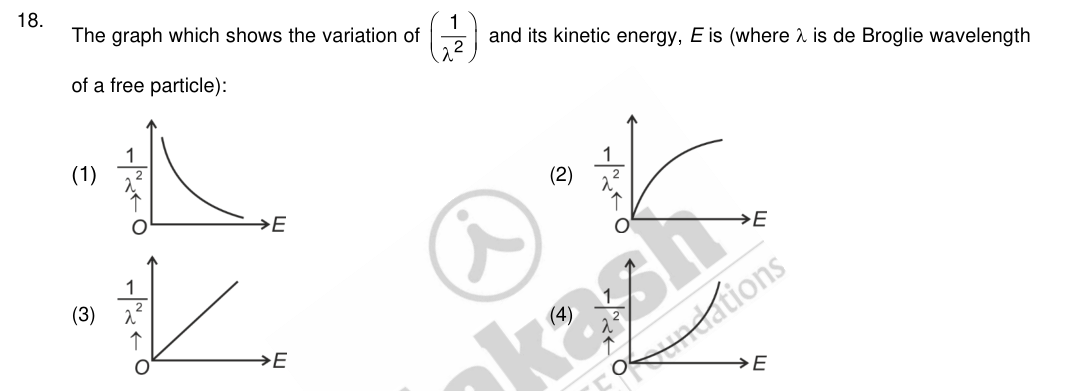
Save for spaced revision (free account)PhysicsNEET 2024show ▾The graph which shows the variation of with the kinetic energy of a free particle (where is its de Broglie wavelength) is:
- A.Graph (1)
- B.Graph (2)
- C.Graph (3)✓
- D.Graph (4)
Solution
, which is directly proportional to : a straight line through the origin.
Open this question on its own page →
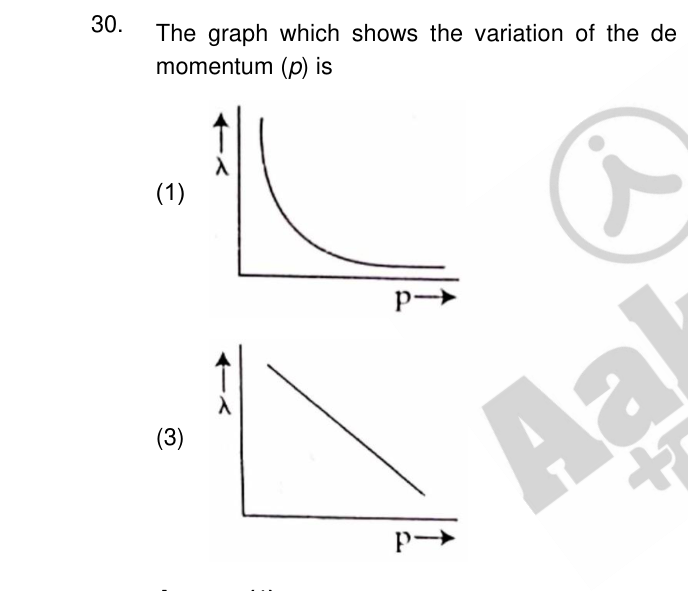
Save for spaced revision (free account)PhysicsNEET 2022show ▾The graph which shows the variation of the de Broglie wavelength () of a particle and its associated momentum () is:
- A.Graph (1)✓
- B.Graph (2)
- C.Graph (3)
- D.Graph (4)
The worked solution is part of a paid pack.
PhysicsNEET 2021show ▾An electromagnetic wave of wavelength is incident on a photosensitive surface of negligible work function. If the photoelectron of mass emitted from the surface has de Broglie wavelength , then:
PhysicsNEET 2020show ▾An electron is accelerated from rest through a potential difference of volt. If the de Broglie wavelength of the electron is nm, the potential difference is:
PhysicsNEET 2019show ▾An electron is accelerated through a potential difference of 10,000 V. Its de Broglie wavelength is, nearly: ( kg)
- A. m
- B. m✓
- C. m
- D.12.2 nm
The worked solution is part of a paid pack.