Magnetic flux through a surface measures how much magnetic field passes through it: , where is the area vector (magnitude equal to the surface area, direction along its normal) and is the angle between and that normal. Its SI unit is the weber (Wb), with . Because flux is the product
Electromagnetic Induction
Class 128 previous-year questions from this chapter every option and the correct answer, free · where the marks are
1. Faraday's and Lenz's laws
Exam focus: Lenz's law says the induced effect opposes the change in flux, not the flux itself — if flux through a loop is decreasing, the induced current flows to try to maintain it, not to fight its existing direction.
Magnetic Flux, Faraday's Law and Lenz's Law
Physics Wallah - Alakh Pandey
Opening lecture of the EMI series; covers magnetic flux, Faraday's law and Lenz's law directly and fully.
PhysicsNEET 2024show ▾In the given diagram, a strong bar magnet is moving towards solenoid-2 from solenoid-1. The direction of the induced current in solenoid-1 and that in solenoid-2, respectively, are through the directions:
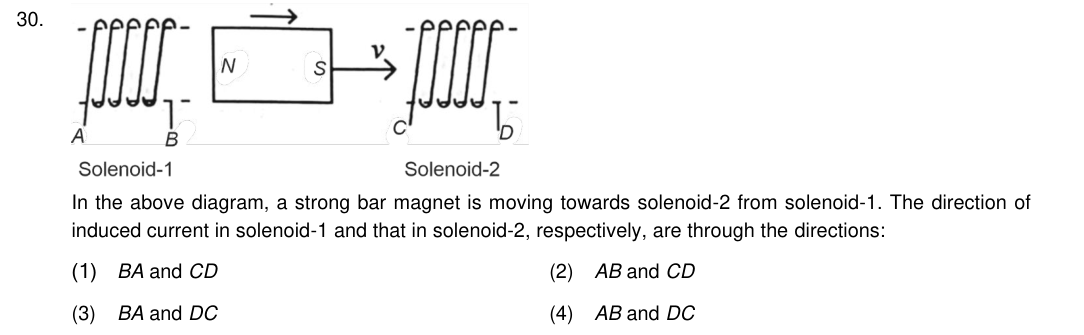
- A.BA and CD
- B.AB and CD
- C.BA and DC
- D.AB and DC✓
Solution
By Lenz's law each solenoid opposes the motion. Solenoid-1 sees the magnet's N pole receding, so its near end (B) becomes an S pole to attract it; solenoid-2 sees the S pole approaching, so its near end (C) becomes an S pole to repel it. Tracing the winding sense that produces those poles gives current directions AB in solenoid-1 and DC in solenoid-2.
Open this question on its own page →
Save for spaced revision (free account)PhysicsNEET 2022show ▾A square loop of side 1 m and resistance is placed in a magnetic field of 0.5 T. If the plane of the loop is perpendicular to the direction of the magnetic field, the magnetic flux through the loop is:
- A.Zero weber
- B.2 weber
- C.0.5 weber✓
- D.1 weber
The worked solution is part of a paid pack.
PhysicsNEET 2022show ▾A big circular coil of 1000 turns and average radius 10 m is rotating about its horizontal diameter at . If the vertical component of the earth's magnetic field at that place is T and the electrical resistance of the coil is , then the maximum induced current in the coil will be:
- A.2 A
- B.0.25 A
- C.1.5 A
- D.1 A✓
The worked solution is part of a paid pack.
PhysicsNEET 2019show ▾An 800-turn coil of effective area 0.05 m is kept perpendicular to a magnetic field of T. When the plane of the coil is rotated by around any of its coplanar axes in 0.1 s, the emf induced in the coil will be:
- A.2 V
- B.0.2 V
- C. V
- D.0.02 V✓
The worked solution is part of a paid pack.
2. Motional EMF and eddy currents
Exam focus: Eddy currents are the same phenomenon whether nuisance or feature: laminated transformer cores exist purely to suppress them, while electromagnetic braking and induction furnaces deliberately rely on them — NEET likes sorting a list into wanted versus unwanted.
Motional EMF and Eddy Currents
Vedantu JEE English
Covers both motional EMF and eddy currents (plus induced E-fields, a bonus topic) in one lecture — a better match than the PW series, which splits motional EMF across several episodes with no dedicated eddy-current one.
PhysicsNEET 2024show ▾A sheet is placed on a horizontal surface in front of a strong magnetic pole. A force is needed to:
A. hold the sheet there if it is magnetic.
B. hold the sheet there if it is non-magnetic.
C. move the sheet away from the pole with uniform velocity if it is conducting.
D. move the sheet away from the pole with uniform velocity if it is both non-conducting and non-polar.
Choose the correct statement(s) from the options given below:
- A.A and C only✓
- B.A, C and D only
- C.C only
- D.B and D only
Solution
A magnetic sheet is attracted and needs a force to hold it (A). Moving a conductor away from a pole induces eddy currents that oppose the motion, so a force is needed to keep it moving uniformly (C). A non-magnetic sheet feels no force (B false); a non-conducting, non-polar sheet has no induced currents (D false).
Open this question on its own page →
Save for spaced revision (free account)3. Self and mutual inductance
Exam focus: Self-inductance is fixed by a coil's geometry and turns alone, never by the current through it — what an inductor actually opposes is a change in current, not current itself, so a steady current flows through it perfectly freely.
Self and Mutual Inductance
JEE Challengers by PW
Covers both self and mutual inductance together, basic to advanced. A PW-affiliated sub-channel rather than an exact preferred-list name, chosen because PW's main numbered series splits these into separate videos.
PhysicsNEET 2025show ▾AB is a part of an electrical circuit (see figure). The potential difference , at the instant when the current A and is increasing at a rate of 1 A/s, is:

- A.5 volt
- B.6 volt
- C.9 volt
- D.10 volt✓
Solution
Walk from A to B adding potential drops: across the inductor V (current increasing); across the cell, entering at the positive plate, a drop of 5 V; across the resistor V. V.
Open this question on its own page →
Save for spaced revision (free account)