An object's displacement is the change in its position — a vector fixed by the straight line from the initial to the final position, regardless of the actual path taken. This is distinct from path length (loosely, distance), the total length of the path actually traversed, always a positive scalar. Path length equals the magnitude of displacement only for motion in a single direction witho
Motion in a Straight Line
Class 1111 previous-year questions from this chapter every option and the correct answer, free · where the marks are
1. Displacement, velocity, acceleration; graphs
Exam focus: Area under a v-t graph gives displacement, not distance — where the graph dips below the axis that area subtracts, so total distance needs the positive and negative areas summed separately, not net.
Displacement-Time, Velocity-Time and Acceleration-Time Graphs
Physics Wallah - Alakh Pandey
Direct match — covers all three graph types for motion in a straight line.
PhysicsNEET 2025show ▾In some appropriate units, the time () and position () relation of a moving particle is given by . The acceleration of the particle is:
- A.
- B.✓
- C.
- D.
Solution
. Then .
Open this question on its own page →
Save for spaced revision (free account)PhysicsNEET 2024show ▾The velocity ()–time () plot of the motion of a body is shown below. The acceleration ()–time () graph that best suits this motion is:
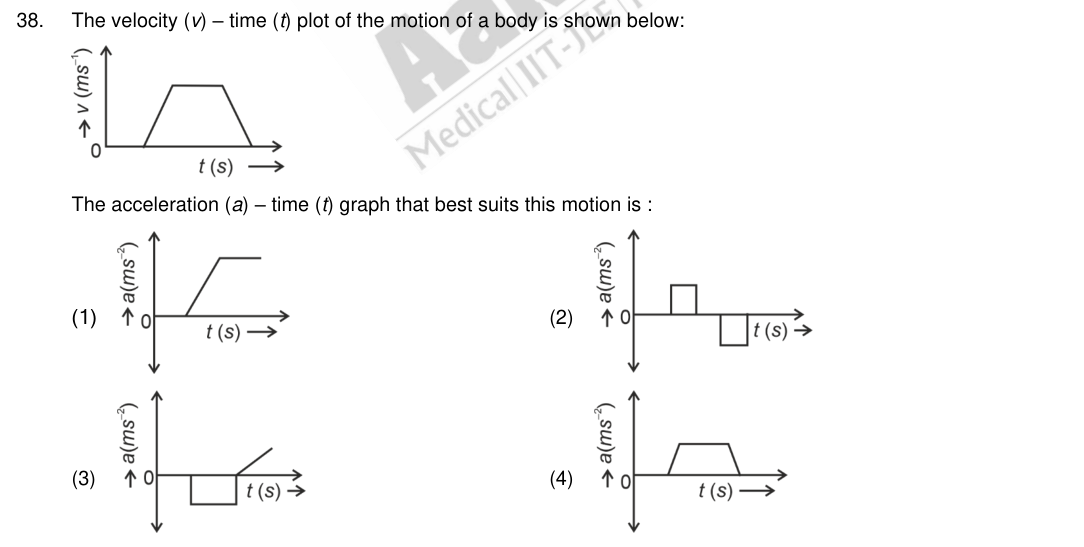
- A.Graph (1)
- B.Graph (2)✓
- C.Graph (3)
- D.Graph (4)
Solution
The velocity rises linearly (constant positive acceleration), stays constant (zero acceleration), then falls linearly (constant negative acceleration). The – graph is therefore a positive rectangle, zero, then a negative rectangle — graph (2).
Open this question on its own page →
Save for spaced revision (free account)PhysicsNEET 2023show ▾A vehicle travels half the distance with speed and the remaining distance with speed . Its average speed is:
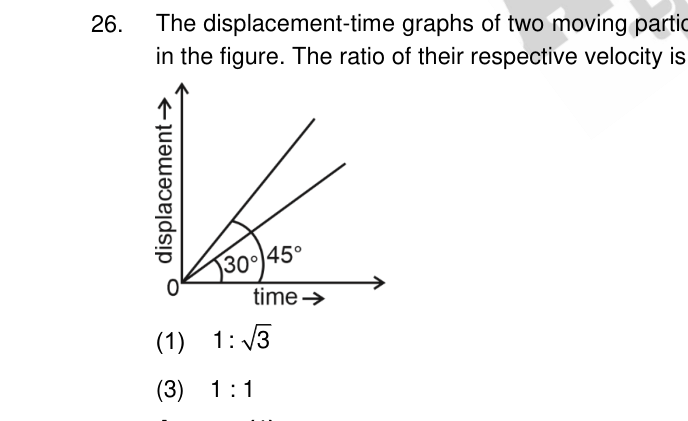
PhysicsNEET 2022show ▾The displacement–time graphs of two moving particles make angles of and with the -axis as shown in the figure. The ratio of their respective velocities is:
2. Equations of uniformly accelerated motion
Exam focus: The distance covered in the nth second, Sn = u + a(2n−1)/2, is a distinct formula from s = ut + ½at² — NEET often wants one specific second's distance, not the total displacement.
Kinematic Equations for Uniformly Accelerated Motion
Magnet Brains
Direct, single-concept match for the three kinematic (SUVAT) equations.
PhysicsNEET 2023show ▾A horizontal bridge is built across a river. A student standing on the bridge throws a small ball vertically upwards with a velocity of . The ball strikes the water surface after 4 s. The height of the bridge above the water surface is (take ):
- A.56 m
- B.60 m
- C.64 m✓
- D.68 m
The worked solution is part of a paid pack.
PhysicsNEET 2023show ▾A bullet from a gun is fired at a rectangular wooden block with velocity . When the bullet has travelled 24 cm through the block along its length horizontally, its velocity becomes . It then penetrates further into the block in the same direction before coming to rest exactly at the other end of the block. The total length of the block is:
- A.27 cm✓
- B.24 cm
- C.28 cm
- D.30 cm
The worked solution is part of a paid pack.
PhysicsNEET 2022show ▾The ratio of the distances travelled by a freely falling body in the 1st, 2nd, 3rd and 4th second is:
- A.1 : 1 : 1 : 1
- B.1 : 2 : 3 : 4
- C.1 : 4 : 9 : 16
- D.1 : 3 : 5 : 7✓
The worked solution is part of a paid pack.
PhysicsNEET 2021show ▾A small block slides down on a smooth inclined plane, starting from rest at time . Let be the distance travelled by the block in the interval to . Then the ratio is:
PhysicsNEET 2020show ▾A ball is thrown vertically downward with a velocity of 20 m/s from the top of a tower. It hits the ground after some time with a velocity of 80 m/s. The height of the tower is: ()
- A.360 m
- B.340 m
- C.320 m
- D.300 m✓
The worked solution is part of a paid pack.
PhysicsNEET 2019show ▾When an object is shot from the bottom of a long, smooth inclined plane kept at an angle of with the horizontal, it can travel a distance along the plane. But when the inclination is decreased to and the same object is shot with the same velocity, it can travel a distance . Then will be:
3. Relative velocity in one dimension
Exam focus: Relative velocity is a subtraction, v_AB = v_A − v_B, so assigned sign matters as much as speed — two objects add their speeds only when opposite directions are already opposite in sign.
Relative Velocity in One Dimension
Magnet Brains
Direct, single-concept match.
PhysicsNEET 2025show ▾Two cities X and Y are connected by a regular bus service with a bus leaving in either direction every min. A girl driving a scooty at a speed of 60 km/h in the direction X to Y notices that a bus goes past her every 30 minutes in the direction of her motion, and every 10 minutes in the opposite direction. Choose the correct option for the period of the bus service and the speed (assumed constant) of the buses.
- A.9 min, 40 km/h
- B.25 min, 100 km/h
- C.10 min, 90 km/h
- D.15 min, 120 km/h✓
Solution
Let bus speed be . Same direction: buses catch her every 30 min, so ; opposite: . Dividing, km/h, then min.
Open this question on its own page →
Save for spaced revision (free account)