The magnetic part of the Lorentz force on a charge moving with velocity through a magnetic field is , with magnitude , where is the angle between and . Because it is a cross product, this force is always perpendicular to both and — direction is fixed by the right-hand rul
Moving Charges and Magnetism
Class 1216 previous-year questions from this chapter every option and the correct answer, free · where the marks are
1. Force on a moving charge and on a current
Exam focus: The magnetic force on a moving charge is always perpendicular to its velocity, so it can never change the charge's speed or kinetic energy, only its direction — and it's exactly zero when velocity is parallel or antiparallel to B.
Force on a Moving Charge in a Magnetic Field
Physics Wallah - Alakh Pandey
Covers the Lorentz force on a moving charge thoroughly; the force-on-a-current-carrying-wire half is covered in a separate episode of the same series, not this one.
PhysicsNEET 2025show ▾An electron (mass kg and charge C) moving with speed ( = speed of light) is injected into a magnetic field of magnitude T perpendicular to its direction of motion. We wish to apply a uniform electric field together with the magnetic field so that the electron does not deflect from its path. Then (speed of light ):
- A. is perpendicular to and its magnitude is
- B. is perpendicular to and its magnitude is ✓
- C. is parallel to and its magnitude is
- D. is parallel to and its magnitude is
Solution
For no deflection the electric force must cancel the magnetic force: , with perpendicular to both and . V/m.
Open this question on its own page →
Save for spaced revision (free account)PhysicsNEET 2023show ▾A wire carrying a current along the positive -axis has length . It is kept in a magnetic field T. The magnitude of the magnetic force acting on the wire is:
PhysicsNEET 2021show ▾In the product
for and and , what will be the complete expression for ?
PhysicsNEET 2021show ▾An infinitely long straight conductor carries a current of 5 A as shown. An electron is moving with a speed of m/s parallel to the conductor. The perpendicular distance between the electron and the conductor is 20 cm at an instant. Calculate the magnitude of the force experienced by the electron at that instant.
PhysicsNEET 2019show ▾Ionised hydrogen atoms and -particles with the same momenta enter a constant magnetic field at right angles to it. The ratio of the radii of their circular paths will be:
2. Biot–Savart and Ampère's laws
Exam focus: Ampère's law is exact for any current distribution but only practically solvable when the geometry is symmetric enough to pull B outside the integral — for anything less symmetric, Biot–Savart's element-by-element integration is what actually gets used.
Moving Charges and Magnetism — Full Chapter (Biot–Savart and Ampère's Law)
Competition Wallah
A full NEET crash-course covering the whole Moving Charges and Magnetism chapter — Biot–Savart law, Ampère's circuital law, and field due to a straight wire/loop/solenoid/toroid are all in it, but bundled with the rest of the chapter (force on a moving charge, force between currents, galvanometer), so it runs well past just this subtopic.
PhysicsNEET 2024show ▾A tightly wound 100-turn coil of radius 10 cm carries a current of 7 A. The magnitude of the magnetic field at the centre of the coil is (take the permeability of free space as SI units):
- A.4.4 T
- B.4.4 mT✓
- C.44 T
- D.44 mT
Solution
T mT.
Open this question on its own page →
Save for spaced revision (free account)PhysicsNEET 2023show ▾A very long conducting wire is bent into a semicircular shape from A to B as shown in the figure. The magnetic field at point P for the steady current configuration is given by:
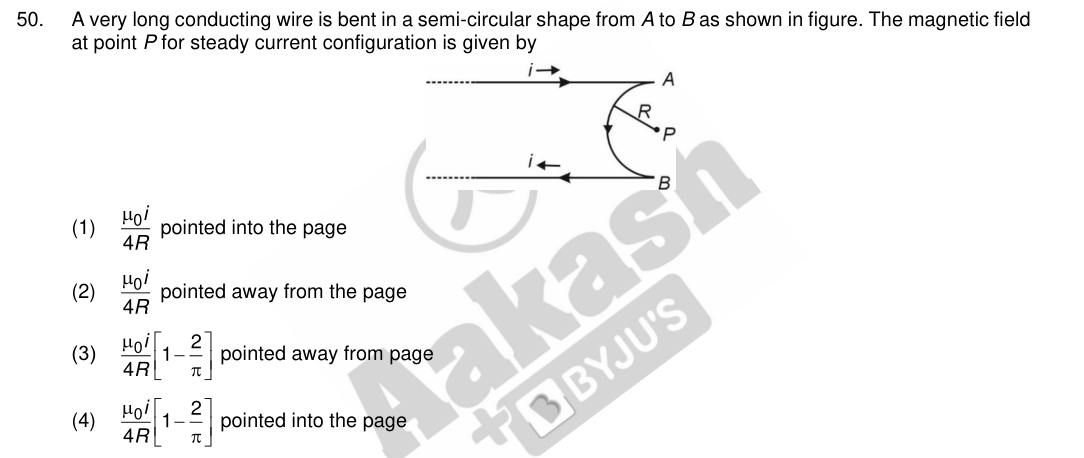
- A., pointed into the page
- B., pointed away from the page
- C., pointed away from the page✓
- D., pointed into the page
The worked solution is part of a paid pack.
PhysicsNEET 2022show ▾A long solenoid of radius 1 mm has 100 turns per mm. If 1 A current flows in the solenoid, the magnetic field strength at the centre of the solenoid is:
PhysicsNEET 2022show ▾Given below are two statements:
Statement I: Biot–Savart's law gives us the expression for the magnetic field strength of an infinitesimal current element () of a current-carrying conductor only.
Statement II: Biot–Savart's law is analogous to Coulomb's inverse square law of charge , with the former being related to the field produced by a scalar source, , while the latter being produced by a vector source, .
In the light of the above statements, choose the most appropriate answer from the options given below:
- A.Statement I is incorrect and Statement II is correct
- B.Both Statement I and Statement II are correct
- C.Both Statement I and Statement II are incorrect
- D.Statement I is correct and Statement II is incorrect✓
The worked solution is part of a paid pack.
PhysicsNEET 2022show ▾From Ampere's circuital law for a long straight wire of circular cross-section carrying a steady current, the variation of the magnetic field in the inside and outside regions of the wire is:
- A.A linearly decreasing function of distance up to the boundary of the wire and then a linearly increasing one for the outside region
- B.Uniform and remains constant for both the regions
- C.A linearly increasing function of distance up to the boundary of the wire and then linearly decreasing for the outside region
- D.A linearly increasing function of distance up to the boundary of the wire and then a decreasing one with dependence for the outside region✓
The worked solution is part of a paid pack.
PhysicsNEET 2021show ▾A thick current-carrying cable of radius carries current uniformly distributed across its cross-section. The variation of the magnetic field due to the cable with the distance from the axis of the cable is represented by:
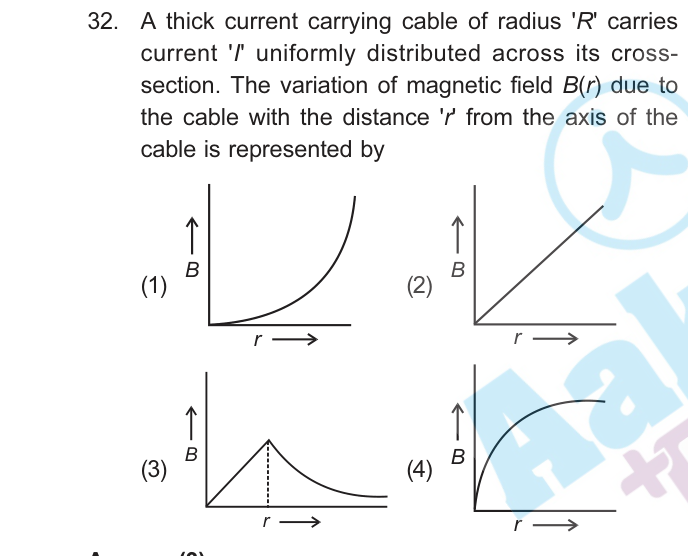
- A.Graph (1)
- B.Graph (2)
- C.Graph (3)✓
- D.Graph (4)
The worked solution is part of a paid pack.
PhysicsNEET 2020show ▾A long solenoid of 50 cm length having 100 turns carries a current of 2.5 A. The magnetic field at the centre of the solenoid is: ()
PhysicsNEET 2019show ▾A cylindrical conductor of radius carries a constant current, uniformly distributed over its cross-section. Which of the following best describes the magnitude of the magnetic field as a function of the distance from the axis of the conductor?
- A. rises to a peak before , then drops sharply to zero at and stays zero for
- B. is zero for , then jumps up sharply at and stays at that high value for
- C. increases linearly with for , reaches its maximum at , and decreases (as ) for ✓
- D. is zero for , then rises and levels off to a constant value for
The worked solution is part of a paid pack.
3. Torque on a current loop, moving-coil galvanometer
Exam focus: Torque on a current loop is maximum when the loop's plane lies along B and zero when the plane is perpendicular to B — a galvanometer uses a radial field specifically to hold this torque near maximum through the whole swing, giving a linear scale.
Torque on a Current Loop and Moving Coil Galvanometer
JEE Wallah
Covers both torque on a current loop and the moving-coil galvanometer in one lecture. A PW-family sub-channel rather than an exact preferred-list name, but well-established and content matches the NEET syllabus exactly.
PhysicsNEET 2025show ▾A model for the quantised motion of an electron in a uniform magnetic field states that the flux passing through the orbit of the electron is , where is an integer, is Planck's constant and is the magnitude of the electron's charge. According to the model, the magnetic moment of an electron in its lowest energy state will be ( is the mass of the electron):
- A.
- B.✓
- C.
- D.
Solution
Flux quantisation: for the lowest state. In the field, . Magnetic moment .
Open this question on its own page →
Save for spaced revision (free account)PhysicsNEET 2025show ▾A 2 A current is flowing through two different small circular copper coils having a radii ratio of 1 : 2. The ratio of their respective magnetic moments will be:
- A.1 : 4✓
- B.1 : 2
- C.2 : 1
- D.4 : 1
Solution
with the same current, so .
Open this question on its own page →
Save for spaced revision (free account)PhysicsNEET 2021show ▾A uniform conducting wire of length and resistance is wound up as a current-carrying coil in the shape of (i) an equilateral triangle of side , (ii) a square of side . The magnetic dipole moments of the coil in each case respectively are:
- A. and ✓
- B. and
- C. and
- D. and
The worked solution is part of a paid pack.