For a system of particles, the centre of mass is the single point that behaves as though the system's entire mass were concentrated there and every external force acted directly on it. For two particles of masses and at positions and on a line, it is defined as ; for particles this generalises to the vector form $\vec{R} =
System of Particles and Rotational Motion
Class 1115 previous-year questions from this chapter every option and the correct answer, free · where the marks are
1. Centre of mass and its motion
Exam focus: Internal forces — an explosion, an internal collision — never change the centre of mass's velocity or path, only external forces do; a shell that explodes mid-air has its COM land exactly where the intact shell would have.
Centre of Mass — Full Concept One-Shot
PW NEET
Covers location and motion of the centre of mass from basics through PYQs, without mixing in collisions.
PhysicsNEET 2022show ▾Two objects of mass 10 kg and 20 kg respectively are connected to the two ends of a rigid rod of length 10 m with negligible mass. The distance of the centre of mass of the system from the 10 kg mass is:
PhysicsNEET 2020show ▾Two particles of mass 5 kg and 10 kg respectively are attached to the two ends of a rigid rod of length 1 m with negligible mass. The centre of mass of the system from the 5 kg particle is nearly at a distance of:
- A.33 cm
- B.50 cm
- C.67 cm✓
- D.80 cm
The worked solution is part of a paid pack.
2. Torque, angular momentum and their conservation
Exam focus: Angular momentum L = Iω is conserved whenever net external torque is zero, even as I itself changes — a skater pulling their arms in spins faster purely because I falls, with no external torque involved.
System of Particles and Rotational Motion — Full Chapter (Torque and Angular Momentum)
Competition Wallah
A full NEET crash-course for the whole chapter; torque (r×F), angular momentum and its conservation are core sections in it, but bundled with the rest of the chapter (centre of mass, moment of inertia, rolling motion).
PhysicsNEET 2025show ▾The Sun rotates around its centre once in 27 days. What will be the period of revolution if the Sun were to expand to twice its present radius without any external influence? Assume the Sun to be a sphere of uniform density.
- A.100 days
- B.105 days
- C.115 days
- D.108 days✓
Solution
No external torque, so is conserved. for a uniform sphere, so doubling quadruples and the period becomes days.
Open this question on its own page →
Save for spaced revision (free account)PhysicsNEET 2025show ▾A uniform rod of mass 20 kg and length 5 m leans against a smooth vertical wall making an angle of with it. The other end rests on a rough horizontal floor. The friction force that the floor exerts on the rod is (take ):
- A.100 N
- B. N✓
- C.200 N
- D. N
Solution
Take torques about the foot. The wall pushes horizontally with ; the rod's weight acts at its midpoint. With the rod at to the wall (i.e. to the floor): N. Friction at the floor balances : N.
Open this question on its own page →
Save for spaced revision (free account)PhysicsNEET 2023show ▾The angular acceleration of a body moving along the circumference of a circle is:
- A.Along the radius, away from the centre
- B.Along the radius, towards the centre
- C.Along the tangent to its position
- D.Along the axis of rotation✓
The worked solution is part of a paid pack.
PhysicsNEET 2022show ▾The angular speed of a flywheel moving with uniform angular acceleration changes from 1200 rpm to 3120 rpm in 16 seconds. The angular acceleration in is:
PhysicsNEET 2021show ▾A uniform rod of length 200 cm and mass 500 g is balanced on a wedge placed at the 40 cm mark. A mass of 2 kg is suspended from the rod at 20 cm and another unknown mass is suspended from the rod at the 160 cm mark as shown in the figure. Find the value of such that the rod is in equilibrium. ()
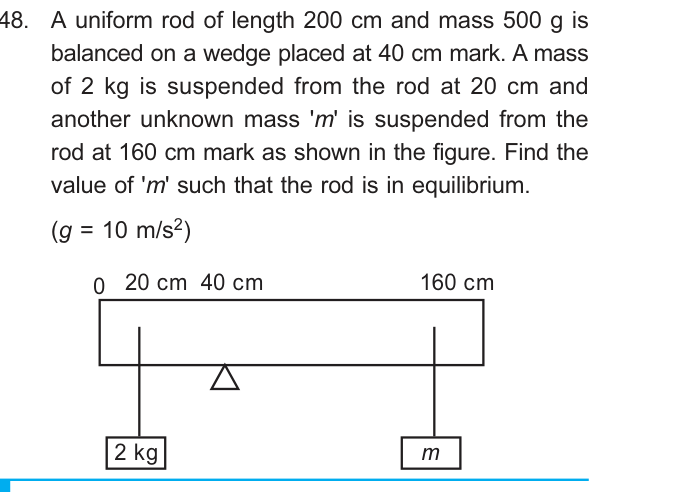
- A. kg
- B. kg
- C. kg
- D. kg✓
The worked solution is part of a paid pack.
PhysicsNEET 2020show ▾Find the torque about the origin when a force of N acts on a particle whose position vector is m.
- A. N·m
- B. N·m
- C. N·m✓
- D. N·m
The worked solution is part of a paid pack.
PhysicsNEET 2019show ▾A solid cylinder of mass 2 kg and radius 4 cm is rotating about its axis at the rate of 3 rpm. The torque required to stop it after 2 revolutions is:
- A. N m✓
- B. N m
- C. N m
- D. N m
The worked solution is part of a paid pack.
3. Moment of inertia, theorems of axes
Exam focus: The perpendicular axis theorem (Iz = Ix+Iy) applies only to flat, planar bodies — using it on a solid sphere or cylinder is a common invalid move — while the parallel axis theorem works for any rigid body.
Moment of Inertia — Parallel and Perpendicular Axis Theorems
Physics Wallah - Alakh Pandey
Direct single-concept lecture on both axis theorems and moment of inertia.
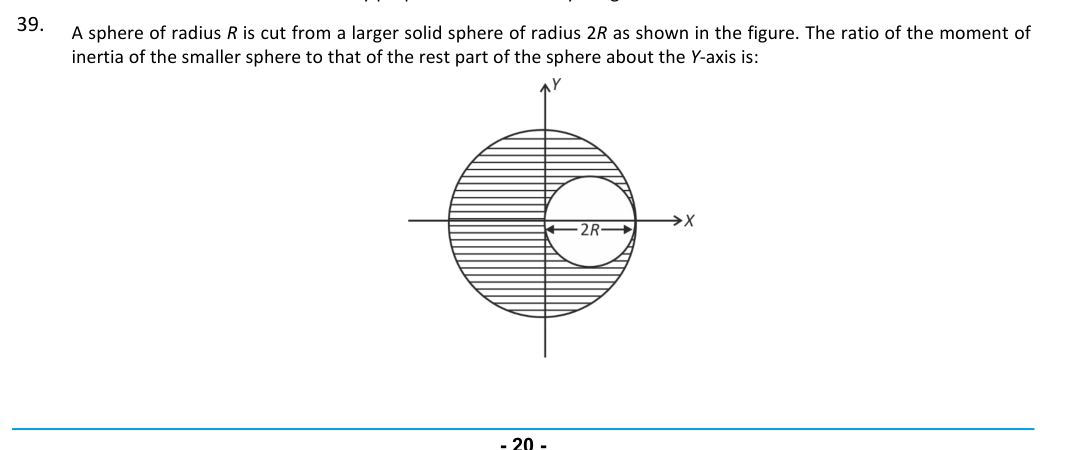
PhysicsNEET 2025show ▾A sphere of radius is cut from a larger solid sphere of radius as shown in the figure. The ratio of the moment of inertia of the smaller sphere to that of the rest part of the sphere about the -axis is:
- A.
- B.
- C.✓
- D.
Solution
The removed sphere has mass (radius halved) and its centre is from the -axis: . The full sphere: . The rest: . Ratio .
Open this question on its own page →
Save for spaced revision (free account)PhysicsNEET 2024show ▾The moment of inertia of a thin rod about an axis passing through its midpoint and perpendicular to the rod is . The length of the 400 g rod is nearly:
- A.17.5 cm
- B.20.7 cm
- C.72.0 cm
- D.8.5 cm✓
Solution
cm.
Open this question on its own page →
Save for spaced revision (free account)PhysicsNEET 2022show ▾The ratio of the radius of gyration of a thin uniform disc about an axis passing through its centre and normal to its plane to the radius of gyration of the disc about its diameter is:
PhysicsNEET 2021show ▾From a circular ring of mass and radius an arc corresponding to a 90° sector is removed. The moment of inertia of the remaining part of the ring about an axis passing through the centre of the ring and perpendicular to the plane of the ring is times . Then the value of is:
4. Rolling motion and rotational kinetic energy
Exam focus: Racing shapes down an incline without slipping, acceleration depends only on the k²/R² ratio, never on mass or radius — so a solid sphere always beats a solid cylinder, which always beats a ring, at any size.
Rolling Motion and Kinetic Energy of a Rolling Body
Competition Wallah
Covers rolling motion and rotational kinetic energy of a rolling body directly.
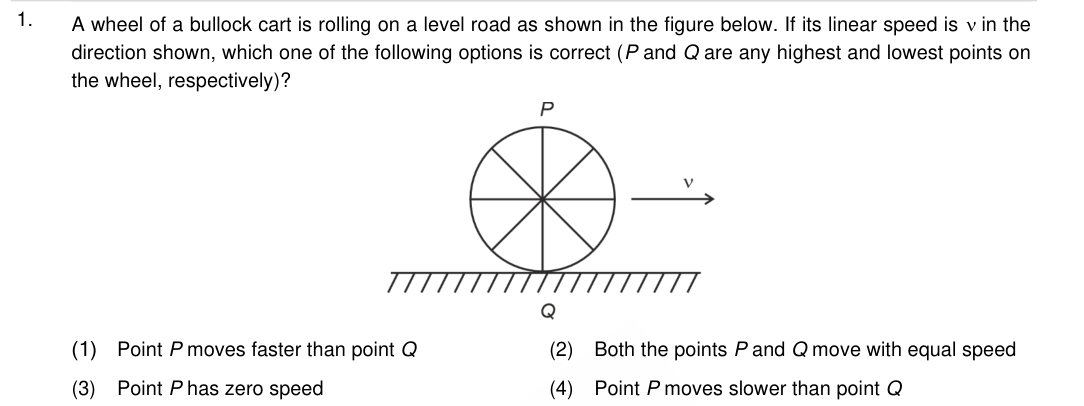
PhysicsNEET 2024show ▾A wheel of a bullock cart is rolling on a level road as shown in the figure below. If its linear speed is in the direction shown, which one of the following options is correct ( and are any highest and lowest points on the wheel, respectively)?
- A.Point P moves faster than point Q✓
- B.Both the points P and Q move with equal speed
- C.Point P has zero speed
- D.Point P moves slower than point Q
Solution
For a wheel rolling without slipping, the point of contact Q is momentarily at rest and the topmost point P moves at . So P moves faster than Q.
Open this question on its own page →
Save for spaced revision (free account)PhysicsNEET 2019show ▾A disc of radius 2 m and mass 100 kg rolls on a horizontal floor. Its centre of mass has a speed of 20 cm/s. How much work is needed to stop it?
- A.3 J✓
- B.30 kJ
- C.2 J
- D.1 J
The worked solution is part of a paid pack.