The human male reproductive system lies in the pelvic region and centres on a pair of testes held inside a sac-like scrotum, which keeps them 2–2.5°C below body temperature — a condition essential for sperm formation. Each testis is packed with highly coiled seminiferous tubules, whose walls contain two cell types: spermatogonia, the germ cells that undergo meiosis to form sperm, and n
Human Reproduction
Class 1225 previous-year questions from this chapter every option and the correct answer, free · where the marks are
1. Male and female reproductive systems
Exam focus: The testis packs two different jobs into two different cell types: Sertoli cells, inside the seminiferous tubules, nurse the developing sperm, while Leydig (interstitial) cells, in the spaces between tubules, secrete testosterone. On the female side, fertilisation normally happens in the ampulla of the fallopian tube, not the uterus itself — NEET regularly offers the isthmus or the uterus as decoy locations.
Human Reproduction — Full Chapter (Male and Female Reproductive Systems)
Vedantu Biotonic for NEET
Full-chapter one-shot that opens with detailed coverage of the male and female reproductive systems before moving into gametogenesis; bundled with the rest of the chapter rather than systems-only.
ZoologyNEET 2024show ▾Given below are two statements:
Statement I: The presence or absence of the hymen is not a reliable indicator of virginity.
Statement II: The hymen is torn during the first coitus only.
In the light of the above statements, choose the correct answer from the options given below:
- A.Both Statement I and Statement II are false
- B.Statement I is true but Statement II is false✓
- C.Statement I is false but Statement II is true
- D.Both Statement I and Statement II are true
Solution
The hymen can be torn by sport, a fall or tampon use, and may persist after coitus — so its presence or absence indicates nothing about virginity (Statement I true) and it is not torn 'during the first coitus only' (Statement II false).
Open this question on its own page →
Save for spaced revision (free account)ZoologyNEET 2024show ▾Which of the following is not a component of the Fallopian tube?
- A.Isthmus
- B.Infundibulum
- C.Ampulla
- D.Uterine fundus✓
Solution
The Fallopian tube consists of the infundibulum, ampulla and isthmus. The fundus is the dome-shaped upper part of the uterus, not the tube.
Open this question on its own page →
Save for spaced revision (free account)ZoologyNEET 2023show ▾Given below are two statements:
Statement I: The vas deferens receives a duct from the seminal vesicle and opens into the urethra as the ejaculatory duct.
Statement II: The cavity of the cervix is called the cervical canal, which along with the vagina forms the birth canal.
In the light of the above statements, choose the correct answer from the options given below:
- A.Both Statement I and Statement II are true.✓
- B.Both Statement I and Statement II are false.
- C.Statement I is correct but Statement II is false.
- D.Statement I is incorrect but Statement II is true.
The worked solution is part of a paid pack.
ZoologyNEET 2020show ▾Match the following columns and select the correct option.
Structure Description (a) Placenta (i) Androgens (b) Zona pellucida (ii) Human chorionic gonadotropin (hCG) (c) Bulbo-urethral glands (iii) Layer of the ovum (d) Leydig cells (iv) Lubrication of the penis
- A.(a)-(iv), (b)-(iii), (c)-(i), (d)-(ii)
- B.(a)-(i), (b)-(iv), (c)-(ii), (d)-(iii)
- C.(a)-(iii), (b)-(ii), (c)-(iv), (d)-(i)
- D.(a)-(ii), (b)-(iii), (c)-(iv), (d)-(i)✓
The worked solution is part of a paid pack.
ZoologyNEET 2019show ▾Select the correct sequence for the transport of sperm cells in the male reproductive system.
- A.Testis epididymis vasa efferentia rete testis inguinal canal urethra
- B.Seminiferous tubules rete testis vasa efferentia epididymis vas deferens ejaculatory duct urethra urethral meatus✓
- C.Seminiferous tubules vasa efferentia epididymis inguinal canal urethra
- D.Testis epididymis vasa efferentia vas deferens ejaculatory duct inguinal canal urethra urethral meatus
The worked solution is part of a paid pack.
2. Gametogenesis and menstrual cycle
Exam focus: FSH acts on Sertoli cells to drive spermatogenesis, which then release inhibin as feedback to lower FSH; LH — called ICSH in males — acts on Leydig cells to trigger testosterone synthesis. In the menstrual cycle it is specifically the LH surge around day 14 that triggers ovulation, not the rising FSH that matured the follicle beforehand — a sequencing swap NEET tests directly.
Human Reproduction — Full Chapter (Gametogenesis and Menstrual Cycle)
Vedantu Biotonic for NEET
A full Human Reproduction chapter one-shot. Includes gametogenesis (spermatogenesis and oogenesis) and the menstrual cycle with hormonal control, but also bundles in reproductive anatomy and fertilisation/implantation beyond this specific subtopic.
ZoologyNEET 2025show ▾The first menstruation is called:
- A.Menopause
- B.Menarche✓
- C.Diapause
- D.Ovulation
Solution
The first menstruation, at puberty, is menarche; the cessation of cycles around age 50 is menopause.
Open this question on its own page →
Save for spaced revision (free account)ZoologyNEET 2025show ▾Consider the following:
A. The reductive division for human female gametogenesis starts earlier than that of male gametogenesis.
B. The gap between the first meiotic division and the second meiotic division is much shorter for males compared to females.
C. The first polar body is associated with the formation of the primary oocyte.
D. The luteinising hormone (LH) surge leads to disintegration of the endometrium and onset of menstrual bleeding.
Choose the correct answer from the options given below:
- A.A and B are true✓
- B.A and C are true
- C.B and D are true
- D.B and C are true
Solution
Oogenesis begins in the foetal ovary, long before spermatogenesis starts at puberty (A true). In males meiosis I and II follow each other quickly; in females meiosis I halts before birth and meiosis II completes only at fertilisation (B true). The first polar body accompanies the secondary oocyte (C false); the LH surge triggers ovulation, not menstruation (D false). Hence A and B.
Open this question on its own page →
Save for spaced revision (free account)BotanyNEET 2025show ▾Match List I with List II.
List I List II A. Head I. Enzymes B. Middle piece II. Sperm motility C. Acrosome III. Energy D. Tail IV. Genetic material
Choose the correct answer from the options given below:
- A.A-IV, B-III, C-I, D-II✓
- B.A-IV, B-III, C-II, D-I
- C.A-III, B-IV, C-II, D-I
- D.A-III, B-II, C-I, D-IV
Solution
The sperm head carries the genetic material in its nucleus (IV); the middle piece has mitochondria that supply energy (III); the acrosome holds enzymes for penetrating the egg (I); the tail gives motility (II).
Open this question on its own page →
Save for spaced revision (free account)ZoologyNEET 2024show ▾Identify the correct option for (A), (B), (C), (D) in the given flow chart with respect to spermatogenesis:
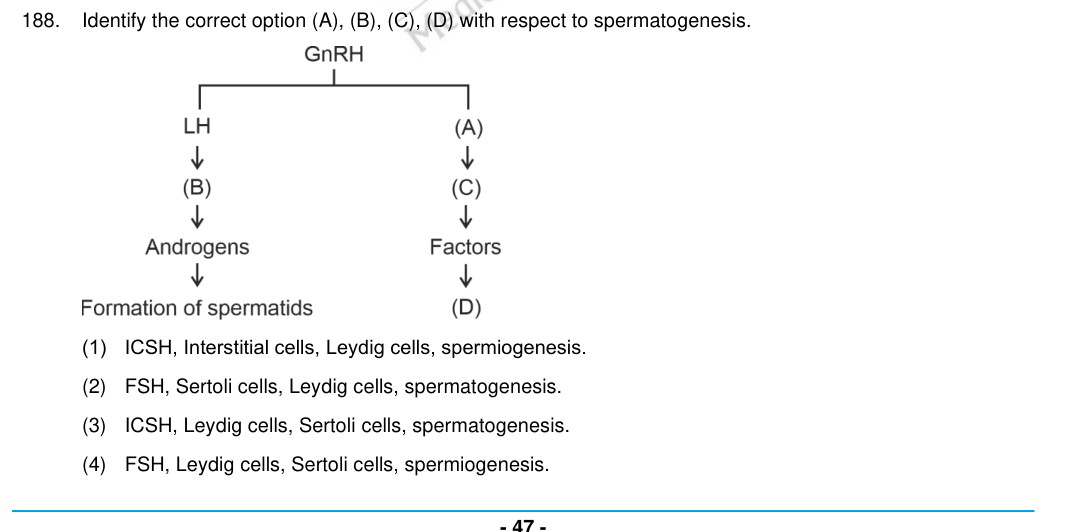
- A.ICSH, Interstitial cells, Leydig cells, spermiogenesis
- B.FSH, Sertoli cells, Leydig cells, spermatogenesis
- C.ICSH, Leydig cells, Sertoli cells, spermatogenesis
- D.FSH, Leydig cells, Sertoli cells, spermiogenesis✓
Solution
Spermatogonia are stimulated by FSH acting on Sertoli cells; LH (ICSH) acts on Leydig cells; Sertoli cells nourish the developing germ cells; the final transformation of spermatids into spermatozoa is spermiogenesis. Reading the flow chart's blanks in order gives FSH, Leydig cells, Sertoli cells, spermiogenesis.
Open this question on its own page →
Save for spaced revision (free account)ZoologyNEET 2024show ▾Given below are two statements: one is labelled as Assertion A and the other is labelled as Reason R.
Assertion A: FSH acts upon ovarian follicles in the female and Leydig cells in the male.
Reason R: Growing ovarian follicles secrete oestrogen in the female while interstitial cells secrete androgen in the male human being.
In the light of the above statements, choose the correct answer from the options given below:
- A.Both A and R are true but R is NOT the correct explanation of A
- B.A is true but R is false
- C.A is false but R is true✓
- D.Both A and R are true and R is the correct explanation of A
Solution
FSH acts on ovarian follicles in females but on Sertoli cells in males; Leydig cells respond to LH — so A is false. Growing follicles do secrete oestrogen and interstitial (Leydig) cells do secrete androgens — R is true.
Open this question on its own page →
Save for spaced revision (free account)ZoologyNEET 2023show ▾Which of the following statements are correct regarding the female reproductive cycle?
A. In non-primate mammals, cyclical changes during reproduction are called the oestrous cycle.
B. The first menstrual cycle begins at puberty and is called menopause.
C. Lack of menstruation may be indicative of pregnancy.
D. Cyclic menstruation extends between menarche and menopause.
Choose the most appropriate answer from the options given below:
- A.A and D only
- B.A and B only
- C.A, B and C only
- D.A, C and D only✓
The worked solution is part of a paid pack.
ZoologyNEET 2022show ▾At which stage of life is the oogenesis process initiated?
- A.Adult
- B.Puberty
- C.Embryonic development stage✓
- D.Birth
The worked solution is part of a paid pack.
ZoologyNEET 2022show ▾Given below are two statements:
Statement I: The release of sperms into the seminiferous tubules is called spermiation.
Statement II: Spermiogenesis is the process of formation of sperms from spermatogonia.
In the light of the above statements, choose the most appropriate answer from the options given below:
- A.Statement I is incorrect but Statement II is correct
- B.Both Statement I and Statement II are correct
- C.Both Statement I and Statement II are incorrect
- D.Statement I is correct but Statement II is incorrect✓
The worked solution is part of a paid pack.
ZoologyNEET 2022show ▾Which of the following statements are true for spermatogenesis but do not hold true for oogenesis?
(a) It results in the formation of haploid gametes
(b) Differentiation of the gamete occurs after the completion of meiosis
(c) Meiosis occurs continuously in a mitotically dividing stem cell population
(d) It is controlled by luteinising hormone (LH) and follicle stimulating hormone (FSH) secreted by the anterior pituitary
(e) It is initiated at puberty
Choose the most appropriate answer from the options given below:
- A.(b), (c) and (e) only✓
- B.(c) and (e) only
- C.(b) and (c) only
- D.(b), (d) and (e) only
The worked solution is part of a paid pack.
ZoologyNEET 2020show ▾Which of the following hormone levels will cause the release of the ovum (ovulation) from the Graafian follicle?
- A.A high concentration of oestrogen✓
- B.A high concentration of progesterone
- C.A low concentration of LH
- D.A low concentration of FSH
The worked solution is part of a paid pack.
ZoologyNEET 2020show ▾The meiotic division of the secondary oocyte is completed:
- A.Prior to ovulation
- B.At the time of copulation
- C.After zygote formation
- D.At the time of fusion of a sperm with an ovum✓
The worked solution is part of a paid pack.
3. Fertilisation, implantation, pregnancy, parturition, lactation
Exam focus: Early pregnancy runs on hCG: it is what keeps the corpus luteum from degenerating, and it is what a pregnancy test actually detects, buying time until the placenta itself takes over progesterone production later on. Parturition is one of the syllabus's rare genuine positive-feedback loops — signals from the fully developed foetus trigger mild contractions, which release oxytocin, which strengthens contractions further — the opposite of the negative feedback most hormone regulation in this chapter runs on.
Fertilisation, Implantation, Pregnancy, Parturition and Lactation
Vedantu Biotonic for NEET
Directly matches the subtopic — covers fertilisation, implantation, embryogenesis, parturition and lactation in one dedicated lecture.
BotanyNEET 2025show ▾Find the correct statements:
(A) In human pregnancy, the major organ systems are formed by the end of 12 weeks.
(B) In human pregnancy, the major organ systems are formed by the end of 8 weeks.
(C) In human pregnancy, the heart is formed after one month of gestation.
(D) In human pregnancy, limbs and digits develop by the end of the second month.
(E) In human pregnancy, the appearance of hair is usually observed in the fifth month.
Choose the correct answer from the options given below:
- A.A and E only
- B.B and C only
- C.B, C, D and E only
- D.A, C, D and E only✓
Solution
Major organ systems form by the end of 12 weeks (A); the heart forms after one month (C); limbs and digits by the end of the second month (D); hair appears by the fifth month (E). Statement B's 8 weeks is wrong. Hence A, C, D and E.
Open this question on its own page →
Save for spaced revision (free account)ZoologyNEET 2025show ▾Twins are born to a family that lives next door to you. The twins are a boy and a girl. Which of the following must be true?
- A.They are monozygotic twins.
- B.They are fraternal twins.✓
- C.They were conceived through in vitro fertilisation.
- D.They have 75% identical genetic content.
Solution
Twins of different sexes must have come from two separate zygotes — they are dizygotic (fraternal) twins, genetically no more alike than ordinary siblings.
Open this question on its own page →
Save for spaced revision (free account)ZoologyNEET 2024show ▾Given below are two statements: one is labelled as Assertion A and the other is labelled as Reason R.
Assertion A: Breast-feeding during the initial period of infant growth is recommended by doctors for bringing up a healthy baby.
Reason R: Colostrum contains several antibodies absolutely essential to develop resistance for the newborn baby.
In the light of the above statements, choose the most appropriate answer from the options given below:
- A.Both A and R are correct but R is NOT the correct explanation of A
- B.A is correct but R is not correct
- C.A is not correct but R is correct
- D.Both A and R are correct and R is the correct explanation of A✓
Solution
Colostrum, the first milk, carries IgA antibodies that protect the newborn — which is exactly why breast-feeding in the first days is recommended. Both A and R are correct and R explains A.
Open this question on its own page →
Save for spaced revision (free account)ZoologyNEET 2023show ▾Given below are two statements: one is labelled as Assertion A and the other is labelled as Reason R.
Assertion A: The endometrium is necessary for implantation of the blastocyst.
Reason R: In the absence of fertilisation, the corpus luteum degenerates, which causes disintegration of the endometrium.
In the light of the above statements, choose the correct answer from the options given below:
- A.Both A and R are true and R is the correct explanation of A.
- B.Both A and R are true but R is NOT the correct explanation of A.✓
- C.A is true but R is false.
- D.A is false but R is true.
The worked solution is part of a paid pack.
ZoologyNEET 2021show ▾Which of the following secretes the hormone relaxin during the later phase of pregnancy?
- A.Graafian follicle
- B.Corpus luteum✓
- C.Foetus
- D.Uterus
The worked solution is part of a paid pack.
ZoologyNEET 2021show ▾Which of these is not an important component of the initiation of parturition in humans?
- A.Increase in oestrogen and progesterone ratio
- B.Synthesis of prostaglandins
- C.Release of oxytocin
- D.Release of prolactin✓
The worked solution is part of a paid pack.
ZoologyNEET 2021show ▾Receptors for sperm binding in mammals are present on the:
- A.Corona radiata
- B.Vitelline membrane
- C.Perivitelline space
- D.Zona pellucida✓
The worked solution is part of a paid pack.
ZoologyNEET 2019show ▾Extrusion of the second polar body from the egg nucleus occurs:
- A.After entry of the sperm but before fertilisation✓
- B.After fertilisation
- C.Before entry of the sperm into the ovum
- D.Simultaneously with the first cleavage
The worked solution is part of a paid pack.
ZoologyNEET 2019show ▾Colostrum, the yellowish fluid secreted by the mother during the initial days of lactation, is very essential to impart immunity to the newborn infant because it contains:
- A.Natural killer cells
- B.Monocytes
- C.Macrophages
- D.Immunoglobulin A✓
The worked solution is part of a paid pack.