Chapter 125 of 2363 min read
Arrhenius equation and activation energy
Why this is asked: A catalyst speeds up a reaction by lowering the activation energy through an alternate pathway — it doesn't change ΔH, and because it accelerates the forward and reverse reactions equally, it never shifts the equilibrium position or the value of K. That "catalysts don't touch equilibrium, only kinetics" point is a recurring assertion-reason question.
This chapter is part of a paid pack
A sample of the book is free to read — the rest, including this chapter, unlocks with full access.
See pricingTest yourself
- •The rate of a reaction quadruples when the temperature changes from C to C. Calculate the energy of activation. (Given , .)
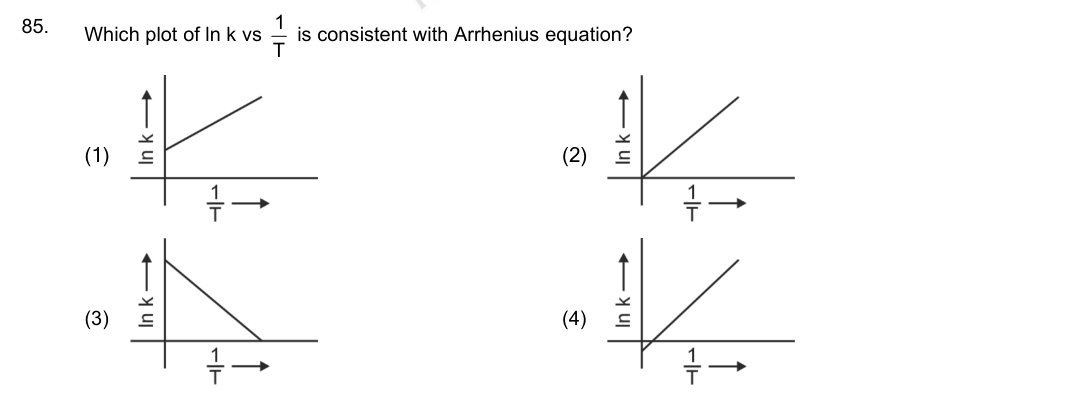
- •Which plot of vs (from the four graphs shown) is consistent with the Arrhenius equation?
- •The activation energy of any chemical reaction can be calculated if one knows the value of:
Open this in the full syllabus view · Chemistry