The rate law (or rate equation) expresses how the rate of a reaction depends on reactant concentrations: for a reaction between A and B, Rate , where is the rate constant and the exponents and must be found experimentally — they equal the stoichiometric coefficients only when the reaction occurs in a single step. The sum is the order of the reaction,
Chemical Kinetics
Class 1215 previous-year questions from this chapter every option and the correct answer, free · where the marks are
1. Rate law, order and molecularity
Exam focus: Order is an experimentally determined exponent in the rate law — it can be zero, fractional, even negative — while molecularity is a theoretical count of colliding species in one elementary step and must be a positive integer; the two coincide only for a genuine single-step reaction. You cannot read a complex, multi-step reaction's rate law off its balanced equation the way you can for an elementary step.
Rate Law, Order and Molecularity
Physics Wallah - Alakh Pandey
Directly covers the rate-law expression and order of reaction.
ChemistryNEET 2023show ▾For a certain reaction, rate . When the initial concentration of A is tripled keeping the concentration of B constant, the initial rate would:
- A.Decrease by a factor of nine
- B.Increase by a factor of six
- C.Increase by a factor of nine✓
- D.Increase by a factor of three
The worked solution is part of a paid pack.
ChemistryNEET 2022show ▾The given graph is a representation of the kinetics of a reaction. The and axes for zero and first order reactions, respectively, are:
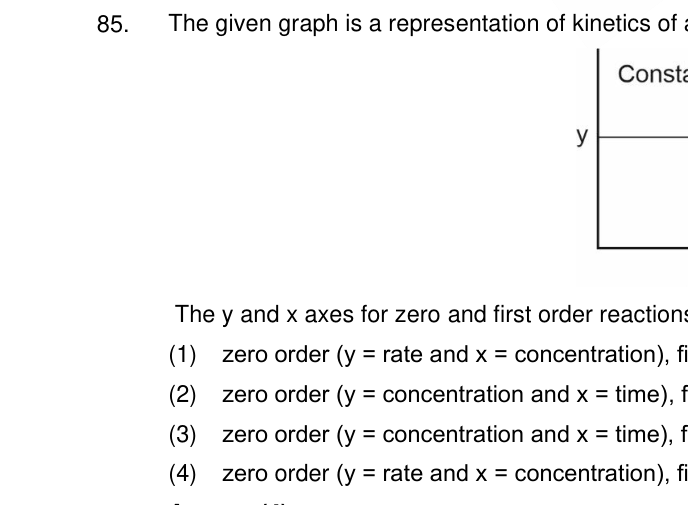
- A.Zero order ( = rate and = concentration), first order ( = rate and = )
- B.Zero order ( = concentration and = time), first order ( = and = concentration)
- C.Zero order ( = concentration and = time), first order ( = rate constant and = concentration)
- D.Zero order ( = rate and = concentration), first order ( = and = concentration)✓
The worked solution is part of a paid pack.
ChemistryNEET 2020show ▾An increase in the concentration of the reactants of a reaction leads to a change in:
- A.Activation energy
- B.Heat of reaction
- C.Threshold energy
- D.Collision frequency✓
The worked solution is part of a paid pack.
ChemistryNEET 2019show ▾For the chemical reaction , the correct expression relating the rates of disappearance/appearance of each species is:
2. Integrated rate equations and half-life
Exam focus: First-order half-life (t½ = 0.693/k) doesn't depend on starting concentration — the signature fact used to identify first order from a data table. Zero-order half-life is the opposite: directly proportional to initial concentration (t½ = [A]₀/2k), and mixing up which order does which is the standard trap.
First-Order Kinetics: Integrated Rate Law and Half-Life
Physics Wallah - Alakh Pandey
Thorough treatment of the first-order integrated rate equation and half-life (the higher-weightage case for NEET); zero-order integrated rate law/half-life is covered in a separate, companion lecture, not this one.
ChemistryNEET 2025show ▾If the rate constant of a reaction is , how much time does it take for a concentration of the reactant to get reduced to ? (Given )
- A.69.3 s✓
- B.23.1 s
- C.210 s
- D.21.0 s
Solution
A rate constant in means first order. s.
Open this question on its own page →
Save for spaced revision (free account)ChemistryNEET 2025show ▾If the half-life () for a first-order reaction is 1 minute, then the time required for 99.9% completion of the reaction is closest to:
- A.2 minutes
- B.4 minutes
- C.5 minutes
- D.10 minutes✓
Solution
99.9% completion leaves of the reactant, i.e. about -fold reduction — ten half-lives. minutes.
Open this question on its own page →
Save for spaced revision (free account)ChemistryNEET 2022show ▾For a first order reaction A → Products, the initial concentration of A is 0.1 M, which becomes 0.001 M after 5 minutes. The rate constant for the reaction in is:
- A.0.2303
- B.1.3818
- C.0.9212✓
- D.0.4606
The worked solution is part of a paid pack.
ChemistryNEET 2020show ▾The rate constant for a first order reaction is . The time required to reduce 2.0 g of the reactant to 0.2 g is:
- A.100 s
- B.200 s
- C.500 s✓
- D.1000 s
The worked solution is part of a paid pack.
ChemistryNEET 2019show ▾If the rate constant for a first-order reaction is , the time required for 99% completion of the reaction is given by:
3. Arrhenius equation and activation energy
Exam focus: A catalyst speeds up a reaction by lowering the activation energy through an alternate pathway — it doesn't change ΔH, and because it accelerates the forward and reverse reactions equally, it never shifts the equilibrium position or the value of K. That "catalysts don't touch equilibrium, only kinetics" point is a recurring assertion-reason question.
Arrhenius Equation and Activation Energy
Physics Wallah - Alakh Pandey
Covers the Arrhenius equation, activation energy and the temperature dependence of rate directly.
ChemistryNEET 2024show ▾Which plot of vs (from the four graphs shown) is consistent with the Arrhenius equation?
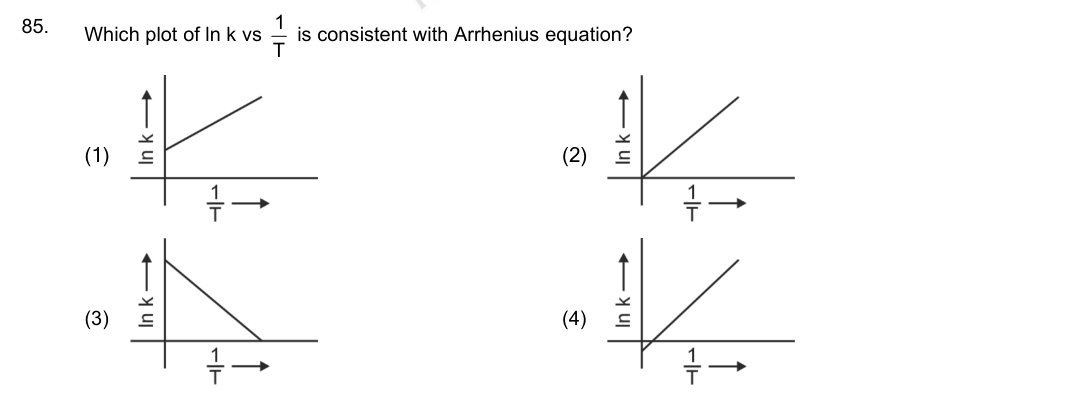
- A.Graph (1)
- B.Graph (2)
- C.Graph (3)✓
- D.Graph (4)
Solution
Arrhenius: . A plot of against is a straight line with negative slope and positive intercept — graph (3).
Open this question on its own page →
Save for spaced revision (free account)ChemistryNEET 2024show ▾The activation energy of any chemical reaction can be calculated if one knows the value of:
- A.probability of collision
- B.orientation of reactant molecules during collision
- C.rate constant at two different temperatures✓
- D.rate constant at standard temperature
Solution
The Arrhenius equation in two-temperature form, , gives from rate constants measured at two temperatures.
Open this question on its own page →
Save for spaced revision (free account)ChemistryNEET 2024show ▾The rate of a reaction quadruples when the temperature changes from C to C. Calculate the energy of activation. (Given , .)
- A.380.4 kJ/mol
- B.3.80 kJ/mol
- C.3804 kJ/mol
- D.38.04 kJ/mol✓
Solution
with , K, K: kJ/mol.
Open this question on its own page →
Save for spaced revision (free account)ChemistryNEET 2023show ▾Given below are two statements: one is labelled as Assertion A and the other is labelled as Reason R.
Assertion A: A reaction can have zero activation energy.
Reason R: The minimum extra amount of energy absorbed by reactant molecules so that their energy becomes equal to the threshold value is called activation energy.
In the light of the above statements, choose the correct answer from the options given below:
- A.Both A and R are true and R is the correct explanation of A
- B.Both A and R are true and R is NOT the correct explanation of A
- C.A is true but R is false
- D.A is false but R is true✓
The worked solution is part of a paid pack.
ChemistryNEET 2021show ▾The slope of the Arrhenius plot ( vs ) of a first order reaction is K. The value of of the reaction is (given ):
ChemistryNEET 2021show ▾For a reaction A → B, the enthalpy of reaction is and the enthalpy of activation is . The correct potential energy profile for the reaction is shown in option:
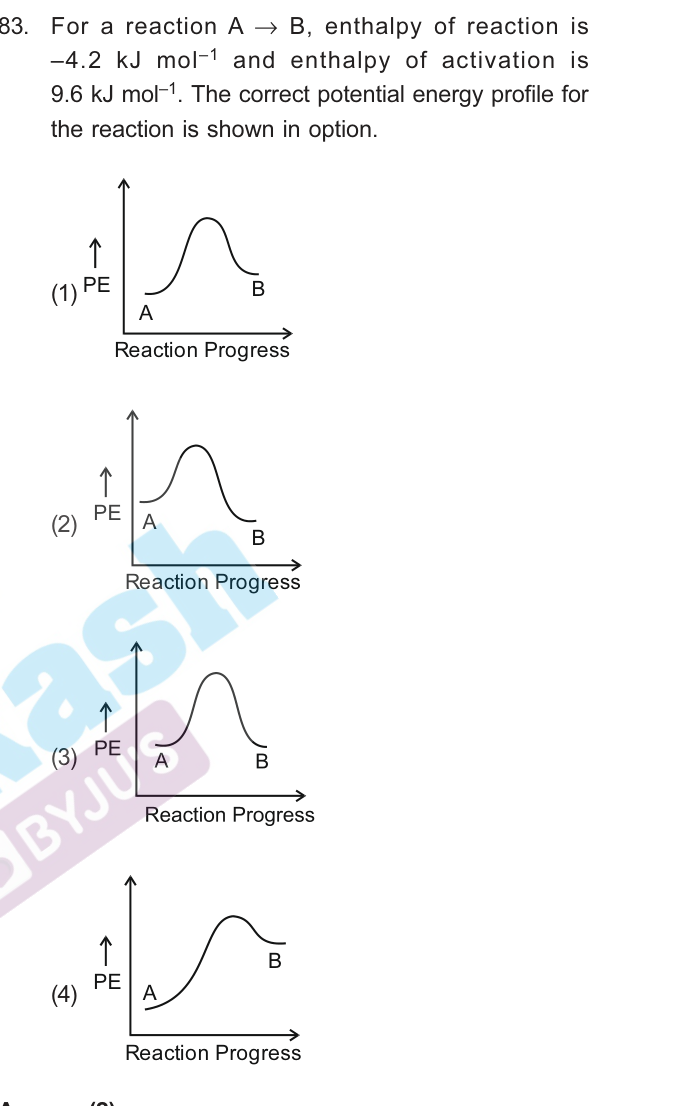
- A.Profile (1)
- B.Profile (2)✓
- C.Profile (3)
- D.Profile (4)
The worked solution is part of a paid pack.