Chapter 78 of 2364 min read
Matter waves and de Broglie wavelength
Why this is asked: Every moving object has a de Broglie wavelength, λ = h/mv, not just electrons — it's simply too small to matter macroscopically. For an electron accelerated through potential V, this gives λ = h/√(2meV), a frequently tested formula in its own right.
This chapter is part of a paid pack
A sample of the book is free to read — the rest, including this chapter, unlocks with full access.
See pricingTest yourself
- •The de Broglie wavelength of an electron orbiting in the state of the hydrogen atom is close to (given Bohr radius = 0.052 nm):
- •A photon and an electron (mass ) have the same energy . The ratio of their de Broglie wavelengths is ( is the speed of light):
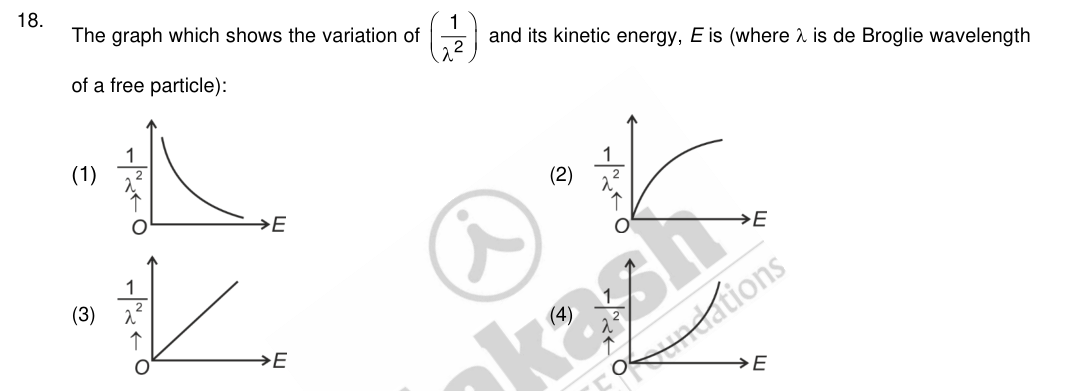
- •The graph which shows the variation of with the kinetic energy of a free particle (where is its de Broglie wavelength) is:
Open this in the full syllabus view · Physics