Chapter 43 of 2363 min read
Spring–mass system and simple pendulum
Why this is asked: A spring-mass system's period, T = 2π√(m/k), doesn't involve g and works the same on the Moon, while a pendulum's period, T = 2π√(L/g), depends on effective g and simply stops swinging in a freely falling lift.
This chapter is part of a paid pack
A sample of the book is free to read — the rest, including this chapter, unlocks with full access.
See pricingTest yourself
- •In an oscillating spring–mass system, a spring is connected to a box filled with sand. As the box oscillates, sand leaks slowly out of the box vertically so that the average frequency and average amplitude of the system change with time . Which one of the following options (graphs shown) schematically depicts these changes correctly?
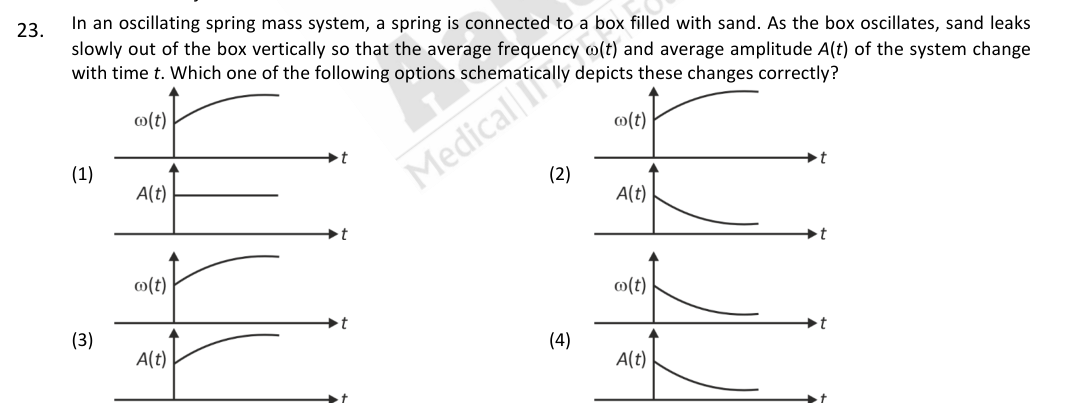
- •Two identical point masses P and Q, suspended from two separate massless springs of spring constants and respectively, oscillate vertically. If their maximum speeds are the same, the ratio of the amplitude of mass Q to the amplitude of mass P is:
- •If the mass of the bob in a simple pendulum is increased to thrice its original mass and its length is made half its original length, then the new time period of oscillation is times its original time period. Then the value of is:
Open this in the full syllabus view · Physics