Motion that repeats itself at equal intervals of time is periodic motion; motion in which a body swings back and forth about a fixed mean position is oscillatory motion. Simple harmonic motion (SHM) is oscillatory motion whose displacement varies as , where is the amplitude (maximum displacement from the mean position), the **angular freque
Oscillations
Class 1112 previous-year questions from this chapter every option and the correct answer, free · where the marks are
1. Simple harmonic motion: equations, energy
Exam focus: Total energy in SHM is constant and proportional to amplitude squared, but keeps trading between KE (maximum at the mean position) and PE (maximum at the extremes) — and acceleration itself is never constant, since a = −ω²x.
SHM: Equations and Energy
Physics Wallah - Alakh Pandey
Directly matches: equations of SHM and energy in SHM.
PhysicsNEET 2024show ▾If m represents the motion of a particle executing simple harmonic motion, the amplitude and time period of the motion, respectively, are:
- A.5 m, 2 s✓
- B.5 cm, 1 s
- C.5 m, 1 s
- D.5 cm, 2 s
Solution
Comparing with : amplitude m and rad/s, so s.
Open this question on its own page →
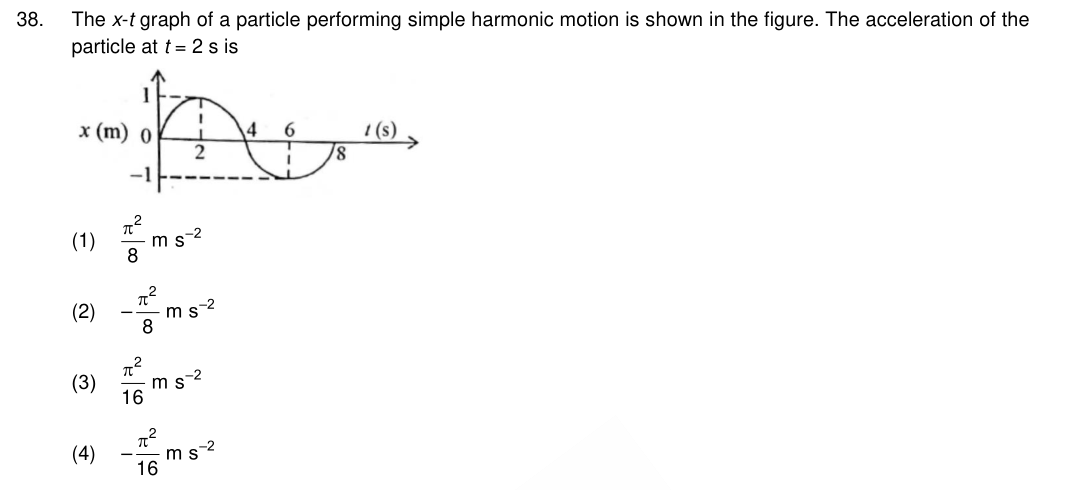
Save for spaced revision (free account)PhysicsNEET 2023show ▾The – graph of a particle performing simple harmonic motion is shown in the figure. The acceleration of the particle at s is:
PhysicsNEET 2021show ▾A body is executing simple harmonic motion with frequency . The frequency of its potential energy is:
PhysicsNEET 2020show ▾The phase difference between the displacement and the acceleration of a particle in simple harmonic motion is:
- A. rad✓
- B. rad
- C. rad
- D.Zero
The worked solution is part of a paid pack.
PhysicsNEET 2019show ▾The average velocity of a particle executing SHM in one complete vibration is:
PhysicsNEET 2019show ▾The displacement of a particle executing simple harmonic motion is given by . Then the amplitude of its oscillation is given by:
PhysicsNEET 2019show ▾A particle P moves in a circle of radius 3 m, centred at the origin in the -plane, with period s. At , P is at the topmost point of the circle (maximum -displacement). The -projection of the position vector of P, as a function of time, is:
2. Spring–mass system and simple pendulum
Exam focus: A spring-mass system's period, T = 2π√(m/k), doesn't involve g and works the same on the Moon, while a pendulum's period, T = 2π√(L/g), depends on effective g and simply stops swinging in a freely falling lift.
Spring-Block Oscillations and Time Period of SHM
Physics Wallah - Alakh Pandey
Thoroughly covers spring-mass/spring-block oscillations and time-period derivation; the simple pendulum is covered by the same channel in a separate lecture, not included here.
PhysicsNEET 2025show ▾Two identical point masses P and Q, suspended from two separate massless springs of spring constants and respectively, oscillate vertically. If their maximum speeds are the same, the ratio of the amplitude of mass Q to the amplitude of mass P is:
- A.
- B.
- C.
- D.✓
Solution
Maximum speed , equal for both: . With for equal masses, .
Open this question on its own page →
Save for spaced revision (free account)PhysicsNEET 2025show ▾In an oscillating spring–mass system, a spring is connected to a box filled with sand. As the box oscillates, sand leaks slowly out of the box vertically so that the average frequency and average amplitude of the system change with time . Which one of the following options (graphs shown) schematically depicts these changes correctly?
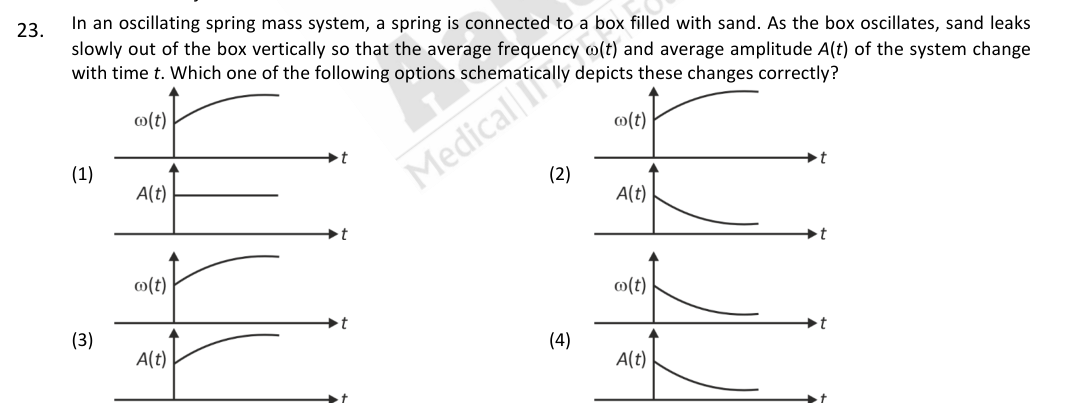
- A.Graph (1)
- B.Graph (2)✓
- C.Graph (3)
- D.Graph (4)
Solution
, so as sand leaves and falls, rises and levels off. Each grain that leaves carries away its share of the kinetic energy, so the oscillator's energy decreases and the amplitude falls — option (2).
Open this question on its own page →
Save for spaced revision (free account)PhysicsNEET 2024show ▾If the mass of the bob in a simple pendulum is increased to thrice its original mass and its length is made half its original length, then the new time period of oscillation is times its original time period. Then the value of is:
- A.2✓
- B.
- C.4
- D.3
Solution
is independent of mass. Halving gives , so .
Open this question on its own page →
Save for spaced revision (free account)PhysicsNEET 2022show ▾Two pendulums of length 121 cm and 100 cm start vibrating in phase. At some instant, the two are at their mean position in the same phase. The minimum number of vibrations of the shorter pendulum after which the two are again in phase at the mean position is:
PhysicsNEET 2021show ▾A spring is stretched by 5 cm by a force of 10 N. The time period of the oscillations when a mass of 2 kg is suspended by it is:
- A.0.0628 s
- B.6.28 s
- C.3.14 s
- D.0.628 s✓
The worked solution is part of a paid pack.
3. Damped, forced oscillations and resonance
Exam focus: Resonance occurs when the driving frequency matches the system's own natural frequency, producing a sharp buildup in amplitude — the textbook reason soldiers break step crossing a bridge rather than march across it in rhythm.
Damped Oscillations, Angular SHM and Resonance
Physics Wallah - Alakh Pandey
Covers damped oscillations and resonance directly, plus angular SHM as a bonus topic.