Chapter 232 of 2363 min read
Tools of recombinant DNA technology
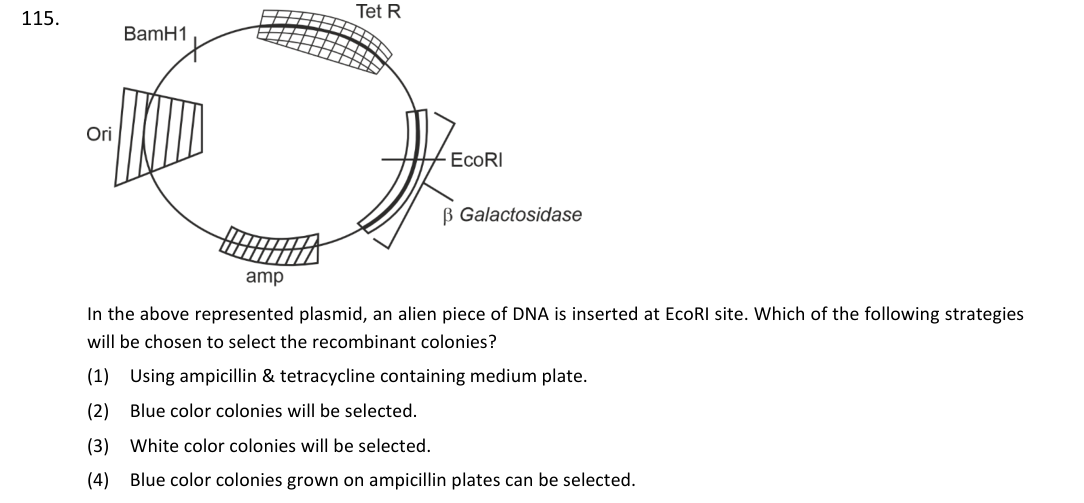
Why this is asked: Recombinants are told apart from non-recombinants by insertional inactivation, not by size: in a vector like pBR322, foreign DNA inserted into the tetR gene knocks that gene out, so a recombinant colony loses tetracycline resistance while keeping ampicillin resistance — only replica plating onto both antibiotics catches the difference. Restriction enzymes cut only at specific palindromic sequences, such as EcoRI at GAATTC, which is why the same enzyme reliably cuts both vector and foreign DNA at matching ends.
This chapter is part of a paid pack
A sample of the book is free to read — the rest, including this chapter, unlocks with full access.
See pricingTest yourself
- •Given below are two statements: Statement I: The DNA fragments extracted from gel electrophoresis can be used in the construction of recombinant DNA. Statement II: Smaller-size DNA fragments are observed near the anode while larger fragments are found near the wells in an agarose gel. In the light of the above statements, choose the most appropriate answer from the options given below:
- •Blue and white selectable markers have been developed which differentiate recombinant colonies from non-recombinant colonies on the basis of their ability to produce colour in the presence of a chromogenic substrate. Given below are two statements about this method: Statement I: The blue-coloured colonies have the DNA insert in the plasmid and they are identified as recombinant colonies. Statement II: The colonies without blue colour have the DNA insert in the plasmid and are identified as recombinant colonies. In the light of the above statements, choose the most appropriate answer from the options given below:
- •In the plasmid represented in the figure, an alien piece of DNA is inserted at the EcoRI site. Which of the following strategies will be chosen to select the recombinant colonies?
Open this in the full syllabus view · Zoology