Restriction enzymes are the molecular scissors that make gene manipulation possible: bacterial enzymes that recognise one short, specific DNA sequence and cut both strands of the double helix within it, part of a defence system that degrades invading (viral) DNA while the bacterium's own DNA stays protected by methylation. The recognition sequence is a palindrome — it reads the same 5' to
Biotechnology: Principles and Processes
Class 1236 previous-year questions from this chapter every option and the correct answer, free · where the marks are
1. Tools of recombinant DNA technology
Exam focus: Recombinants are told apart from non-recombinants by insertional inactivation, not by size: in a vector like pBR322, foreign DNA inserted into the tetR gene knocks that gene out, so a recombinant colony loses tetracycline resistance while keeping ampicillin resistance — only replica plating onto both antibiotics catches the difference. Restriction enzymes cut only at specific palindromic sequences, such as EcoRI at GAATTC, which is why the same enzyme reliably cuts both vector and foreign DNA at matching ends.
Recombinant DNA Technology — Tools
Vedantu NEET
Restriction enzymes, cloning vectors and the host-vector system — the vocabulary NEET's biotechnology questions are built from.
ZoologyNEET 2025show ▾Blue and white selectable markers have been developed which differentiate recombinant colonies from non-recombinant colonies on the basis of their ability to produce colour in the presence of a chromogenic substrate. Given below are two statements about this method:
Statement I: The blue-coloured colonies have the DNA insert in the plasmid and they are identified as recombinant colonies.
Statement II: The colonies without blue colour have the DNA insert in the plasmid and are identified as recombinant colonies.
In the light of the above statements, choose the most appropriate answer from the options given below:
- A.Both Statement I and Statement II are correct
- B.Both Statement I and Statement II are incorrect
- C.Statement I is correct but Statement II is incorrect
- D.Statement I is incorrect but Statement II is correct✓
Solution
An insert in the lacZ gene destroys galactosidase, so recombinant colonies cannot turn the chromogenic substrate blue — recombinants are the white colonies. Statement I is wrong, Statement II is correct.
Open this question on its own page →
Save for spaced revision (free account)ZoologyNEET 2025show ▾Given below are two statements:
Statement I: The DNA fragments extracted from gel electrophoresis can be used in the construction of recombinant DNA.
Statement II: Smaller-size DNA fragments are observed near the anode while larger fragments are found near the wells in an agarose gel.
In the light of the above statements, choose the most appropriate answer from the options given below:
- A.Both Statement I and Statement II are correct✓
- B.Both Statement I and Statement II are incorrect
- C.Statement I is correct but Statement II is incorrect
- D.Statement I is incorrect but Statement II is correct
Solution
DNA bands cut from an agarose gel and eluted are used to build recombinant DNA (I correct). DNA is negative and moves towards the anode; smaller fragments travel farthest, so they lie nearer the anode while large ones stay near the wells (II correct).
Open this question on its own page →
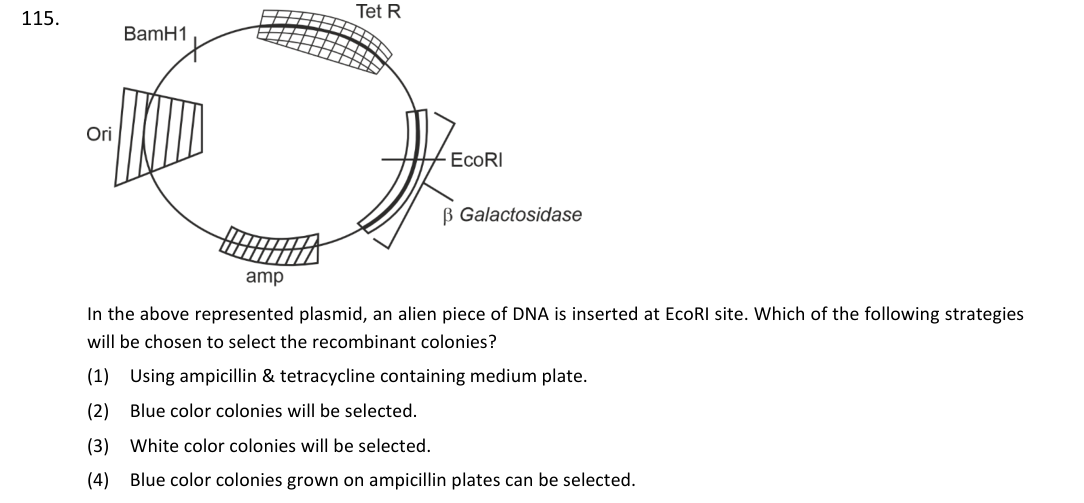
Save for spaced revision (free account)BotanyNEET 2025show ▾In the plasmid represented in the figure, an alien piece of DNA is inserted at the EcoRI site. Which of the following strategies will be chosen to select the recombinant colonies?
- A.Using an ampicillin- and tetracycline-containing medium plate.
- B.Blue-coloured colonies will be selected.
- C.White-coloured colonies will be selected.✓
- D.Blue-coloured colonies grown on ampicillin plates can be selected.
Solution
The EcoRI site lies within the lacZ gene of the vector. An insert there inactivates galactosidase, so recombinant colonies cannot break down the chromogenic substrate and stay white, while non-recombinants turn blue. Select the white colonies.
Open this question on its own page →
Save for spaced revision (free account)ZoologyNEET 2025show ▾Which of the following enzymes are not essential for gene cloning?
A. Restriction enzymes · B. DNA ligase · C. DNA mutase · D. DNA recombinase · E. DNA polymerase
Choose the correct answer from the options given below:
- A.C and D only✓
- B.A and B only
- C.D and E only
- D.B and C only
Solution
Gene cloning needs restriction enzymes to cut, DNA ligase to join and DNA polymerase for PCR. 'DNA mutase' and 'DNA recombinase' are not part of the toolkit. Hence C and D.
Open this question on its own page →
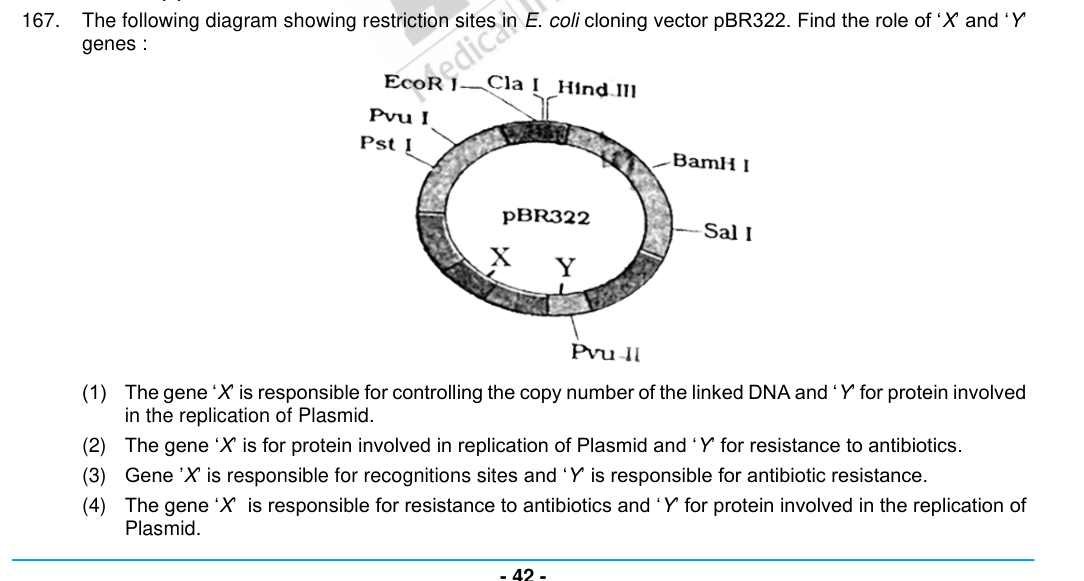
Save for spaced revision (free account)ZoologyNEET 2024show ▾The following diagram shows the restriction sites in the E. coli cloning vector pBR322. Find the role of the 'X' and 'Y' genes:
- A.Gene 'X' is responsible for controlling the copy number of the linked DNA and 'Y' for a protein involved in the replication of the plasmid.✓
- B.Gene 'X' is for a protein involved in the replication of the plasmid and 'Y' for resistance to antibiotics.
- C.Gene 'X' is responsible for recognition sites and 'Y' is responsible for antibiotic resistance.
- D.Gene 'X' is responsible for resistance to antibiotics and 'Y' for a protein involved in the replication of the plasmid.
Solution
In pBR322 the rop gene codes for proteins involved in plasmid replication, and ori controls copy number; the antibiotic-resistance genes are amp^R and tet^R. With X labelled at ori and Y at rop in the figure, X controls copy number and Y codes for a replication protein.
Open this question on its own page →
Save for spaced revision (free account)BotanyNEET 2024show ▾Hind II always cuts DNA molecules at a particular point called the recognition sequence, and it consists of:
- A.6 bp✓
- B.4 bp
- C.10 bp
- D.8 bp
Solution
Hind II, the first restriction endonuclease discovered, always cuts at a specific six-base-pair recognition sequence.
Open this question on its own page →
Save for spaced revision (free account)ZoologyNEET 2024show ▾The 'Ti plasmid' of Agrobacterium tumefaciens stands for:
- A.Tumour independent plasmid
- B.Tumour inducing plasmid✓
- C.Temperature independent plasmid
- D.Tumour inhibiting plasmid
Solution
Ti stands for tumour-inducing: the plasmid of Agrobacterium tumefaciens that causes crown gall, disarmed and used as a vector for plant transformation.
Open this question on its own page →
Save for spaced revision (free account)BotanyNEET 2024show ▾What is the fate of a piece of DNA carrying only the gene of interest which is transferred into an alien organism?
A. The piece of DNA would be able to multiply itself independently in the progeny cells of the organism.
B. It may get integrated into the genome of the recipient.
C. It may multiply and be inherited along with the host DNA.
D. The alien piece of DNA is not an integral part of the chromosome.
E. It shows the ability to replicate.
Choose the correct answer from the options given below:
- A.D and E only
- B.B and C only✓
- C.A and E only
- D.A and B only
Solution
A DNA fragment that carries only the gene of interest has no origin of replication, so it cannot multiply on its own (A, D and E are wrong). It may integrate into the host genome and then be copied and inherited with the host DNA — B and C.
Open this question on its own page →
Save for spaced revision (free account)BotanyNEET 2023show ▾In the gene gun method used to introduce alien DNA into host cells, microparticles of ________ metal are used.
- A.Copper
- B.Zinc
- C.Tungsten or gold✓
- D.Silver
The worked solution is part of a paid pack.
BotanyNEET 2023show ▾During the purification process in recombinant DNA technology, the addition of chilled ethanol precipitates out:
- A.RNA
- B.DNA✓
- C.Histones
- D.Polysaccharides
The worked solution is part of a paid pack.
ZoologyNEET 2023show ▾Which of the following is not a cloning vector?
- A.BAC
- B.YAC
- C.pBR322
- D.Probe✓
The worked solution is part of a paid pack.
BotanyNEET 2023show ▾Upon exposure to UV radiation, DNA stained with ethidium bromide will show:
- A.Bright red colour
- B.Bright blue colour
- C.Bright yellow colour
- D.Bright orange colour✓
The worked solution is part of a paid pack.
ZoologyNEET 2022show ▾Which of the following is not a desirable feature of a cloning vector?
- A.Presence of two or more recognition sites✓
- B.Presence of an origin of replication
- C.Presence of a marker gene
- D.Presence of a single restriction enzyme site
The worked solution is part of a paid pack.
BotanyNEET 2022show ▾In the following palindromic base sequences of DNA, which one can be cut easily by a particular restriction enzyme?
- A.5′-GTATTC-3′ / 3′-CATAAG-5′
- B.5′-GATACT-3′ / 3′-CTATGA-5′
- C.5′-GAATTC-3′ / 3′-CTTAAG-5′✓
- D.5′-CTCAGT-3′ / 3′-GAGTCA-5′
The worked solution is part of a paid pack.
ZoologyNEET 2022show ▾Given below are two statements:
Statement I: Restriction endonucleases recognise a specific sequence to cut DNA, known as a palindromic nucleotide sequence.
Statement II: Restriction endonucleases cut the DNA strand a little away from the centre of the palindromic site.
In the light of the above statements, choose the most appropriate answer from the options given below:
- A.Statement I is incorrect but Statement II is correct
- B.Both Statement I and Statement II are correct✓
- C.Both Statement I and Statement II are incorrect
- D.Statement I is correct but Statement II is incorrect
The worked solution is part of a paid pack.
BotanyNEET 2021show ▾Plasmid pBR322 has a PstI restriction enzyme site within the gene amp^R that confers ampicillin resistance. If this enzyme is used for inserting a gene for galactoside production and the recombinant plasmid is inserted in an E. coli strain:
- A.It will not be able to confer ampicillin resistance to the host cell✓
- B.The transformed cells will have the ability to resist ampicillin as well as produce galactoside
- C.It will lead to lysis of the host cell
- D.It will be able to produce a novel protein with dual ability
The worked solution is part of a paid pack.
ZoologyNEET 2021show ▾A specific recognition sequence identified by endonucleases to make cuts at specific positions within the DNA is:
- A.Degenerate primer sequence
- B.Okazaki sequences
- C.Palindromic nucleotide sequences✓
- D.Poly(A) tail sequences
The worked solution is part of a paid pack.
ZoologyNEET 2020show ▾Choose the correct pair from the following.
- A.Ligases – Join two DNA molecules✓
- B.Polymerases – Break DNA into fragments
- C.Nucleases – Separate the two strands of DNA
- D.Exonucleases – Make cuts at specific positions within DNA
The worked solution is part of a paid pack.
ZoologyNEET 2020show ▾Match the organism with its use in biotechnology.
Organism Use (a) Bacillus thuringiensis (i) Cloning vector (b) Thermus aquaticus (ii) Construction of the first rDNA molecule (c) Agrobacterium tumefaciens (iii) DNA polymerase (d) Salmonella typhimurium (iv) Cry proteins
Select the correct option from the following:
- A.(a)-(ii), (b)-(iv), (c)-(iii), (d)-(i)
- B.(a)-(iv), (b)-(iii), (c)-(i), (d)-(ii)✓
- C.(a)-(iii), (b)-(ii), (c)-(iv), (d)-(i)
- D.(a)-(iii), (b)-(iv), (c)-(i), (d)-(ii)
The worked solution is part of a paid pack.
ZoologyNEET 2020show ▾Identify the wrong statement with regard to restriction enzymes.
- A.Each restriction enzyme functions by inspecting the length of a DNA sequence
- B.They cut the strand of DNA at palindromic sites
- C.They are useful in genetic engineering
- D.Sticky ends can be joined by using DNA ligases✓
The worked solution is part of a paid pack.
ZoologyNEET 2020show ▾The sequence that controls the copy number of the linked DNA in the vector is termed:
- A.A selectable marker
- B.The ori site✓
- C.A palindromic sequence
- D.A recognition site
The worked solution is part of a paid pack.
ZoologyNEET 2020show ▾The specific palindromic sequence recognised by EcoRI is:
- A.5′-GAATTC-3′ / 3′-CTTAAG-5′✓
- B.5′-GGAACC-3′ / 3′-CCTTGG-5′
- C.5′-CTTAAG-3′ / 3′-GAATTC-5′
- D.5′-GGATCC-3′ / 3′-CCTAGG-5′
The worked solution is part of a paid pack.
ZoologyNEET 2019show ▾DNA precipitation out of a mixture of biomolecules can be achieved by treatment with:
- A.Isopropanol
- B.Chilled ethanol✓
- C.Methanol at room temperature
- D.Chilled chloroform
The worked solution is part of a paid pack.
ZoologyNEET 2019show ▾The following statements describe characteristics of the enzyme restriction endonuclease. Identify the INCORRECT statement.
- A.The enzyme cuts a DNA molecule at an identified position within the DNA
- B.The enzyme binds DNA at specific sites and cuts only one of the two strands✓
- C.The enzyme cuts the sugar-phosphate backbone at specific sites on each strand
- D.The enzyme recognises a specific palindromic nucleotide sequence in the DNA
The worked solution is part of a paid pack.
2. Processes: cloning, PCR, bioreactors
Exam focus: PCR only survives cycle after cycle because Taq polymerase, isolated from Thermus aquaticus (a bacterium living in hot springs), survives the roughly 95°C denaturation step intact — an ordinary DNA polymerase would be destroyed at that temperature and need replacing every cycle, which is why the source organism itself, not just "a polymerase is used," is the specific fact NEET asks for.
Biotechnology Processes: PCR and Bioreactors
Competition Wallah
Part 5 of a dedicated Biotechnology series, giving thorough coverage of PCR and bioreactors/downstream processing. It does NOT cover gene cloning or cloning vectors — that is a separate video earlier in the same series — so the 'cloning' third of this subtopic is not covered here.
BotanyNEET 2025show ▾Polymerase chain reaction (PCR) amplifies DNA following the equation:
- A.
- B.✓
- C.
- D.
Solution
Each PCR cycle doubles the target, so after cycles there are copies — about a billion after 30 cycles.
Open this question on its own page →
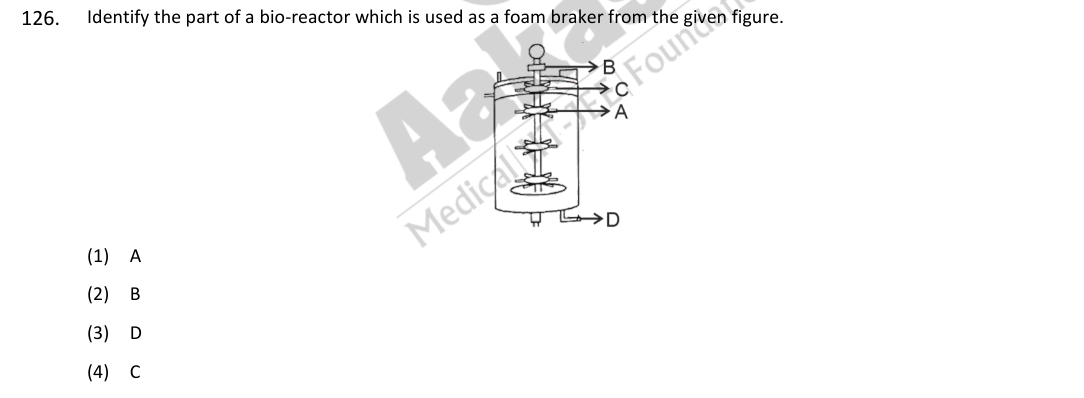
Save for spaced revision (free account)BotanyNEET 2025show ▾Identify the part of a bioreactor which is used as a foam breaker from the given figure.
- A.A
- B.B
- C.D
- D.C✓
Solution
In a stirred-tank bioreactor the foam breaker sits at the top, above the agitator and the sparger, labelled C in the given figure.
Open this question on its own page →
Save for spaced revision (free account)ZoologyNEET 2024show ▾Which of the following statements is incorrect?
- A.The most commonly used bioreactors are of the stirring type
- B.Bioreactors are used to produce small-scale bacterial cultures✓
- C.Bioreactors have an agitator system, an oxygen delivery system and a foam control system
- D.A bioreactor provides optimal growth conditions for achieving the desired product
Solution
Bioreactors are for large-scale production — hundreds to thousands of litres — not small cultures. The other three statements correctly describe a stirred-tank bioreactor.
Open this question on its own page →
Save for spaced revision (free account)BotanyNEET 2022show ▾Which one of the following statements is not true regarding the gel electrophoresis technique?
- A.Bright orange coloured bands of DNA can be observed in the gel when exposed to UV light
- B.The process of extraction of separated DNA strands from the gel is called elution
- C.The separated DNA fragments are stained by using ethidium bromide
- D.The presence of a chromogenic substrate gives blue coloured DNA bands on the gel✓
The worked solution is part of a paid pack.
BotanyNEET 2022show ▾Given below are two statements: one is labelled as Assertion (A) and the other is labelled as Reason (R).
Assertion (A): Polymerase chain reaction is used in DNA amplification.
Reason (R): The ampicillin resistant gene is used as a selectable marker to check transformation.
In the light of the above statements, choose the correct answer from the options given below:
- A.(A) is not correct but (R) is correct
- B.Both (A) and (R) are correct and (R) is the correct explanation of (A)
- C.Both (A) and (R) are correct but (R) is not the correct explanation of (A)✓
- D.(A) is correct but (R) is not correct
The worked solution is part of a paid pack.
BotanyNEET 2021show ▾Which of the following is the correct sequence of steps in a PCR (polymerase chain reaction)?
- A.Denaturation, Annealing, Extension✓
- B.Denaturation, Extension, Annealing
- C.Extension, Denaturation, Annealing
- D.Annealing, Denaturation, Extension
The worked solution is part of a paid pack.
BotanyNEET 2021show ▾Which of the following is not an application of PCR (polymerase chain reaction)?
- A.Molecular diagnosis
- B.Gene amplification
- C.Purification of isolated protein✓
- D.Detection of gene mutation
The worked solution is part of a paid pack.
BotanyNEET 2021show ▾DNA strands on a gel stained with ethidium bromide, when viewed under UV radiation, appear as:
- A.Yellow bands
- B.Bright orange bands✓
- C.Dark red bands
- D.Bright blue bands
The worked solution is part of a paid pack.
BotanyNEET 2021show ▾During the purification process in recombinant DNA technology, the addition of chilled ethanol precipitates out:
- A.RNA
- B.DNA✓
- C.Histones
- D.Polysaccharides
The worked solution is part of a paid pack.
ZoologyNEET 2021show ▾During the process of gene amplification using PCR, if a very high temperature is not maintained in the beginning, then which of the following steps of PCR will be affected first?
- A.Annealing
- B.Extension
- C.Denaturation✓
- D.Ligation
The worked solution is part of a paid pack.
ZoologyNEET 2020show ▾In gel electrophoresis, separated DNA fragments can be visualised with the help of:
- A.Acetocarmine in bright blue light
- B.Ethidium bromide in UV radiation✓
- C.Acetocarmine in UV radiation
- D.Ethidium bromide in infrared radiation
The worked solution is part of a paid pack.
ZoologyNEET 2019show ▾Which one of the following equipments is essentially required for growing microbes on a large scale, for industrial production of enzymes?
- A.BOD incubator
- B.Sludge digester
- C.Industrial oven
- D.Bioreactor✓
The worked solution is part of a paid pack.