Skip to content

Chemical Bonding and Molecular Structure

Class 11

19 previous-year questions from this chapter every option and the correct answer, free · where the marks are

1. Ionic and covalent bonds, Lewis structures

Exam focus: Fajans' rules explain why some "ionic" compounds behave covalently: a small, highly charged cation next to a large, polarisable anion pulls electron density back toward itself, which is why AlCl₃ and BeCl₂ don't act like typical ionic solids. Octet exceptions — BF₃ incomplete, PCl₅/SF₆ expanded, NO odd-electron — are tested directly, not as a footnote.

Chemical Bonding and Molecular Structure — Full Chapter

Vedantu 11&12

Full-chapter one-shot; ionic/covalent bonds and Lewis structures are covered as the opening section.

2. VSEPR and molecular shapes

Exam focus: Shape isn't the same as electron-pair geometry: NH₃ and H₂O both have a tetrahedral arrangement of electron pairs, but lone pairs are dropped when naming the shape (pyramidal, bent). The repulsion order lone pair–lone pair > lone pair–bond pair > bond pair–bond pair is why NH₃'s bond angle (107°, one lone pair) is squeezed less than H₂O's (104.5°, two lone pairs).

Chemical Bonding and Molecular Structure — Full Chapter

Vedantu 11&12

Same full-chapter video; VSEPR theory and molecular shapes are one section of it.

3. Valence bond theory and hybridisation

Exam focus: Hybridisation is decided by the steric number — sigma bonds plus lone pairs on the central atom — not by the number of bonds alone; forgetting a lone pair is the most common way to misassign sp³ to something that's actually sp³d or sp³d² (XeF₄ is sp³d², with two lone pairs on Xe alongside its four bonds).

Chemical Bonding and Molecular Structure — Full Chapter

Vedantu 11&12

Same full-chapter video; valence bond theory and hybridisation are covered within it.

4. Molecular orbital theory

Exam focus: MOT's headline NEET question is O₂'s paramagnetism — two unpaired electrons in its degenerate π*2p orbitals, which the paired-electron double-bond picture from Lewis structures or VBT can't show at all. Watch the filling order too: from Li₂ to N₂, σ2p fills after π2p (s–p mixing pushes it up); from O₂ onward σ2p drops back below π2p.

Chemical Bonding and Molecular Structure — Full Chapter

Vedantu 11&12

Same full-chapter video; molecular orbital theory is one section of this one-shot.

5. Hydrogen bonding and dipole moment

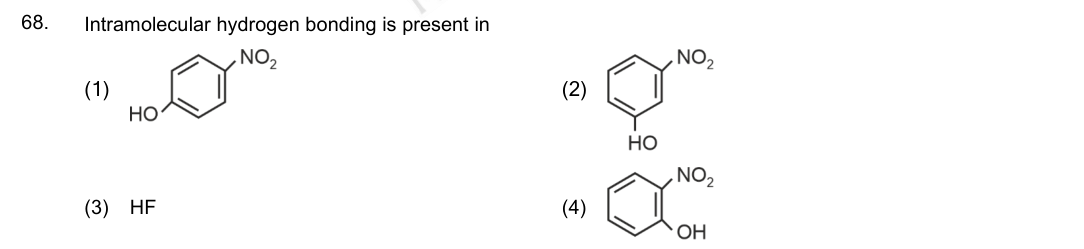
Exam focus: Net dipole moment is a vector sum of bond dipoles, not a scalar one — CO₂'s two C=O dipoles cancel exactly in its linear geometry (μ=0), while bent H₂O's don't. The classic trap: o-nitrophenol's intramolecular hydrogen bond makes it more volatile than p-nitrophenol, whose hydrogen bonding is intermolecular — having H-bonds isn't enough, the question is whether they're within or between molecules.

Chemical Bonding and Molecular Structure — Full Chapter

Vedantu 11&12

Same full-chapter video; hydrogen bonding and dipole moment are covered near the end of this one-shot.