Auxin is used by gardeners to prepare weed-free lawns. But no damage is caused to grass, as auxin:
NEET 2024 — Botany
All 50 Botany questions we hold from this paper, of the 200 on the site for this sitting — every option and the answer key. 4 marks each, −1 for a wrong answer.
Botany
45 questions, one correct option each. +4 for a correct answer, −1 for a wrong one, nothing for a blank.
Q1openPlant Growth and Development · Plant growth regulators: auxin, gibberellin, cytokinin, ethylene, ABA
- A.promotes abscission of mature leaves only.
- B.does not affect mature monocotyledonous plants.✓
- C.can help in cell division in grasses, to produce growth.
- D.promotes apical dominance.
Solution
2,4-D and other synthetic auxins kill dicot weeds but leave mature monocots such as grasses unaffected, which is why they are used to keep lawns weed-free.
Q2openBiomolecules · Carbohydrates, lipids, amino acids and proteins
Lecithin, a small molecular weight organic compound found in living tissues, is an example of:
- A.Phospholipids✓
- B.Glycerides
- C.Carbohydrates
- D.Amino acids
Solution
Lecithin is a phosphoglyceride — a glycerol backbone carrying two fatty acids and a phosphate-linked choline. It is the standard NCERT example of a phospholipid found in cell membranes.
Q3openPrinciples of Inheritance and Variation · Mendel's laws and deviations
Match List I with List II.
| List I | List II |
|---|---|
| A. Two or more alternative forms of a gene | I. Back cross |
| B. Cross of F1 progeny with homozygous recessive parent | II. Ploidy |
| C. Cross of F1 progeny with any of the parents | III. Allele |
| D. Number of chromosome sets in a plant | IV. Test cross |
Choose the correct answer from the options given below:
- A.A-II, B-I, C-III, D-IV
- B.A-III, B-IV, C-I, D-II✓
- C.A-IV, B-III, C-II, D-I
- D.A-I, B-II, C-III, D-IV
Solution
Alternative forms of a gene are alleles (III). Crossing F1 with the homozygous recessive parent is a test cross (IV); with either parent, a back cross (I). The number of chromosome sets is ploidy (II).
Q4openSexual Reproduction in Flowering Plants · Pollination and double fertilisation
Identify the set of correct statements:
A. The flowers of Vallisneria are colourful and produce nectar.
B. The flowers of water lily are not pollinated by water.
C. In most water-pollinated species, the pollen grains are protected from wetting.
D. Pollen grains of some hydrophytes are long and ribbon-like.
E. In some hydrophytes, the pollen grains are carried passively inside water.
Choose the correct answer from the options given below:
- A.A, B, C and D only
- B.A, C, D and E only
- C.B, C, D and E only✓
- D.C, D and E only
Solution
Vallisneria flowers are small and nectarless (A false); water lilies are pollinated by insects, not water (B true). Water-pollinated species protect pollen with a mucilaginous coat, some have ribbon-like pollen, and in some the pollen is carried passively under water. So B, C, D and E.
Q5openBiodiversity and Conservation · Loss of biodiversity and its conservation
The list of endangered species was released by:
- A.WWF
- B.FOAM
- C.IUCN✓
- D.GEAC
Solution
The IUCN maintains the Red List, the global inventory of threatened and endangered species.
Q6openBiotechnology: Principles and Processes · Tools of recombinant DNA technology
What is the fate of a piece of DNA carrying only the gene of interest which is transferred into an alien organism?
A. The piece of DNA would be able to multiply itself independently in the progeny cells of the organism.
B. It may get integrated into the genome of the recipient.
C. It may multiply and be inherited along with the host DNA.
D. The alien piece of DNA is not an integral part of the chromosome.
E. It shows the ability to replicate.
Choose the correct answer from the options given below:
- A.D and E only
- B.B and C only✓
- C.A and E only
- D.A and B only
Solution
A DNA fragment that carries only the gene of interest has no origin of replication, so it cannot multiply on its own (A, D and E are wrong). It may integrate into the host genome and then be copied and inherited with the host DNA — B and C.
Q7openPhotosynthesis in Higher Plants · Calvin cycle, C4 pathway, photorespiration
Which of the following are required for the dark reaction of photosynthesis?
A. Light · B. Chlorophyll · C. CO2 · D. ATP · E. NADPH
Choose the correct answer from the options given below:
- A.B, C and D only
- B.C, D and E only✓
- C.D and E only
- D.A, B and C only
Solution
The Calvin cycle (the 'dark' reaction) needs CO2 as the substrate and the ATP and NADPH produced by the light reaction. It does not directly need light or chlorophyll.
Q8openBiodiversity and Conservation · Loss of biodiversity and its conservation
The type of conservation in which threatened species are taken out of their natural habitat and placed in a special setting where they can be protected and given special care is called:
- A.Biodiversity conservation✓
- B.Semi-conservative method
- C.Sustainable development
- D.in-situ conservation
Solution
Taking threatened species out of their habitat into a protected setting — zoos, botanical gardens, seed banks, cryopreservation — is ex-situ conservation. In-situ conservation protects them in their own habitat. (Of the options offered, 'biodiversity conservation' is the accepted answer.)
Q9openBiotechnology and its Applications · Applications in agriculture: Bt crops, RNAi
Given below are two statements:
Statement I: Bt toxins are insect-group specific and coded by a gene cryIAc.
Statement II: Bt toxin exists as an inactive protoxin in B. thuringiensis. However, after ingestion by the insect the inactive protoxin gets converted into the active form due to the acidic pH of the insect gut.
In the light of the above statements, choose the correct answer from the options given below:
- A.Both Statement I and Statement II are false
- B.Statement I is true but Statement II is false✓
- C.Statement I is false but Statement II is true
- D.Both Statement I and Statement II are true
Solution
Bt toxins are indeed insect-group specific and encoded by cry genes (Statement I true). The inactive protoxin is activated by the alkaline pH of the insect gut, not acidic — Statement II is false.
Q10openMolecular Basis of Inheritance · Transcription, genetic code, translation
A transcription unit in DNA is defined primarily by three regions in the DNA, and these are, with respect to the upstream and downstream ends:
- A.Structural gene, Transposons, Operator gene
- B.Inducer, Repressor, Structural gene
- C.Promoter, Structural gene, Terminator✓
- D.Repressor, Operator gene, Structural gene
Solution
A transcription unit runs, in the 5′→3′ direction of the coding strand, from a promoter through the structural gene to a terminator. Repressors, operators and inducers belong to regulation, not to the definition of the unit.
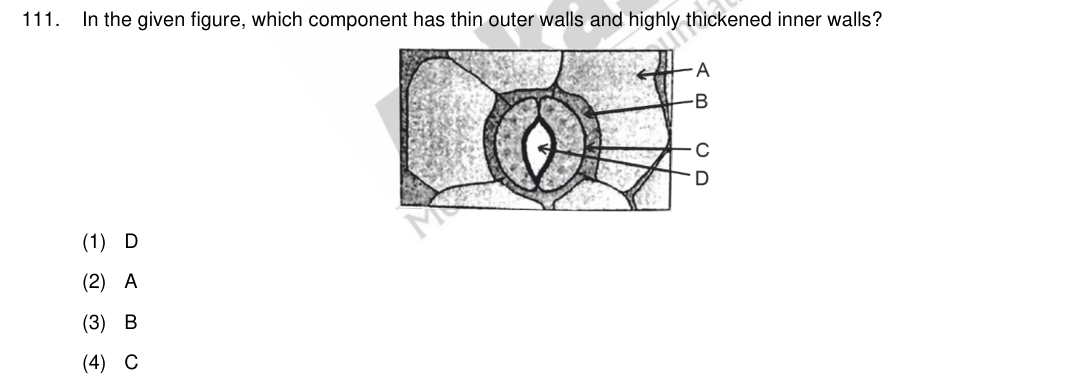
Q11openAnatomy of Flowering Plants · Tissues and tissue systems
In the given figure, which component has thin outer walls and highly thickened inner walls?
- A.D
- B.A
- C.B
- D.C✓
Solution
Label C points to a guard cell. Guard cells have thin outer walls and thick inner walls (facing the pore); this unequal thickening lets them bow outward when turgid and open the stoma.
Q12openBiotechnology: Principles and Processes · Tools of recombinant DNA technology
Hind II always cuts DNA molecules at a particular point called the recognition sequence, and it consists of:
- A.6 bp✓
- B.4 bp
- C.10 bp
- D.8 bp
Solution
Hind II, the first restriction endonuclease discovered, always cuts at a specific six-base-pair recognition sequence.
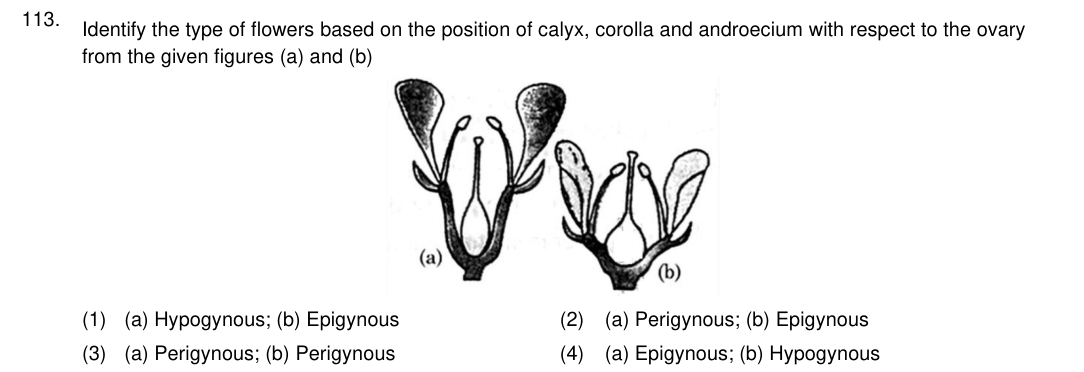
Q13openMorphology of Flowering Plants · Inflorescence, flower and floral formula
Identify the type of flowers based on the position of calyx, corolla and androecium with respect to the ovary from the given figures (a) and (b):
- A.(a) Hypogynous; (b) Epigynous
- B.(a) Perigynous; (b) Epigynous
- C.(a) Perigynous; (b) Perigynous✓
- D.(a) Epigynous; (b) Hypogynous
Solution
In both drawings the ovary sits at the centre of a cup-shaped thalamus with the sepals, petals and stamens arising from its rim at the same level as the ovary — the perigynous condition (half-inferior ovary), as in plum and rose. Neither shows the parts fused around the ovary (epigynous) or arising below it (hypogynous).
Q14openMorphology of Flowering Plants · Inflorescence, flower and floral formula
Which of the following is an example of an actinomorphic flower?
- A.Cassia
- B.Pisum
- C.Sesbania
- D.Datura✓
Solution
Datura flowers can be divided into equal halves by any radial plane — actinomorphic. Cassia, Pisum and Sesbania (all with irregular corollas) are zygomorphic.
Q15openBiological Classification · Monera, Protista and Fungi
Which one of the following is not a criterion for the classification of fungi?
- A.Mode of nutrition✓
- B.Mode of spore formation
- C.Fruiting body
- D.Morphology of mycelium
Solution
Fungi are classified on the morphology of the mycelium, the mode of spore formation and the fruiting body. Mode of nutrition is not a criterion — all fungi are heterotrophic.
Q16openOrganisms and Populations · Population attributes, growth models and interactions
The equation of Verhulst–Pearl logistic growth is dtdN=rN(KK−N). From this equation, K indicates:
- A.Biotic potential
- B.Carrying capacity✓
- C.Population density
- D.Intrinsic rate of natural increase
Solution
In the logistic equation dtdN=rN(KK−N), K is the carrying capacity — the maximum population the habitat can support; r is the intrinsic rate of natural increase.
Q17openPrinciples of Inheritance and Variation · Mendel's laws and deviations
Which of the following can be explained on the basis of Mendel's Law of Dominance?
A. Out of one pair of factors one is dominant and the other is recessive.
B. Alleles do not show any expression and both the characters appear as such in the F2 generation.
C. Factors occur in pairs in normal diploid plants.
D. The discrete unit controlling a particular character is called a factor.
E. The expression of only one of the parental characters is found in a monohybrid cross.
Choose the correct answer from the options given below:
- A.A, C, D and E only✓
- B.B, C and D only
- C.A, B, C, D and E
- D.A, B and C only
Solution
The law of dominance covers: characters are controlled by factors (D); factors occur in pairs (C); in a dissimilar pair one factor is dominant, the other recessive (A); so only one parental character shows in the F1 of a monohybrid cross (E). Statement B describes incomplete/co-dominance, not dominance. So A, C, D and E.
Q18openBiological Classification · Monera, Protista and Fungi
Match List I with List II.
| List I | List II |
|---|---|
| A. Rhizopus | I. Mushroom |
| B. Ustilago | II. Smut fungus |
| C. Puccinia | III. Bread mould |
| D. Agaricus | IV. Rust fungus |
Choose the correct answer from the options given below:
- A.A-I, B-III, C-II, D-IV
- B.A-III, B-II, C-I, D-IV
- C.A-IV, B-III, C-II, D-I
- D.A-III, B-II, C-IV, D-I✓
Solution
Rhizopus is the bread mould (III), Ustilago the smut fungus (II), Puccinia the rust fungus (IV) and Agaricus the mushroom (I).
Q19openBiomolecules · Enzymes: mechanism, factors, classification
Inhibition of the succinic dehydrogenase enzyme by malonate is a classical example of:
- A.Feedback inhibition
- B.Competitive inhibition✓
- C.Enzyme activation
- D.Cofactor inhibition
Solution
Malonate closely resembles succinate, the substrate, and competes for the active site of succinic dehydrogenase — the textbook example of competitive inhibition.
Q20openPlant Growth and Development · Phases of growth and differentiation
Formation of interfascicular cambium from fully developed parenchyma cells is an example of:
- A.Redifferentiation
- B.Dedifferentiation✓
- C.Maturation
- D.Differentiation
Solution
Mature parenchyma cells regaining the ability to divide and form interfascicular cambium is dedifferentiation; the cambium later redifferentiating into secondary tissues is redifferentiation.
Q21openPrinciples of Inheritance and Variation · Mendel's laws and deviations
A pink-flowered snapdragon plant was crossed with a red-flowered snapdragon plant. What type of phenotype(s) is/are expected in the progeny?
- A.Red-flowered as well as pink-flowered plants✓
- B.Only pink-flowered plants
- C.Red, pink as well as white-flowered plants
- D.Only red-flowered plants
Solution
Snapdragon flower colour shows incomplete dominance: pink is the heterozygote (Rr). Pink × red (Rr × RR) gives 1 RR : 1 Rr — red and pink plants only, no white.
Q22openPrinciples of Inheritance and Variation · Mendel's laws and deviations
In a plant, black seed colour (BB/Bb) is dominant over white seed colour (bb). In order to find out the genotype of a black-seeded plant, with which of the following genotypes will you cross it?
- A.bb✓
- B.Bb
- C.BB/Bb
- D.BB
Solution
To reveal a dominant plant's genotype, cross it with the homozygous recessive (bb) — a test cross. Any white-seeded progeny proves the parent is Bb.
Q23openMicrobes in Human Welfare · Microbes in household and industrial products
Match List I with List II.
| List I | List II |
|---|---|
| A. Clostridium butylicum | I. Ethanol |
| B. Saccharomyces cerevisiae | II. Streptokinase |
| C. Trichoderma polysporum | III. Butyric acid |
| D. Streptococcus sp. | IV. Cyclosporin-A |
Choose the correct answer from the options given below:
- A.A-II, B-IV, C-III, D-I
- B.A-III, B-I, C-IV, D-II✓
- C.A-IV, B-I, C-III, D-II
- D.A-III, B-I, C-II, D-IV
Solution
Clostridium butylicum gives butyric acid (III); Saccharomyces cerevisiae, ethanol (I); Trichoderma polysporum, cyclosporin-A (IV); Streptococcus, streptokinase (II).
Q24openPhotosynthesis in Higher Plants · Calvin cycle, C4 pathway, photorespiration
How many molecules of ATP and NADPH are required for every molecule of CO2 fixed in the Calvin cycle?
- A.2 molecules of ATP and 2 molecules of NADPH
- B.3 molecules of ATP and 3 molecules of NADPH
- C.3 molecules of ATP and 2 molecules of NADPH✓
- D.2 molecules of ATP and 3 molecules of NADPH
Solution
Each CO2 fixed in the Calvin cycle costs 3 ATP and 2 NADPH — 18 ATP and 12 NADPH per hexose.
Q25openPlant Growth and Development · Phases of growth and differentiation
The capacity to generate a whole plant from any cell of the plant is called:
- A.Micropropagation
- B.Differentiation
- C.Somatic hybridisation
- D.Totipotency✓
Solution
The capacity of any plant cell to regenerate a whole plant is totipotency, the basis of tissue culture.
Q26openBiodiversity and Conservation · Levels and patterns of biodiversity
Tropical regions show the greatest level of species richness because:
A. Tropical latitudes have remained relatively undisturbed for millions of years, hence more time was available for species diversification.
B. Tropical environments are more seasonal.
C. More solar energy is available in the tropics.
D. Constant environments promote niche specialisation.
E. Tropical environments are constant and predictable.
Choose the correct answer from the options given below:
- A.A and B only
- B.A, B and E only
- C.A, B and D only
- D.A, C, D and E only✓
Solution
The tropics have had a long undisturbed evolutionary time (A), receive more solar energy that supports higher productivity (C), and have constant, predictable environments that promote niche specialisation (D, E). Tropical environments are less seasonal, so B is false.
Q27openCell: The Unit of Life · Mitochondria, plastids, ribosomes, cytoskeleton, nucleus
Match List I with List II.
| List I | List II |
|---|---|
| A. Nucleolus | I. Site of formation of glycolipid |
| B. Centriole | II. Organisation like a cartwheel |
| C. Leucoplasts | III. Site for active ribosomal RNA synthesis |
| D. Golgi apparatus | IV. For storing nutrients |
Choose the correct answer from the options given below:
- A.A-II, B-III, C-I, D-IV
- B.A-III, B-IV, C-II, D-I
- C.A-I, B-II, C-III, D-IV
- D.A-III, B-II, C-IV, D-I✓
Solution
The nucleolus is the site of rRNA synthesis (III); the centriole has a cartwheel organisation (II); leucoplasts store nutrients (IV); the Golgi apparatus forms glycolipids and glycoproteins (I).
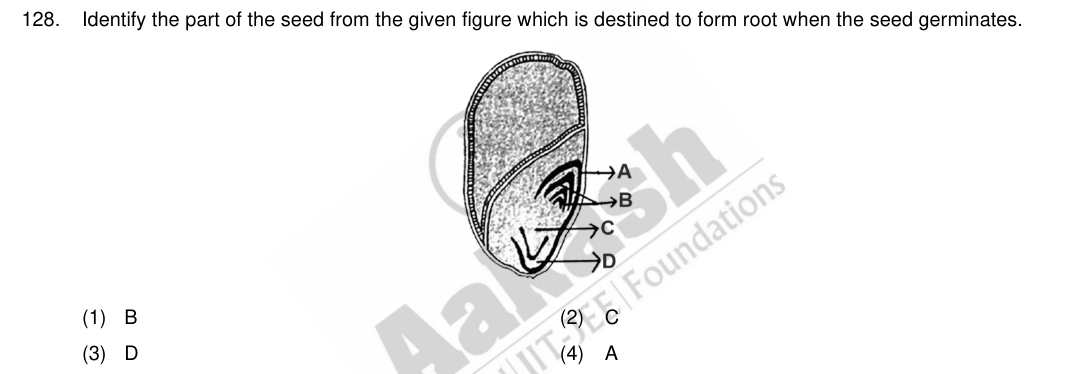
Q28openMorphology of Flowering Plants · Fruit and seed; families
Identify the part of the seed from the given figure which is destined to form the root when the seed germinates.
- A.B
- B.C✓
- C.D
- D.A
Solution
The embryo of the dicot seed consists of the embryonal axis with the plumule at one end and the radicle at the other. Label C marks the radicle, which grows out first at germination to form the root.
Q29openCell Cycle and Cell Division · Mitosis
Spindle fibres attach to the kinetochores of chromosomes during:
- A.Metaphase✓
- B.Anaphase
- C.Telophase
- D.Prophase
Solution
Spindle fibres attach to kinetochores during metaphase, when chromosomes align at the equatorial plate; they were assembled during prometaphase.
Q30openCell Cycle and Cell Division · Meiosis and its significance
Given below are two statements:
Statement I: Chromosomes become gradually visible under the light microscope during the leptotene stage.
Statement II: The beginning of the diplotene stage is recognised by the dissolution of the synaptonemal complex.
In the light of the above statements, choose the correct answer from the options given below:
- A.Both Statement I and Statement II are false
- B.Statement I is true but Statement II is false
- C.Statement I is false but Statement II is true
- D.Both Statement I and Statement II are true✓
Solution
Chromosomes first become visible as thin threads in leptotene (I true); diplotene begins with dissolution of the synaptonemal complex, leaving chiasmata (II true).
Q31openAnatomy of Flowering Plants · Tissues and tissue systems
Given below are two statements:
Statement I: Parenchyma is living but collenchyma is dead tissue.
Statement II: Gymnosperms lack xylem vessels but the presence of xylem vessels is characteristic of angiosperms.
In the light of the above statements, choose the correct answer from the options given below:
- A.Both Statement I and Statement II are false
- B.Statement I is true but Statement II is false
- C.Statement I is false but Statement II is true✓
- D.Both Statement I and Statement II are true
Solution
Collenchyma is a living tissue (Statement I false). Vessels are characteristic of angiosperms and absent from gymnosperms, whose xylem has only tracheids (Statement II true).
Q32openBiodiversity and Conservation · Loss of biodiversity and its conservation
These are regarded as major causes of biodiversity loss:
A. Over-exploitation · B. Co-extinction · C. Mutation · D. Habitat loss and fragmentation · E. Migration
Choose the correct option:
- A.A, B, C and D only
- B.A, B and E only
- C.A, B and D only✓
- D.A, C and D only
Solution
The 'Evil Quartet' of biodiversity loss is habitat loss and fragmentation, over-exploitation, alien species invasion and co-extinction. Mutation and migration are not causes. So A, B and D.
Q33openMolecular Basis of Inheritance · Gene regulation: lac operon; Human Genome Project, DNA fingerprinting
The lactose present in the growth medium of bacteria is transported into the cell by the action of:
- A.Acetylase
- B.Permease✓
- C.Polymerase
- D.Beta-galactosidase
Solution
Lactose enters E. coli through lac permease, the product of the y gene; β−galactosidase (z) then hydrolyses it inside the cell.
Q34openAnatomy of Flowering Plants · Anatomy of dicot and monocot root, stem, leaf
Bulliform cells are responsible for:
- A.Protecting the plant from salt stress.
- B.Increased photosynthesis in monocots.
- C.Providing large spaces for storage of sugars.
- D.Inward curling of leaves in monocots.✓
Solution
Bulliform (motor) cells in the upper epidermis of grass leaves lose turgor in dry conditions and make the leaf roll inward, reducing water loss.
Q35openBiomolecules · Enzymes: mechanism, factors, classification
The cofactor of the enzyme carboxypeptidase is:
- A.Niacin
- B.Flavin
- C.Haem
- D.Zinc✓
Solution
Carboxypeptidase requires zinc as its cofactor (a metal ion bound at the active site); niacin and flavin are coenzyme precursors, haem the prosthetic group of catalase and peroxidase.
Q36openPlant Kingdom · Algae
Read the following statements and choose the set of correct statements. In the members of Phaeophyceae:
A. Asexual reproduction occurs usually by biflagellate zoospores.
B. Sexual reproduction is by the oogamous method only.
C. Stored food is in the form of carbohydrates, which is either mannitol or laminarin.
D. The major pigments found are chlorophyll a, c and carotenoids and xanthophyll.
E. Vegetative cells have a cellulosic wall, usually covered on the outside by a gelatinous coating of algin.
Choose the correct answer from the options given below:
- A.B, C, D and E only
- B.A, C, D and E only✓
- C.A, B, C and E only
- D.A, B, C and D only
Solution
In Phaeophyceae (brown algae) asexual reproduction is by biflagellate zoospores (A); food is stored as mannitol or laminarin (C); pigments are chlorophyll a, c, carotenoids and xanthophyll (D); the wall is cellulose coated with algin (E). Sexual reproduction may be isogamous, anisogamous or oogamous, so B is false. Hence A, C, D and E.
Q37openBiodiversity and Conservation · Levels and patterns of biodiversity
Match List I with List II.
| List I | List II |
|---|---|
| A. Robert May | I. Species–area relationship |
| B. Alexander von Humboldt | II. Long-term ecosystem experiment using outdoor plots |
| C. Paul Ehrlich | III. Global species diversity at about 7 million |
| D. David Tilman | IV. Rivet popper hypothesis |
Choose the correct answer from the options given below:
- A.A-III, B-I, C-IV, D-II✓
- B.A-I, B-III, C-II, D-IV
- C.A-III, B-IV, C-II, D-I
- D.A-II, B-III, C-I, D-IV
Solution
Robert May estimated global species diversity at about 7 million (III); Humboldt described the species–area relationship (I); Ehrlich proposed the rivet-popper hypothesis (IV); Tilman ran long-term outdoor plot experiments (II).
Q38openPhotosynthesis in Higher Plants · Calvin cycle, C4 pathway, photorespiration
Given below are two statements:
Statement I: In C3 plants, some O2 binds to RuBisCO, hence CO2 fixation is decreased.
Statement II: In C4 plants, mesophyll cells show very little photorespiration while bundle sheath cells do not show photorespiration.
In the light of the above statements, choose the correct answer from the options given below:
- A.Both Statement I and Statement II are false
- B.Statement I is true but Statement II is false✓
- C.Statement I is false but Statement II is true
- D.Both Statement I and Statement II are true
Solution
In C3 plants RuBisCO's oxygenase activity binds O2 and lowers CO2 fixation — Statement I true. In C4 plants photorespiration is avoided because bundle-sheath cells (where RuBisCO sits) are kept CO2-rich; the statement's reversal of which cells photorespire is wrong — Statement II false.
Q39openCell: The Unit of Life · Mitochondria, plastids, ribosomes, cytoskeleton, nucleus
The DNA present in the chloroplast is:
- A.Circular, double-stranded✓
- B.Linear, single-stranded
- C.Circular, single-stranded
- D.Linear, double-stranded
Solution
Chloroplast DNA, like mitochondrial and bacterial DNA, is circular and double-stranded, without histones.
Q40openEcosystem · Energy flow, ecological pyramids
In an ecosystem, if the Net Primary Productivity (NPP) of the first trophic level is 100x (kcalm−2)yr−1, what would be the GPP (Gross Primary Productivity) of the third trophic level of the same ecosystem?
- A.x (kcalm−2)yr−1
- B.10x (kcalm−2)yr−1✓
- C.3100x (kcalm−2)yr−1
- D.10x (kcalm−2)yr−1
Solution
By the 10% law each trophic level passes on about a tenth of its production. From a producer NPP of 100x, the second level takes in 10x. The official key marks 10x — it treats the third level's gross intake as the energy handed on by the level below it. (Applying the 10% step once more, the third level's own NPP would be x; that is not what was marked.)
Q41openPlant Growth and Development · Phases of growth and differentiation
Which of the following are fused in somatic hybridisation involving two varieties of plants?
- A.Somatic embryos
- B.Protoplasts✓
- C.Pollens
- D.Callus
Solution
Somatic hybridisation fuses protoplasts (cells stripped of their walls) from two different varieties or species, e.g. the pomato.
Q42openRespiration in Plants · Krebs cycle and electron transport chain
Match List I with List II.
| List I | List II |
|---|---|
| A. Citric acid cycle | I. Cytoplasm |
| B. Glycolysis | II. Mitochondrial matrix |
| C. Electron transport system | III. Intermembrane space of mitochondria |
| D. Proton gradient | IV. Inner mitochondrial membrane |
Choose the correct answer from the options given below:
- A.A-II, B-I, C-IV, D-III✓
- B.A-III, B-IV, C-I, D-II
- C.A-IV, B-III, C-II, D-I
- D.A-I, B-II, C-III, D-IV
Solution
The citric acid cycle runs in the mitochondrial matrix (II); glycolysis in the cytoplasm (I); the electron transport system sits in the inner membrane (IV); protons are pumped into the intermembrane space to build the gradient (III).
Q43openMolecular Basis of Inheritance · DNA structure and replication
Match List I with List II.
| List I | List II |
|---|---|
| A. Frederick Griffith | I. Genetic code |
| B. François Jacob & Jacques Monod | II. Semi-conservative mode of DNA replication |
| C. Har Gobind Khorana | III. Transformation |
| D. Meselson & Stahl | IV. Lac operon |
Choose the correct answer from the options given below:
- A.A-III, B-IV, C-I, D-II✓
- B.A-II, B-III, C-IV, D-I
- C.A-IV, B-I, C-II, D-III
- D.A-III, B-II, C-I, D-IV
Solution
Griffith showed transformation (III); Jacob and Monod described the lac operon (IV); Khorana helped decipher the genetic code (I); Meselson and Stahl proved semi-conservative replication (II).
Q44openMorphology of Flowering Plants · Inflorescence, flower and floral formula
Match List I with List II.
| List I (Type of stamens) | List II (Example) |
|---|---|
| A. Monoadelphous | I. Citrus |
| B. Diadelphous | II. Pea |
| C. Polyadelphous | III. Lily |
| D. Epiphyllous | IV. China rose |
Choose the correct answer from the options given below:
- A.A-IV, B-I, C-II, D-III
- B.A-I, B-II, C-IV, D-III
- C.A-III, B-I, C-IV, D-II
- D.A-IV, B-II, C-I, D-III✓
Solution
China rose has monoadelphous stamens (one bundle, IV); pea diadelphous (two bundles, II); Citrus polyadelphous (many bundles, I); lily's stamens are epiphyllous, attached to the perianth (III).
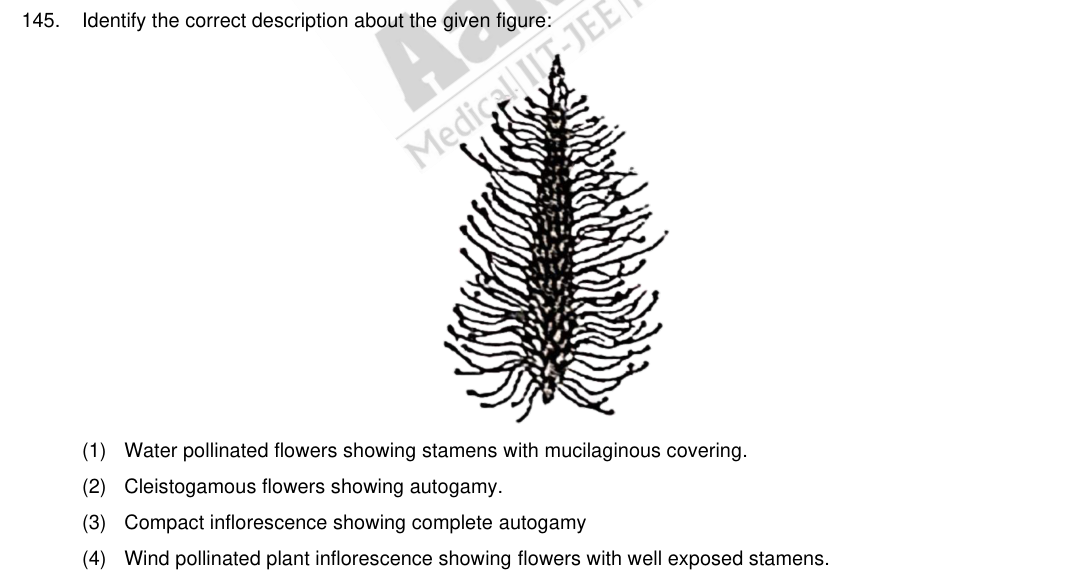
Q45openSexual Reproduction in Flowering Plants · Pollination and double fertilisation
Identify the correct description of the given figure:
- A.Water-pollinated flowers showing stamens with mucilaginous covering.
- B.Cleistogamous flowers showing autogamy.
- C.Compact inflorescence showing complete autogamy.
- D.Wind-pollinated plant inflorescence showing flowers with well-exposed stamens.✓
Solution
The figure shows a grass inflorescence with long, dangling stamens hanging well out of the florets — an adaptation of wind-pollinated flowers, which expose stamens and feathery stigmas to the air. Water-pollinated stamens have a mucilaginous coat, and cleistogamous flowers never open.
Q46openBiomolecules · Carbohydrates, lipids, amino acids and proteins
Match List I with List II.
| List I | List II |
|---|---|
| A. GLUT-4 | I. Hormone |
| B. Insulin | II. Enzyme |
| C. Trypsin | III. Intercellular ground substance |
| D. Collagen | IV. Enables glucose transport into cells |
Choose the correct answer from the options given below:
- A.A-I, B-II, C-III, D-IV
- B.A-II, B-III, C-IV, D-I
- C.A-III, B-IV, C-I, D-II
- D.A-IV, B-I, C-II, D-III✓
Solution
GLUT-4 transports glucose into cells (IV); insulin is a hormone (I); trypsin an enzyme (II); collagen the intercellular ground substance of connective tissue (III).
Q47openRespiration in Plants · Krebs cycle and electron transport chain
Identify the step in the tricarboxylic acid cycle which does not involve oxidation of the substrate:
- A.Succinic acid → Malic acid
- B.Succinyl-CoA → Succinic acid✓
- C.Isocitrate →α−ketoglutaric acid
- D.Malic acid → Oxaloacetic acid
Solution
Succinyl-CoA → succinic acid is a substrate-level phosphorylation that releases CoA and makes GTP; no hydrogen is removed. The other three steps are dehydrogenations (oxidations).
Q48openPlant Growth and Development · Plant growth regulators: auxin, gibberellin, cytokinin, ethylene, ABA
Spraying a sugarcane crop with which of the following plant growth regulators increases the length of the stem, thus increasing the yield?
- A.Gibberellin✓
- B.Cytokinin
- C.Abscisic acid
- D.Auxin
Solution
Gibberellin sprayed on sugarcane increases internode length, so the stem — where sugar is stored — grows longer and yield rises.
Q49openMorphology of Flowering Plants · Inflorescence, flower and floral formula
Match List I with List II.
| List I | List II |
|---|---|
| A. Rose | I. Twisted aestivation |
| B. Pea | II. Perigynous flower |
| C. Cotton | III. Drupe |
| D. Mango | IV. Marginal placentation |
Choose the correct answer from the options given below:
- A.A-I, B-II, C-III, D-IV
- B.A-IV, B-III, C-II, D-I
- C.A-II, B-III, C-IV, D-I
- D.A-II, B-IV, C-I, D-III✓
Solution
Rose has a perigynous flower (II); pea shows marginal placentation (IV); cotton has twisted aestivation (I); mango is a drupe (III).
Q50openMolecular Basis of Inheritance · DNA structure and replication
Which of the following statements is correct regarding the process of replication in E. coli?
- A.The DNA-dependent RNA polymerase catalyses polymerisation in one direction, that is 5′ → 3′
- B.The DNA-dependent DNA polymerase catalyses polymerisation in the 5′ → 3′ as well as the 3′ → 5′ direction
- C.The DNA-dependent DNA polymerase catalyses polymerisation in the 5′ → 3′ direction✓
- D.The DNA-dependent DNA polymerase catalyses polymerisation in one direction, that is 3′ → 5′
Solution
DNA-dependent DNA polymerase adds nucleotides only in the 5′→3′ direction — on the leading strand continuously and on the lagging strand as Okazaki fragments. The 3′→5′ direction is never synthesised.