Skip to content

NEET 2024Physics

All 50 Physics questions we hold from this paper, of the 200 on the site for this sitting — every option and the answer key. 4 marks each, −1 for a wrong answer.

Physics

45 questions, one correct option each. +4 for a correct answer, −1 for a wrong one, nothing for a blank.

Q1openSystem of Particles and Rotational Motion · Rolling motion and rotational kinetic energy

A wheel of a bullock cart is rolling on a level road as shown in the figure below. If its linear speed is in the direction shown, which one of the following options is correct ( and are any highest and lowest points on the wheel, respectively)?
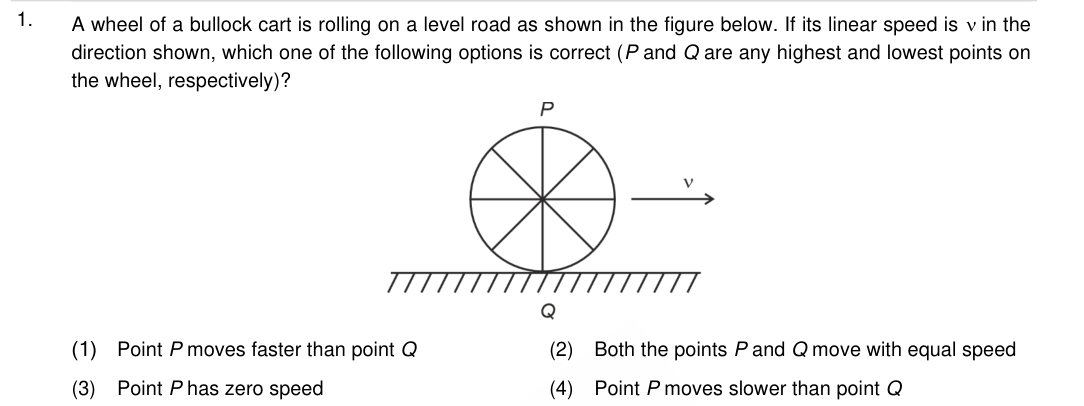
Question 1 as printed in the NEET 2024 booklet

  1. A.Point P moves faster than point Q
  2. B.Both the points P and Q move with equal speed
  3. C.Point P has zero speed
  4. D.Point P moves slower than point Q

Solution

For a wheel rolling without slipping, the point of contact Q is momentarily at rest and the topmost point P moves at . So P moves faster than Q.

Save for spaced revision (free account)

Q2openAtoms · Hydrogen spectrum and energy levels

Match List I with List II.

List I (Spectral lines of hydrogen for transitions from)List II (Wavelength, nm)
A. to I. 410.2
B. to II. 434.1
C. to III. 656.3
D. to IV. 486.1

Choose the correct answer from the options given below:

  1. A.A-III, B-IV, C-II, D-I
  2. B.A-IV, B-III, C-I, D-II
  3. C.A-I, B-II, C-III, D-IV
  4. D.A-II, B-I, C-IV, D-III

Solution

Balmer wavelengths follow : the smallest jump () gives the longest wavelength, 656.3 nm , then 486.1, 434.1 and 410.2 nm as rises. Hence A-III, B-IV, C-II, D-I.

Save for spaced revision (free account)

Q3openThermodynamics · First law, work and internal energy

A thermodynamic system is taken through the cycle shown in the diagram. The work done by the gas along the path is:
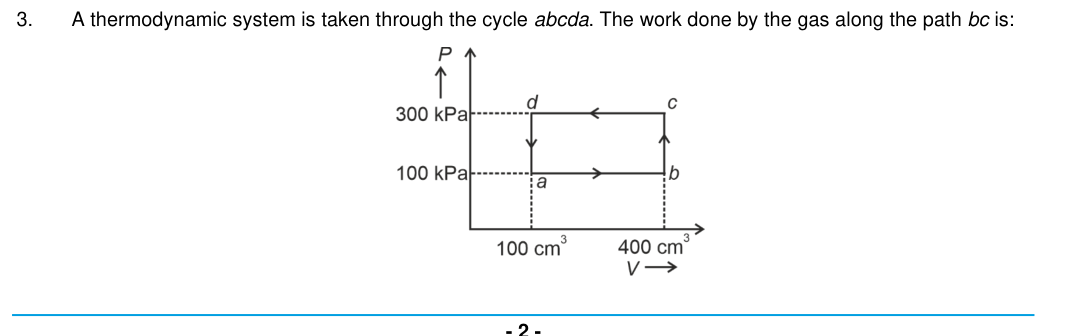
Question 3 as printed in the NEET 2024 booklet

  1. A.30 J
  2. B.–90 J
  3. C.–60 J
  4. D.Zero

Solution

Path runs vertically on the diagram: the volume stays at 400 cm while the pressure rises. With , the work done by the gas is zero.

Save for spaced revision (free account)

Q4openCurrent Electricity · Cells, EMF, internal resistance, combinations

The terminal voltage of a battery whose emf is 10 V and internal resistance , when connected through an external resistance of , is:

  1. A.6 V
  2. B.8 V
  3. C.10 V
  4. D.4 V

Solution

Current A. Terminal voltage V.

Save for spaced revision (free account)

Q5openAlternating Current · Transformers

In an ideal transformer, the turns ratio is . The ratio is equal to (the symbols carry their usual meaning):

  1. A.2 : 1
  2. B.1 : 1
  3. C.1 : 4
  4. D.1 : 2

Solution

For an ideal transformer . With , , i.e. .

Save for spaced revision (free account)

Q6openRay Optics and Optical Instruments · Total internal reflection and prisms

A light ray enters through a right-angled prism at point with the angle of incidence as shown in the figure. It travels through the prism parallel to its base and emerges along the face . The refractive index of the prism is:
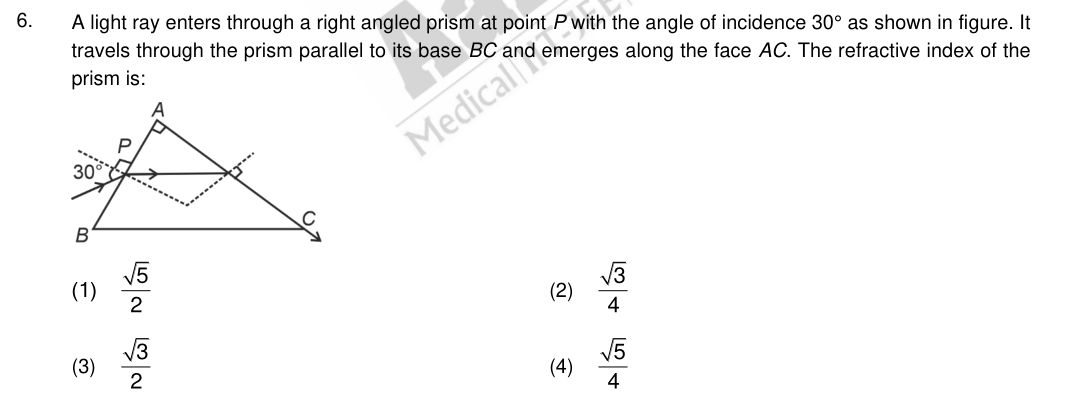
Question 6 as printed in the NEET 2024 booklet

  1. A.
  2. B.
  3. C.
  4. D.

Solution

Let the prism angles at B and C be and with . The ray inside is parallel to BC, so its angle of refraction at AB is and its angle of incidence at AC is . Emerging along AC means is the critical angle: . At P, , so . Squaring and adding: .

Save for spaced revision (free account)

Q7openUnits and Measurements · SI units, dimensions and dimensional analysis

The quantities which have the same dimensions as those of solid angle are:

  1. A.stress and angle
  2. B.strain and arc
  3. C.angular speed and stress
  4. D.strain and angle

Solution

Solid angle is a ratio of area to (length — dimensionless. Strain (length/length) and plane angle (arc/radius) are the two dimensionless quantities listed; stress has dimensions of pressure.

Save for spaced revision (free account)

Q8openMechanical Properties of Fluids · Surface tension, capillarity, excess pressure

A thin flat circular disc of radius 4.5 cm is placed gently over the surface of water. If the surface tension of water is , then the excess force required to take it away from the surface is:

  1. A.198 N
  2. B.1.98 mN
  3. C.99 N
  4. D.19.8 mN

Solution

A disc lifted off a liquid surface is held by surface tension along its full circumference: N mN.

Save for spaced revision (free account)

Q9openElectrostatic Potential and Capacitance · Potential and potential energy of charges and dipoles

Given below are two statements: one is labelled as Assertion A and the other is labelled as Reason R.

Assertion A: The potential at any axial point, at 2 m distance from the centre of a dipole of dipole moment of magnitude C m, is V. (Take SI units.)

Reason R: , where is the distance of any axial point, situated at 2 m from the centre of the dipole.

In the light of the above statements, choose the correct answer from the options given below:

  1. A.Both A and R are true and R is NOT the correct explanation of A.
  2. B.A is true but R is false.
  3. C.A is false but R is true.
  4. D.Both A and R are true and R is the correct explanation of A.

Solution

Axial potential of a dipole is , not (the factor 2 belongs to the axial field). Numerically V, so A is true but R is false.

Save for spaced revision (free account)

Q10openMagnetism and Matter · Bar magnet and magnetic field lines

In a uniform magnetic field of 0.049 T, a magnetic needle performs 20 complete oscillations in 5 seconds. The moment of inertia of the needle is . If the magnitude of the magnetic moment of the needle is , then the value of is:

  1. A.
  2. B.
  3. C.
  4. D.

Solution

Oscillation period s. For a magnetic needle, , so . Hence .

Save for spaced revision (free account)

Q11openWave Optics · Interference and Young's double slit

If the monochromatic source in Young's double slit experiment is replaced by white light, then:

  1. A.There will be a central dark fringe surrounded by a few coloured fringes
  2. B.There will be a central bright white fringe surrounded by a few coloured fringes
  3. C.All bright fringes will be of equal width
  4. D.Interference pattern will disappear

Solution

With white light every wavelength produces a bright fringe at the centre (zero path difference), so the central fringe is white; on either side the different colours spread at different fringe widths and only a few coloured fringes are seen before they wash out.

Save for spaced revision (free account)

Q12openAtoms · Rutherford and Bohr models

Given below are two statements:

Statement I: Atoms are electrically neutral as they contain equal number of positive and negative charges.

Statement II: Atoms of each element are stable and emit their characteristic spectrum.

In the light of the above statements, choose the most appropriate answer from the options given below:

  1. A.Both Statement I and Statement II are incorrect
  2. B.Statement I is correct but Statement II is incorrect
  3. C.Statement I is incorrect but Statement II is correct
  4. D.Both Statement I and Statement II are correct

Solution

Atoms are neutral because they carry equal positive and negative charge — Statement I is correct. Atoms emit their characteristic spectrum only when excited, not simply because they are stable — Statement II is incorrect.

Save for spaced revision (free account)

Q13openMechanical Properties of Solids · Young's, bulk and shear moduli; Poisson's ratio

The maximum elongation of a steel wire of 1 m length, if the elastic limit of steel and its Young's modulus are respectively and , is:

  1. A.0.4 mm
  2. B.40 mm
  3. C.8 mm
  4. D.4 mm

Solution

At the elastic limit, strain . Elongation m mm.

Save for spaced revision (free account)

Q14openSemiconductor Electronics · p-n junction diode, rectifiers, Zener diode

Consider the following statements A and B and identify the correct answer (refer to the given graph):

A. For a solar cell, the characteristic lies in the IV quadrant of the given graph.

B. In a reverse-biased p-n junction diode, the current measured (in A) is due to majority charge carriers.
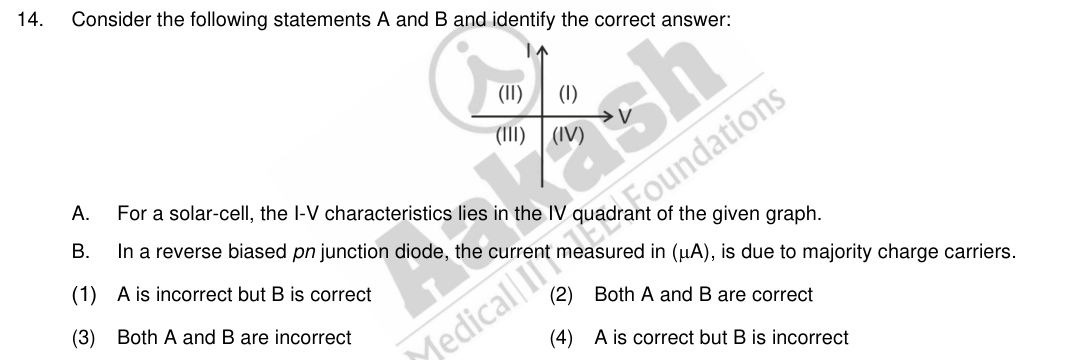
Question 14 as printed in the NEET 2024 booklet

  1. A.A is incorrect but B is correct
  2. B.Both A and B are correct
  3. C.Both A and B are incorrect
  4. D.A is correct but B is incorrect

Solution

A solar cell's curve lies in the fourth quadrant (it delivers power, so and have opposite signs) — A is correct. Reverse current in a p-n junction is carried by minority carriers — B is incorrect.

Save for spaced revision (free account)

Q15openMotion in a Plane · Uniform circular motion and relative velocity

A particle moving with uniform speed in a circular path maintains:

  1. A.Constant acceleration
  2. B.Constant velocity but varying acceleration
  3. C.Varying velocity and varying acceleration
  4. D.Constant velocity

Solution

In uniform circular motion the speed is constant but the direction of velocity keeps changing, so velocity varies; the centripetal acceleration has constant magnitude but continuously changing direction, so acceleration varies too.

Save for spaced revision (free account)

Q16openDual Nature of Radiation and Matter · Photoelectric effect and Einstein's equation

If is the velocity of light in free space, the correct statements about a photon among the following are:

A. The energy of a photon is .

B. The velocity of a photon is .

C. The momentum of a photon is .

D. In a photon–electron collision, both total energy and total momentum are conserved.

E. A photon possesses positive charge.

Choose the correct answer from the options given below:

  1. A.A, B, C and D only
  2. B.A, C and D only
  3. C.A, B, D and E only
  4. D.A and B only

Solution

A photon has energy , moves at , carries momentum , and photon–electron collisions conserve both energy and momentum. A photon is uncharged, so E is false. Hence A, B, C and D only.

Save for spaced revision (free account)

Q17openWork, Energy and Power · Collisions: elastic and inelastic

Two bodies A and B of the same mass undergo a completely inelastic one-dimensional collision. Body A moves with velocity while body B is at rest before the collision. The velocity of the system after the collision is . The ratio is:

  1. A.2 : 1
  2. B.4 : 1
  3. C.1 : 4
  4. D.1 : 2

Solution

Momentum conservation for a perfectly inelastic collision: .

Save for spaced revision (free account)

Q18openDual Nature of Radiation and Matter · Matter waves and de Broglie wavelength

The graph which shows the variation of with the kinetic energy of a free particle (where is its de Broglie wavelength) is:
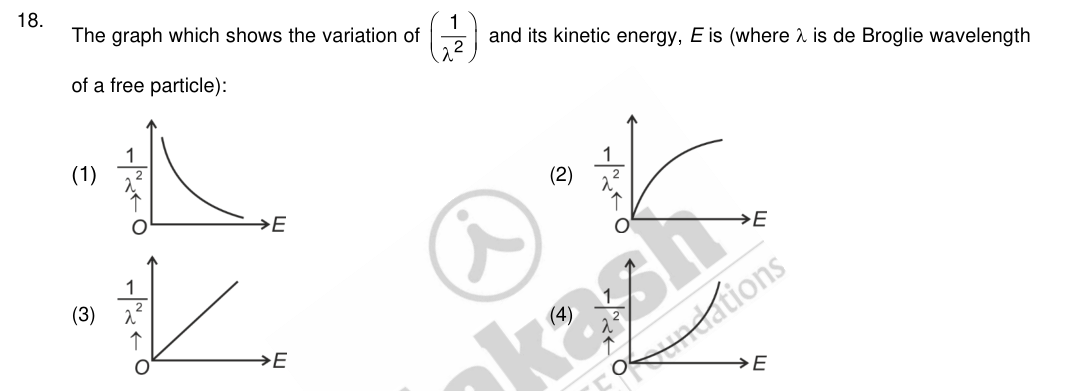
Question 18 as printed in the NEET 2024 booklet

  1. A.Graph (1)
  2. B.Graph (2)
  3. C.Graph (3)
  4. D.Graph (4)

Solution

, which is directly proportional to : a straight line through the origin.

Save for spaced revision (free account)

Q19openWave Optics · Diffraction and polarisation

An unpolarised light beam strikes a glass surface at Brewster's angle. Then:

  1. A.The refracted light will be completely polarised.
  2. B.Both the reflected and refracted light will be completely polarised.
  3. C.The reflected light will be completely polarised but the refracted light will be partially polarised.
  4. D.The reflected light will be partially polarised.

Solution

At Brewster's angle the reflected light is completely plane-polarised (electric vector perpendicular to the plane of incidence), while the refracted beam contains both components and is only partially polarised.

Save for spaced revision (free account)

Q20openWork, Energy and Power · Power and vertical circular motion

At any instant of time , the displacement of a particle is given by (SI units) under the influence of a force of 5 N. The value of the instantaneous power is (in SI units):

  1. A.5
  2. B.7
  3. C.6
  4. D.10

Solution

Velocity m/s (constant). Instantaneous power W.

Save for spaced revision (free account)

Q21openMoving Charges and Magnetism · Biot–Savart and Ampère's laws

A tightly wound 100-turn coil of radius 10 cm carries a current of 7 A. The magnitude of the magnetic field at the centre of the coil is (take the permeability of free space as SI units):

  1. A.4.4 T
  2. B.4.4 mT
  3. C.44 T
  4. D.44 mT

Solution

T mT.

Save for spaced revision (free account)

Q22openSystem of Particles and Rotational Motion · Moment of inertia, theorems of axes

The moment of inertia of a thin rod about an axis passing through its midpoint and perpendicular to the rod is . The length of the 400 g rod is nearly:

  1. A.17.5 cm
  2. B.20.7 cm
  3. C.72.0 cm
  4. D.8.5 cm

Solution

cm.

Save for spaced revision (free account)

Q23openLaws of Motion · Circular motion dynamics, banking of roads

A bob is whirled in a horizontal plane by means of a string with an initial speed of rpm. The tension in the string is . If the speed becomes while keeping the same radius, the tension in the string becomes:

  1. A.
  2. B.
  3. C.
  4. D.

Solution

Tension supplies the centripetal force, . Doubling the angular speed at the same radius quadruples it: .

Save for spaced revision (free account)

Q24openMagnetism and Matter · Dia-, para- and ferromagnetism

Match List I with List II.

List I (Material)List II (Susceptibility )
A. DiamagneticI.
B. FerromagneticII.
C. ParamagneticIII.
D. Non-magneticIV. (a small positive number)

Choose the correct answer from the options given below:

  1. A.A-II, B-I, C-III, D-IV
  2. B.A-III, B-II, C-I, D-IV
  3. C.A-IV, B-III, C-II, D-I
  4. D.A-II, B-III, C-IV, D-I

Solution

Diamagnetic: small negative susceptibility, (II). Ferromagnetic: (III). Paramagnetic: small positive, (IV). Non-magnetic: (I).

Save for spaced revision (free account)

Q25openElectrostatic Potential and Capacitance · Capacitors: series, parallel, energy stored

In the following circuit, the equivalent capacitance between terminal A and terminal B is:
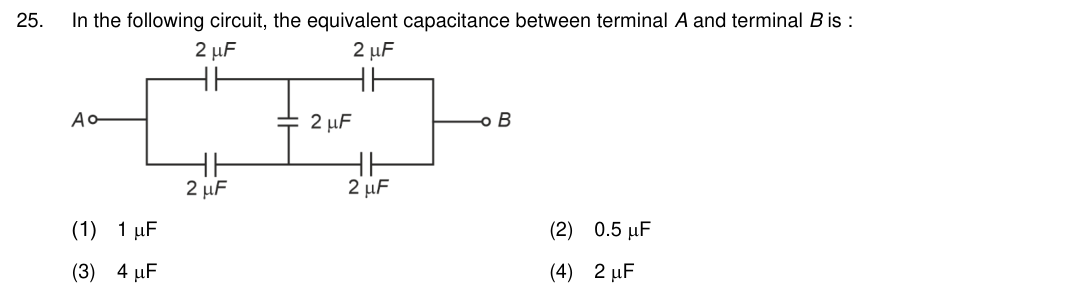
Question 25 as printed in the NEET 2024 booklet

  1. A.
  2. B.
  3. C.
  4. D.

Solution

The upper and lower branches each have two capacitors in series, so the midpoints of both sit at the same potential; the central carries no charge and can be removed. Each branch is , and the two in parallel give .

Save for spaced revision (free account)

Q26openLaws of Motion · Connected bodies, pulleys and pseudo forces

A horizontal force of 10 N is applied to a block A, which is in contact with a block B on the side away from the force. The masses of blocks A and B are 2 kg and 3 kg respectively. The blocks slide over a frictionless surface. The force exerted by block A on block B is:

  1. A.4 N
  2. B.6 N
  3. C.10 N
  4. D.Zero

Solution

Both blocks share acceleration . The only horizontal force on B is the push from A: N.

Save for spaced revision (free account)

Q27openNuclei · Radioactivity and decay law

In the nuclear emission stated above, the mass number and atomic number of the product , respectively, are:

  1. A.286, 80
  2. B.288, 82
  3. C.286, 81
  4. D.280, 81

Solution

An emission lowers by 4 and by 2: . Each emission leaves unchanged; a positron lowers by 1 and an electron raises it by 1. Net over : . So is .

Save for spaced revision (free account)

Q28openUnits and Measurements · Measuring instruments: vernier, screw gauge

In a vernier callipers, divisions of the vernier scale coincide with divisions of the main scale. If 1 MSD represents 0.1 mm, the vernier constant (in cm) is:

  1. A.
  2. B.
  3. C.
  4. D.

Solution

VSD MSD, so 1 VSD MSD. Vernier constant 1 MSD 1 VSD MSD mm cm.

Save for spaced revision (free account)

Q29openOscillations · Simple harmonic motion: equations, energy

If m represents the motion of a particle executing simple harmonic motion, the amplitude and time period of the motion, respectively, are:

  1. A.5 m, 2 s
  2. B.5 cm, 1 s
  3. C.5 m, 1 s
  4. D.5 cm, 2 s

Solution

Comparing with : amplitude m and rad/s, so s.

Save for spaced revision (free account)

Q30openElectromagnetic Induction · Faraday's and Lenz's laws

In the given diagram, a strong bar magnet is moving towards solenoid-2 from solenoid-1. The direction of the induced current in solenoid-1 and that in solenoid-2, respectively, are through the directions:
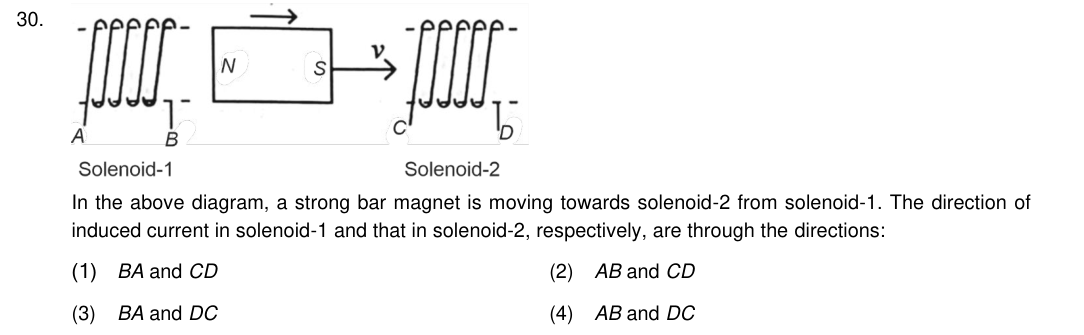
Question 30 as printed in the NEET 2024 booklet

  1. A.BA and CD
  2. B.AB and CD
  3. C.BA and DC
  4. D.AB and DC

Solution

By Lenz's law each solenoid opposes the motion. Solenoid-1 sees the magnet's N pole receding, so its near end (B) becomes an S pole to attract it; solenoid-2 sees the S pole approaching, so its near end (C) becomes an S pole to repel it. Tracing the winding sense that produces those poles gives current directions AB in solenoid-1 and DC in solenoid-2.

Save for spaced revision (free account)

Q31openSemiconductor Electronics · Logic gates

A logic circuit provides the output as per the following truth table:

ABY
001
010
101
110

The expression for the output is:

  1. A.
  2. B.
  3. C.
  4. D.

Solution

The output is 1 exactly when , regardless of — the table is that of .

Save for spaced revision (free account)

Q32openCurrent Electricity · Ohm's law, resistivity, temperature dependence

A wire of length and resistance is divided into 10 equal parts. The first 5 parts are connected in series while the next 5 parts are connected in parallel. The two combinations are again connected in series. The resistance of this final combination is:

  1. A.
  2. B.
  3. C.
  4. D.

Solution

Each part is . Five in series give ; five in parallel give ; the two groups in series give .

Save for spaced revision (free account)

Q33openSemiconductor Electronics · Logic gates

The output () of the given logic gate circuit is similar to the output of a/an:
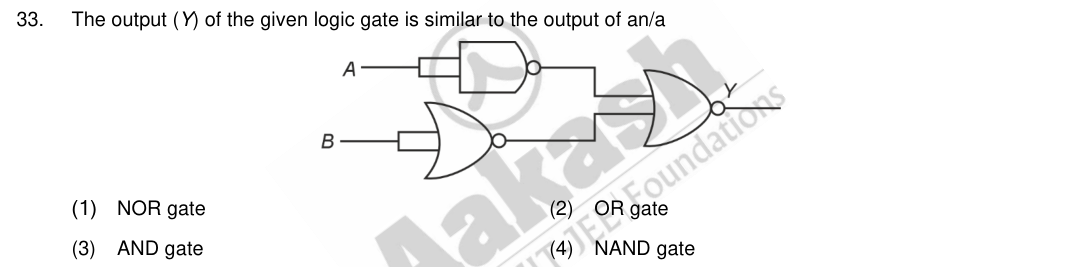
Question 33 as printed in the NEET 2024 booklet

  1. A.NOR gate
  2. B.OR gate
  3. C.AND gate
  4. D.NAND gate

Solution

The upper gate has both inputs tied to A, so it outputs ; the lower NOR with both inputs B outputs . The final NOR gives — an AND gate.

Save for spaced revision (free account)

Q34openElectrostatic Potential and Capacitance · Conductors and dielectrics

A thin spherical shell is charged by some source. The potential difference between the two points C and P (in V) shown in the figure is: (Take SI units.)
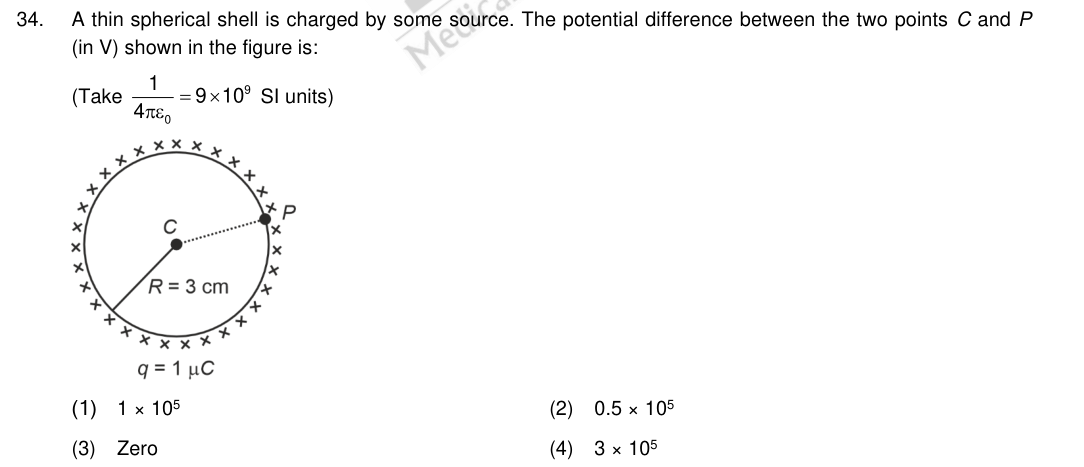
Question 34 as printed in the NEET 2024 booklet

  1. A.
  2. B.
  3. C.Zero
  4. D.

Solution

Inside a charged spherical shell the field is zero, so the potential is the same at every interior point (and equal to the surface value). The potential difference between C and P is zero.

Save for spaced revision (free account)

Q35openGravitation · Newton's law of gravitation, g and its variation

The mass of a planet is th that of the earth and its diameter is half that of the earth. The acceleration due to gravity on that planet is:

  1. A.9.8 m s⁻
  2. B.4.9 m s⁻
  3. C.3.92 m s⁻
  4. D.19.6 m s⁻

Solution

. With and : .

Save for spaced revision (free account)

Q36openGravitation · Kepler's laws, satellites, escape velocity

The minimum energy required to launch a satellite of mass from the surface of the earth (mass , radius ) into a circular orbit at an altitude of from the surface of the earth is:

  1. A.
  2. B.
  3. C.
  4. D.

Solution

Orbit radius . Energy in orbit ; on the surface . Minimum energy .

Save for spaced revision (free account)

Q37openRay Optics and Optical Instruments · Optical instruments: microscope and telescope

A small telescope has an objective of focal length 140 cm and an eyepiece of focal length 5.0 cm. The magnifying power of the telescope for viewing a distant object is:

  1. A.28
  2. B.17
  3. C.32
  4. D.34

Solution

For a distant object, .

Save for spaced revision (free account)

Q38openMotion in a Straight Line · Displacement, velocity, acceleration; graphs

The velocity ()–time () plot of the motion of a body is shown below. The acceleration ()–time () graph that best suits this motion is:
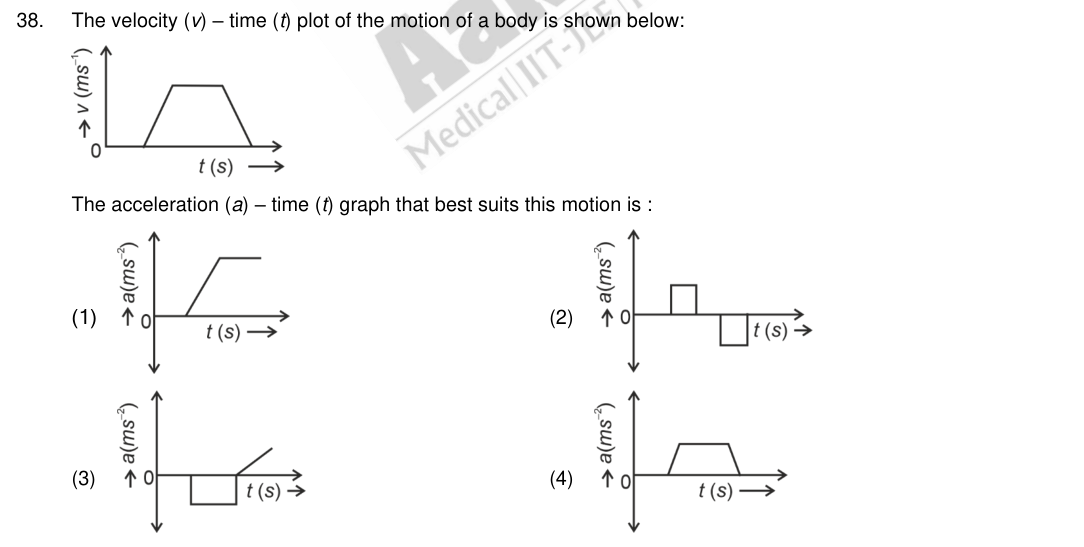
Question 38 as printed in the NEET 2024 booklet

  1. A.Graph (1)
  2. B.Graph (2)
  3. C.Graph (3)
  4. D.Graph (4)

Solution

The velocity rises linearly (constant positive acceleration), stays constant (zero acceleration), then falls linearly (constant negative acceleration). The graph is therefore a positive rectangle, zero, then a negative rectangle — graph (2).

Save for spaced revision (free account)

Q39openCurrent Electricity · Cells, EMF, internal resistance, combinations

Two heaters A and B have power ratings of 1 kW and 2 kW, respectively. The two are first connected in series and then in parallel to a fixed power source. The ratio of power outputs for these two cases is:

  1. A.2 : 9
  2. B.1 : 2
  3. C.2 : 3
  4. D.1 : 1

Solution

Series: kW. Parallel: kW. Ratio .

Save for spaced revision (free account)

Q40openUnits and Measurements · SI units, dimensions and dimensional analysis

A force defined by acts on a particle at a given time . The factor which is dimensionless, if and are constants, is:

  1. A.
  2. B.
  3. C.
  4. D.

Solution

and both have the dimensions of force, so . Hence is dimensionless.

Save for spaced revision (free account)

Q41openAlternating Current · AC through R, L, C and LCR circuits

capacitor is connected to a 210 V, 50 Hz source. The peak current in the circuit is nearly (take ):

  1. A.0.93 A
  2. B.1.20 A
  3. C.0.35 A
  4. D.0.58 A

Solution

. Peak current A.

Save for spaced revision (free account)

Q42openThermal Properties of Matter · Thermal expansion and calorimetry

A metallic bar of Young's modulus and coefficient of linear thermal expansion , length 1 m and area of cross-section , is heated from C to C without expansion or bending. The compressive force developed in it is:

  1. A. N
  2. B. N
  3. C. N
  4. D. N

Solution

Thermal strain prevented . Force N N.

Save for spaced revision (free account)

Q43openElectromagnetic Waves · Displacement current and Maxwell's equations (qualitative)

A parallel plate capacitor is charged by connecting it to a battery through a resistor. If is the current in the circuit, then in the gap between the plates:

  1. A.Displacement current of magnitude equal to flows in the same direction as
  2. B.Displacement current of magnitude equal to flows in a direction opposite to that of
  3. C.Displacement current of magnitude greater than flows but can be in any direction
  4. D.There is no current

Solution

Between the plates the changing electric field constitutes a displacement current , equal in magnitude to the conduction current and in the same direction, so the current is continuous around the circuit.

Save for spaced revision (free account)

Q44openCurrent Electricity · Kirchhoff's rules, Wheatstone bridge, potentiometer

Choose the correct circuit (from the four given) which can achieve the bridge balance.
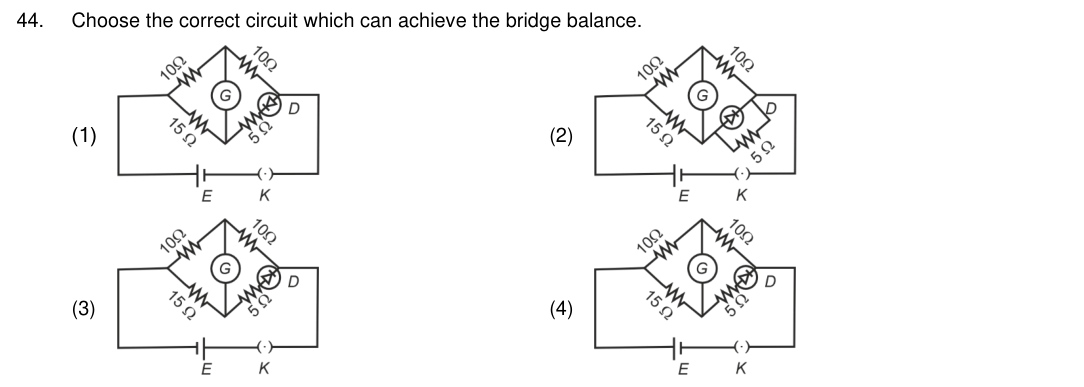
Question 44 as printed in the NEET 2024 booklet

  1. A.Circuit (1)
  2. B.Circuit (2)
  3. C.Circuit (3)
  4. D.Circuit (4)
Save for spaced revision (free account)

Q45openElectromagnetic Induction · Motional EMF and eddy currents

A sheet is placed on a horizontal surface in front of a strong magnetic pole. A force is needed to:

A. hold the sheet there if it is magnetic.

B. hold the sheet there if it is non-magnetic.

C. move the sheet away from the pole with uniform velocity if it is conducting.

D. move the sheet away from the pole with uniform velocity if it is both non-conducting and non-polar.

Choose the correct statement(s) from the options given below:

  1. A.A and C only
  2. B.A, C and D only
  3. C.C only
  4. D.B and D only

Solution

A magnetic sheet is attracted and needs a force to hold it (A). Moving a conductor away from a pole induces eddy currents that oppose the motion, so a force is needed to keep it moving uniformly (C). A non-magnetic sheet feels no force (B false); a non-conducting, non-polar sheet has no induced currents (D false).

Save for spaced revision (free account)

Q46openElectrostatic Potential and Capacitance · Capacitors: series, parallel, energy stored

If the plates of a parallel plate capacitor connected to a battery are moved closer to each other, then:

A. the charge stored in it increases.

B. the energy stored in it decreases.

C. its capacitance increases.

D. the ratio of charge to its potential remains the same.

E. the product of charge and voltage increases.

Choose the most appropriate answer from the options given below:

  1. A.A, C and E only
  2. B.B, D and E only
  3. C.A, B and C only
  4. D.A, B and E only

Solution

At constant (battery connected), rises as falls, so rises and rises; increases; increases. A, C and E are correct; B and D are false.

Save for spaced revision (free account)

Q47openKinetic Theory · Ideal gas equation and kinetic interpretation of pressure

The following graph represents the curves of an ideal gas (where is the temperature and the volume) at three pressures , and , compared with those of Charles's law represented as dotted lines. Then the correct relation is:
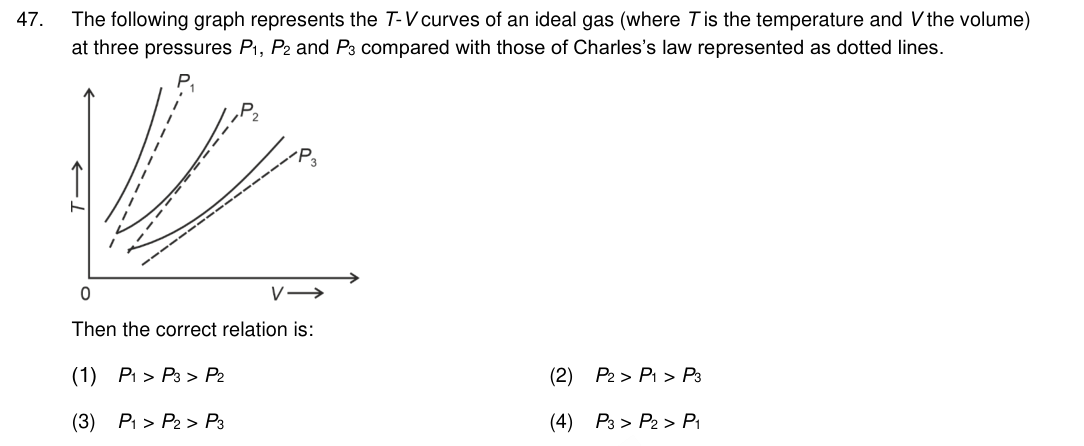
Question 47 as printed in the NEET 2024 booklet

  1. A.
  2. B.
  3. C.
  4. D.

Solution

For an ideal gas at fixed pressure, : the line through the origin has slope , so the steepest line corresponds to the lowest pressure. Reading the slopes in the figure gives .

Save for spaced revision (free account)

Q48openElectromagnetic Waves · Electromagnetic spectrum

The property which is not of an electromagnetic wave travelling in free space is that:

  1. A.The energy density in the electric field is equal to the energy density in the magnetic field
  2. B.They travel with a speed equal to
  3. C.They originate from charges moving with uniform speed
  4. D.They are transverse in nature

Solution

Electromagnetic waves are produced by accelerating charges; a charge moving with uniform velocity does not radiate. The other three statements are standard properties of EM waves in free space.

Save for spaced revision (free account)

Q49openMagnetism and Matter · Bar magnet and magnetic field lines

An iron bar of length has magnetic moment . It is bent at the middle of its length such that the two arms make an angle of with each other. The magnetic moment of this new magnet is:

  1. A.
  2. B.
  3. C.
  4. D.

Solution

Bending does not change the pole strength ; it changes the distance between the poles. The two end poles are now separated by the chord of two arms of length at : . So .

Save for spaced revision (free account)

Q50openOscillations · Spring–mass system and simple pendulum

If the mass of the bob in a simple pendulum is increased to thrice its original mass and its length is made half its original length, then the new time period of oscillation is times its original time period. Then the value of is:

  1. A.2
  2. B.
  3. C.4
  4. D.3

Solution

is independent of mass. Halving gives , so .

Save for spaced revision (free account)