Skip to content

NEET 2024Zoology

All 50 Zoology questions we hold from this paper, of the 200 on the site for this sitting — every option and the answer key. 4 marks each, −1 for a wrong answer.

Zoology

45 questions, one correct option each. +4 for a correct answer, −1 for a wrong one, nothing for a blank.

Q1openNeural Control and Coordination · Central nervous system

Match List I with List II.

List IList II
A. PonsI. Provides additional space for neurons, regulates posture and balance
B. HypothalamusII. Controls respiration and gastric secretions
C. MedullaIII. Connects different regions of the brain
D. CerebellumIV. Neurosecretory cells

Choose the correct answer from the options given below:
  1. A.A-III, B-IV, C-II, D-I
  2. B.A-I, B-III, C-II, D-IV
  3. C.A-II, B-I, C-III, D-IV
  4. D.A-II, B-III, C-I, D-IV

Solution

The pons connects different regions of the brain (III); the hypothalamus carries neurosecretory cells (IV); the medulla controls respiration and gastric secretions (II); the cerebellum regulates posture and balance (I).

Save for spaced revision (free account)

Q2openHuman Reproduction · Male and female reproductive systems

Which of the following is not a component of the Fallopian tube?

  1. A.Isthmus
  2. B.Infundibulum
  3. C.Ampulla
  4. D.Uterine fundus

Solution

The Fallopian tube consists of the infundibulum, ampulla and isthmus. The fundus is the dome-shaped upper part of the uterus, not the tube.

Save for spaced revision (free account)

Q3openBiotechnology: Principles and Processes · Tools of recombinant DNA technology

The 'Ti plasmid' of Agrobacterium tumefaciens stands for:

  1. A.Tumour independent plasmid
  2. B.Tumour inducing plasmid
  3. C.Temperature independent plasmid
  4. D.Tumour inhibiting plasmid

Solution

Ti stands for tumour-inducing: the plasmid of Agrobacterium tumefaciens that causes crown gall, disarmed and used as a vector for plant transformation.

Save for spaced revision (free account)

Q4openBreathing and Exchange of Gases · Respiratory organs and mechanism of breathing

Match List I with List II.

List IList II
A. Expiratory capacityI. Expiratory reserve volume + Tidal volume + Inspiratory reserve volume
B. Functional residual capacityII. Tidal volume + Expiratory reserve volume
C. Vital capacityIII. Tidal volume + Inspiratory reserve volume
D. Inspiratory capacityIV. Expiratory reserve volume + Residual volume

Choose the correct answer from the options given below:
  1. A.A-III, B-II, C-IV, D-I
  2. B.A-II, B-I, C-IV, D-III
  3. C.A-I, B-III, C-II, D-IV
  4. D.A-II, B-IV, C-I, D-III

Solution

Expiratory capacity (II); functional residual capacity (IV); vital capacity (I); inspiratory capacity (III).

Save for spaced revision (free account)

Q5openHuman Reproduction · Gametogenesis and menstrual cycle

Given below are two statements: one is labelled as Assertion A and the other is labelled as Reason R.

Assertion A: FSH acts upon ovarian follicles in the female and Leydig cells in the male.

Reason R: Growing ovarian follicles secrete oestrogen in the female while interstitial cells secrete androgen in the male human being.

In the light of the above statements, choose the correct answer from the options given below:

  1. A.Both A and R are true but R is NOT the correct explanation of A
  2. B.A is true but R is false
  3. C.A is false but R is true
  4. D.Both A and R are true and R is the correct explanation of A

Solution

FSH acts on ovarian follicles in females but on Sertoli cells in males; Leydig cells respond to LH — so A is false. Growing follicles do secrete oestrogen and interstitial (Leydig) cells do secrete androgens — R is true.

Save for spaced revision (free account)

Q6openBiomolecules · Enzymes: mechanism, factors, classification

Match List I with List II.

List IList II
A. LipaseI. Peptide bond
B. NucleaseII. Ester bond
C. ProteaseIII. Glycosidic bond
D. AmylaseIV. Phosphodiester bond

Choose the correct answer from the options given below:

  1. A.A-III, B-II, C-I, D-IV
  2. B.A-II, B-IV, C-I, D-III
  3. C.A-IV, B-I, C-III, D-II
  4. D.A-IV, B-II, C-III, D-I

Solution

Lipase breaks ester bonds (II); nucleases break phosphodiester bonds (IV); proteases break peptide bonds (I); amylase breaks glycosidic bonds (III).

Save for spaced revision (free account)

Q7openEvolution · Human evolution

Given below are some stages of human evolution. Arrange them in the correct sequence (past to recent):

A. Homo habilis · B. Homo sapiens · C. Homo neanderthalensis · D. Homo erectus

Choose the correct sequence of human evolution from the options given below:

  1. A.B-A-D-C
  2. B.C-B-D-A
  3. C.A-D-C-B
  4. D.D-A-C-B

Solution

Chronological order: Homo habilis (~2 mya) → Homo erectus (~1.5 mya) → Neanderthal man (~100,000 years ago) → Homo sapiens. So A-D-C-B.

Save for spaced revision (free account)

Q8openHuman Health and Disease · Immunity, vaccination, AIDS, cancer

Which of the following are autoimmune disorders?

A. Myasthenia gravis · B. Rheumatoid arthritis · C. Gout · D. Muscular dystrophy · E. Systemic lupus erythematosus (SLE)

Choose the most appropriate answer from the options given below:

  1. A.A, B & E only
  2. B.B, C & E only
  3. C.C, D & E only
  4. D.A, B & D only

Solution

Myasthenia gravis, rheumatoid arthritis and SLE are autoimmune disorders. Gout is a metabolic disorder (urate crystals); muscular dystrophy is genetic.

Save for spaced revision (free account)

Q9openHuman Health and Disease · Common diseases: pathogens and life cycles

Match List I with List II.

List IList II
A. Common coldI. Plasmodium
B. HaemozoinII. Typhoid
C. Widal testIII. Rhinoviruses
D. AllergyIV. Dust mites

Choose the correct answer from the options given below:

  1. A.A-I, B-III, C-II, D-IV
  2. B.A-III, B-I, C-II, D-IV
  3. C.A-IV, B-II, C-III, D-I
  4. D.A-II, B-IV, C-III, D-I

Solution

The common cold is caused by rhinoviruses (III); haemozoin is the toxin released by Plasmodium (I); the Widal test diagnoses typhoid (II); dust mites are a common allergen (IV).

Save for spaced revision (free account)

Q10openCell: The Unit of Life · Mitochondria, plastids, ribosomes, cytoskeleton, nucleus

Match List I with List II.

List IList II
A. AxonemeI. Centriole
B. Cartwheel patternII. Cilia and flagella
C. CristaIII. Chromosome
D. SatelliteIV. Mitochondria

Choose the correct answer from the options given below:

  1. A.A-IV, B-II, C-III, D-I
  2. B.A-II, B-IV, C-I, D-III
  3. C.A-II, B-I, C-IV, D-III
  4. D.A-IV, B-III, C-II, D-I

Solution

The axoneme is the core of cilia and flagella (II); the cartwheel pattern is the centriole's structure (I); cristae are the mitochondrial inner-membrane folds (IV); the satellite is a chromosome region beyond a secondary constriction (III).

Save for spaced revision (free account)

Q11openAnimal Kingdom · Non-chordates: Porifera to Echinodermata

Match List I with List II.

List IList II
A. PleurobrachiaI. Mollusca
B. RadulaII. Ctenophora
C. StomochordIII. Osteichthyes
D. Air bladderIV. Hemichordata

Choose the correct answer from the options given below:

  1. A.A-II, B-I, C-IV, D-III
  2. B.A-II, B-IV, C-I, D-III
  3. C.A-IV, B-III, C-II, D-I
  4. D.A-IV, B-II, C-III, D-I

Solution

Pleurobrachia is a ctenophore (II); the radula is the molluscan rasping organ (I); the stomochord is the buccal diverticulum of hemichordates (IV); the air bladder is found in bony fishes, Osteichthyes (III).

Save for spaced revision (free account)

Q12openStructural Organisation in Animals · Animal tissues

Three types of muscles are given as (a), (b) and (c). Identify the correct matching set along with their location in the human body:

  1. A.(a) Skeletal – Triceps; (b) Smooth – Stomach; (c) Cardiac – Heart
  2. B.(a) Skeletal – Biceps; (b) Involuntary – Intestine; (c) Smooth – Heart
  3. C.(a) Involuntary – Nose tip; (b) Skeletal – Bone; (c) Cardiac – Heart
  4. D.(a) Smooth – Toes; (b) Skeletal – Legs; (c) Cardiac – Heart

Solution

Skeletal muscle (voluntary) forms the triceps; smooth muscle lines the stomach; cardiac muscle is confined to the heart. The other sets misplace smooth muscle in the heart or skeletal muscle in bone.

Save for spaced revision (free account)

Q13openCell Cycle and Cell Division · Meiosis and its significance

Match List I with List II.

List I (Sub-phases of Prophase I)List II (Specific characters)
A. DiakinesisI. Synaptonemal complex formation
B. PachyteneII. Completion of terminalisation of chiasmata
C. ZygoteneIII. Chromosomes look like thin threads
D. LeptoteneIV. Appearance of recombination nodules

Choose the correct answer from the options given below:

  1. A.A-I, B-II, C-IV, D-III
  2. B.A-II, B-IV, C-I, D-III
  3. C.A-IV, B-III, C-II, D-I
  4. D.A-IV, B-II, C-III, D-I

Solution

Diakinesis: terminalisation of chiasmata (II). Pachytene: recombination nodules appear (IV). Zygotene: synaptonemal complex forms (I). Leptotene: chromosomes look like thin threads (III).

Save for spaced revision (free account)

Q14openPrinciples of Inheritance and Variation · Sex determination, mutation, genetic disorders

Match List I with List II.

List IList II
A. Down's syndromeI. 11th chromosome
ThalassemiaII. X chromosome
ThalassemiaIII. 21st chromosome
D. Klinefelter's syndromeIV. 16th chromosome

Choose the correct answer from the options given below:

  1. A.A-II, B-III, C-IV, D-I
  2. B.A-III, B-IV, C-I, D-II
  3. C.A-IV, B-I, C-II, D-III
  4. D.A-I, B-II, C-III, D-IV

Solution

Down's syndrome is trisomy 21 (III). The globin gene is on chromosome 11 (I) and the globin genes on chromosome 16 (IV). Klinefelter's syndrome involves an extra X chromosome (II).

Save for spaced revision (free account)

Q15openBiotechnology: Principles and Processes · Processes: cloning, PCR, bioreactors

Which of the following statements is incorrect?

  1. A.The most commonly used bioreactors are of the stirring type
  2. B.Bioreactors are used to produce small-scale bacterial cultures
  3. C.Bioreactors have an agitator system, an oxygen delivery system and a foam control system
  4. D.A bioreactor provides optimal growth conditions for achieving the desired product

Solution

Bioreactors are for large-scale production — hundreds to thousands of litres — not small cultures. The other three statements correctly describe a stirred-tank bioreactor.

Save for spaced revision (free account)

Q16openAnimal Kingdom · Chordates: Pisces to Mammalia

Match List I with List II.

List IList II
A. PterophyllumI. Hag fish
B. MyxineII. Saw fish
C. PristisIII. Angel fish
D. ExocoetusIV. Flying fish

Choose the correct answer from the options given below:

  1. A.A-III, B-I, C-II, D-IV
  2. B.A-IV, B-I, C-II, D-III
  3. C.A-III, B-II, C-I, D-IV
  4. D.A-II, B-I, C-III, D-IV

Solution

Pterophyllum is the angel fish (III); Myxine the hag fish (I); Pristis the saw fish (II); Exocoetus the flying fish (IV).

Save for spaced revision (free account)

Q17openBiotechnology: Principles and Processes · Tools of recombinant DNA technology

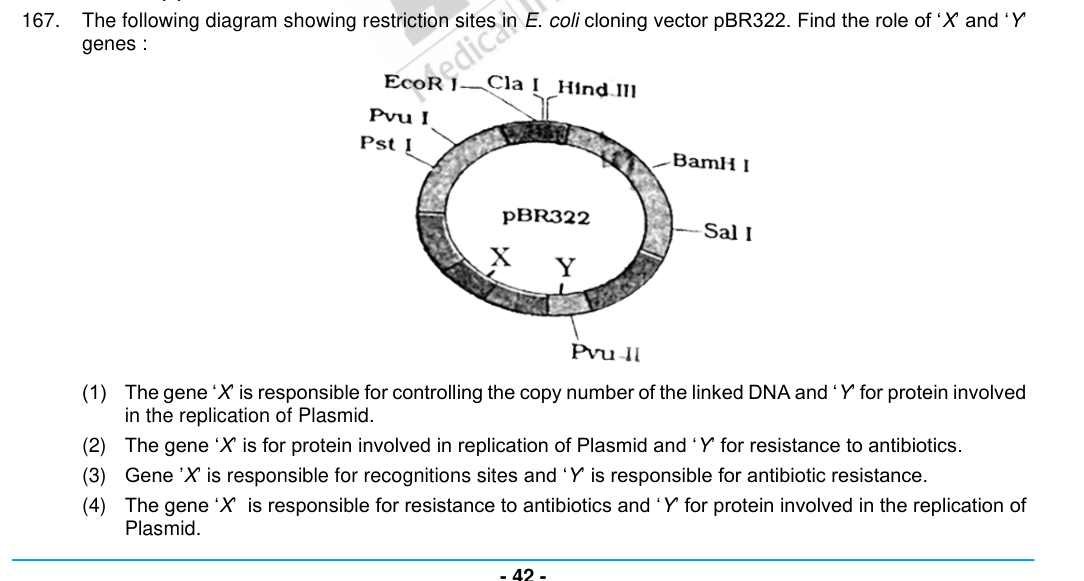
The following diagram shows the restriction sites in the E. coli cloning vector pBR322. Find the role of the 'X' and 'Y' genes:

Question 167 as printed in the NEET 2024 booklet

  1. A.Gene 'X' is responsible for controlling the copy number of the linked DNA and 'Y' for a protein involved in the replication of the plasmid.
  2. B.Gene 'X' is for a protein involved in the replication of the plasmid and 'Y' for resistance to antibiotics.
  3. C.Gene 'X' is responsible for recognition sites and 'Y' is responsible for antibiotic resistance.
  4. D.Gene 'X' is responsible for resistance to antibiotics and 'Y' for a protein involved in the replication of the plasmid.

Solution

In pBR322 the rop gene codes for proteins involved in plasmid replication, and ori controls copy number; the antibiotic-resistance genes are amp^R and tet^R. With X labelled at ori and Y at rop in the figure, X controls copy number and Y codes for a replication protein.

Save for spaced revision (free account)

Q18openHuman Reproduction · Male and female reproductive systems

Given below are two statements:

Statement I: The presence or absence of the hymen is not a reliable indicator of virginity.

Statement II: The hymen is torn during the first coitus only.

In the light of the above statements, choose the correct answer from the options given below:

  1. A.Both Statement I and Statement II are false
  2. B.Statement I is true but Statement II is false
  3. C.Statement I is false but Statement II is true
  4. D.Both Statement I and Statement II are true

Solution

The hymen can be torn by sport, a fall or tampon use, and may persist after coitus — so its presence or absence indicates nothing about virginity (Statement I true) and it is not torn 'during the first coitus only' (Statement II false).

Save for spaced revision (free account)

Q19openAnimal Kingdom · Basis of classification

Consider the following statements:

A. Annelids are true coelomates.

B. Poriferans are pseudocoelomates.

C. Aschelminthes are acoelomates.

D. Platyhelminthes are pseudocoelomates.

Choose the correct answer from the options given below:

  1. A.A only
  2. B.C only
  3. C.D only
  4. D.B only

Solution

Annelids are true coelomates (A true). Poriferans lack a body cavity, aschelminthes are pseudocoelomates and platyhelminthes are acoelomates — B, C and D are all wrong.

Save for spaced revision (free account)

Q20openExcretory Products and their Elimination · Human excretory system and nephron

Given below are two statements:

Statement I: In the nephron, the descending limb of the loop of Henle is impermeable to water and permeable to electrolytes.

Statement II: The proximal convoluted tubule is lined by simple columnar brush-border epithelium and increases the surface area for reabsorption.

In the light of the above statements, choose the correct answer from the options given below:

  1. A.Both Statement I and Statement II are false
  2. B.Statement I is true but Statement II is false
  3. C.Statement I is false but Statement II is true
  4. D.Both Statement I and Statement II are true

Solution

The descending limb of the loop of Henle is permeable to water but nearly impermeable to electrolytes — the reverse of Statement I. The PCT is lined by simple cuboidal brush-border epithelium, not columnar — Statement II is also false.

Save for spaced revision (free account)

Q21openCell Cycle and Cell Division · Phases of the cell cycle

Following are the stages of cell division:

A. Gap 2 phase · B. Cytokinesis · C. Synthesis phase · D. Karyokinesis · E. Gap 1 phase

Choose the correct sequence of stages from the options given below:

  1. A.E-B-D-A-C
  2. B.B-D-E-A-C
  3. C.E-C-A-D-B
  4. D.C-E-D-A-B

Solution

The cell cycle runs , and M phase is karyokinesis followed by cytokinesis: E, C, A, D, B.

Save for spaced revision (free account)

Q22openStructural Organisation in Animals · Frog: morphology and anatomy

In both sexes of the cockroach, a pair of jointed filamentous structures called anal cerci are present on the:

  1. A.10th segment
  2. B.8th and 9th segments
  3. C.11th segment
  4. D.5th segment

Solution

In both sexes of the cockroach a pair of jointed anal cerci arises from the 10th abdominal segment; anal styles (males only) are on the 9th.

Save for spaced revision (free account)

Q23openLocomotion and Movement · Skeletal system and joints

Match List I with List II.

List IList II
A. Fibrous jointsI. Adjacent vertebrae, limited movement
B. Cartilaginous jointsII. Humerus and pectoral girdle, rotational movement
C. Hinge jointsIII. Skull, don't allow any movement
D. Ball and socket jointsIV. Knee, help in locomotion

Choose the correct answer from the options given below:

  1. A.A-I, B-III, C-II, D-IV
  2. B.A-II, B-III, C-I, D-IV
  3. C.A-III, B-I, C-IV, D-II
  4. D.A-IV, B-II, C-III, D-I

Solution

Fibrous joints in the skull allow no movement (III); cartilaginous joints between vertebrae allow limited movement (I); the knee is a hinge joint (IV); the shoulder (humerus–pectoral girdle) is a ball-and-socket joint allowing rotation (II).

Save for spaced revision (free account)

Q24openChemical Coordination and Integration · Mechanism of hormone action

Which of the following is not a steroid hormone?

  1. A.Testosterone
  2. B.Progesterone
  3. C.Glucagon
  4. D.Cortisol

Solution

Glucagon is a peptide hormone from the pancreatic cells. Testosterone, progesterone and cortisol are all steroids derived from cholesterol.

Save for spaced revision (free account)

Q25openBody Fluids and Circulation · Human heart, cardiac cycle and ECG

Following are the stages of the pathway for conduction of an action potential through the heart:

A. AV bundle · B. Purkinje fibres · C. AV node · D. Bundle branches · E. SA node

Choose the correct sequence of the pathway from the options given below:

  1. A.A-E-C-B-D
  2. B.B-D-E-C-A
  3. C.E-A-D-B-C
  4. D.E-C-A-D-B

Solution

The impulse starts at the SA node, reaches the AV node, passes down the AV bundle, splits into the bundle branches and spreads through the Purkinje fibres: E, C, A, D, B.

Save for spaced revision (free account)

Q26openReproductive Health · Population and birth control methods

Match List I with List II.

List IList II
A. Non-medicated IUDI. Multiload 375
B. Copper-releasing IUDII. Progestogens
C. Hormone-releasing IUDIII. Lippes loop
D. ImplantsIV. LNG-20

Choose the correct answer from the options given below:

  1. A.A-I, B-III, C-IV, D-II
  2. B.A-IV, B-I, C-II, D-III
  3. C.A-III, B-I, C-IV, D-II
  4. D.A-III, B-I, C-II, D-IV

Solution

Lippes loop is a non-medicated IUD (III); Multiload 375 releases copper (I); LNG-20 releases a hormone (IV); implants deliver progestogens (II).

Save for spaced revision (free account)

Q27openReproductive Health · Population and birth control methods

Which of the following is not a natural/traditional contraceptive method?

  1. A.Periodic abstinence
  2. B.Lactational amenorrhea
  3. C.Vaults
  4. D.Coitus interruptus

Solution

Periodic abstinence, lactational amenorrhea and coitus interruptus are natural methods. Vaults are barrier devices placed over the cervix.

Save for spaced revision (free account)

Q28openMolecular Basis of Inheritance · Transcription, genetic code, translation

Which one is the correct product of DNA-dependent RNA polymerase on the given template?

3′-TACATGGCAAATATCCATTCA-5′

  1. A.5′-AUGUAAAGUUUAUAGGUAAGU-3′
  2. B.5′-AUGUACCGUUUAUAGGGAAGU-3′
  3. C.5′-ATGTACCGTTTATAGGTAAGT-3′
  4. D.5′-AUGUACCGUUUAUAGGUAAGU-3′

Solution

RNA polymerase reads the template 3′→5′ and builds a complementary RNA 5′→3′ with U in place of T: 3′-TACATGGCAAATATCCATTCA-5′ gives 5′-AUGUACCGUUUAUAGGUAAGU-3′.

Save for spaced revision (free account)

Q29openEvolution · Natural selection, Hardy–Weinberg, adaptive radiation

Which one of the following factors will not affect the Hardy–Weinberg equilibrium?

  1. A.Genetic drift
  2. B.Gene migration
  3. C.Constant gene pool
  4. D.Genetic recombination

Solution

Hardy–Weinberg equilibrium is disturbed by gene migration, genetic drift, mutation, recombination and natural selection. A constant gene pool is the condition of equilibrium itself, not a disturbance.

Save for spaced revision (free account)

Q30openHuman Health and Disease · Drugs and alcohol abuse

Match List I with List II.

List IList II
A. CocaineI. Effective sedative in surgery
B. HeroinII. Cannabis sativa
C. MorphineIII. Erythroxylum
D. MarijuanaIV. Papaver somniferum

Choose the correct answer from the options given below:

  1. A.A-I, B-III, C-II, D-IV
  2. B.A-II, B-I, C-III, D-IV
  3. C.A-III, B-IV, C-I, D-II
  4. D.A-IV, B-III, C-I, D-II

Solution

Cocaine comes from Erythroxylum coca (III); heroin (diacetylmorphine) from the opium poppy Papaver somniferum (IV); morphine is used as a sedative and painkiller in surgery (I); marijuana from Cannabis sativa (II).

Save for spaced revision (free account)

Q31openHuman Health and Disease · Common diseases: pathogens and life cycles

Match List I with List II.

List IList II
A. TyphoidI. Fungus
B. LeishmaniasisII. Nematode
C. RingwormIII. Protozoa
D. FilariasisIV. Bacteria

Choose the correct answer from the options given below:

  1. A.A-IV, B-III, C-I, D-II
  2. B.A-III, B-I, C-IV, D-II
  3. C.A-II, B-IV, C-III, D-I
  4. D.A-I, B-III, C-II, D-IV

Solution

Typhoid is bacterial, Salmonella typhi (IV); leishmaniasis is protozoan (III); ringworm is fungal, Microsporum and Trichophyton (I); filariasis is caused by the nematode Wuchereria (II).

Save for spaced revision (free account)

Q32openBiotechnology and its Applications · Applications in medicine: insulin, gene therapy, molecular diagnosis

Match List I with List II.

List IList II
antitrypsinI. Cotton bollworm
B. Cry IAbII. ADA deficiency
C. Cry IAcIII. Emphysema
D. Enzyme replacement therapyIV. Corn borer

Choose the correct answer from the options given below:

  1. A.A-III, B-I, C-II, D-IV
  2. B.A-III, B-IV, C-I, D-II
  3. C.A-II, B-IV, C-I, D-III
  4. D.A-II, B-I, C-IV, D-III

Solution

antitrypsin is used to treat emphysema (III); cry IAb controls corn borer (IV); cry IAc controls cotton bollworm (I); enzyme replacement therapy treats ADA deficiency (II).

Save for spaced revision (free account)

Q33openHuman Reproduction · Fertilisation, implantation, pregnancy, parturition, lactation

Given below are two statements: one is labelled as Assertion A and the other is labelled as Reason R.

Assertion A: Breast-feeding during the initial period of infant growth is recommended by doctors for bringing up a healthy baby.

Reason R: Colostrum contains several antibodies absolutely essential to develop resistance for the newborn baby.

In the light of the above statements, choose the most appropriate answer from the options given below:

  1. A.Both A and R are correct but R is NOT the correct explanation of A
  2. B.A is correct but R is not correct
  3. C.A is not correct but R is correct
  4. D.Both A and R are correct and R is the correct explanation of A

Solution

Colostrum, the first milk, carries IgA antibodies that protect the newborn — which is exactly why breast-feeding in the first days is recommended. Both A and R are correct and R explains A.

Save for spaced revision (free account)

Q34openEvolution · Natural selection, Hardy–Weinberg, adaptive radiation

The flippers of penguins and dolphins are an example of:

  1. A.Natural selection
  2. B.Convergent evolution
  3. C.Divergent evolution
  4. D.Adaptive radiation

Solution

Penguins (birds) and dolphins (mammals) evolved flippers independently for the same aquatic function — analogous organs, i.e. convergent evolution.

Save for spaced revision (free account)

Q35openBreathing and Exchange of Gases · Exchange and transport of gases

Which of the following factors are favourable for the formation of oxyhaemoglobin in the alveoli?

  1. A.High and lesser concentration
  2. B.Low and high concentration
  3. C.Low and high temperature
  4. D.High and high

Solution

In the alveoli, high , low , lower concentration and lower temperature all favour binding of oxygen to haemoglobin.

Save for spaced revision (free account)

Q36openStructural Organisation in Animals · Animal tissues

Match List I with List II.

List IList II
A. Unicellular glandular epitheliumI. Salivary glands
B. Compound epitheliumII. Pancreas
C. Multicellular glandular epitheliumIII. Goblet cells of the alimentary canal
D. Endocrine glandular epitheliumIV. Moist surface of the buccal cavity

Choose the correct answer from the options given below:

  1. A.A-IV, B-III, C-I, D-II
  2. B.A-III, B-IV, C-I, D-II
  3. C.A-II, B-I, C-IV, D-III
  4. D.A-II, B-I, C-III, D-IV

Solution

Goblet cells are unicellular glands (III); the moist buccal lining is compound epithelium (IV); salivary glands are multicellular exocrine glands (I); the pancreas contains endocrine glandular epithelium, the islets (II).

Save for spaced revision (free account)

Q37openExcretory Products and their Elimination · Human excretory system and nephron

Choose the correct statement regarding the juxtamedullary nephron:

  1. A.The renal corpuscle of a juxtamedullary nephron lies in the outer portion of the renal medulla.
  2. B.The loop of Henle of a juxtamedullary nephron runs deep into the medulla.
  3. C.Juxtamedullary nephrons outnumber the cortical nephrons.
  4. D.Juxtamedullary nephrons are located in the columns of Bertini.

Solution

Juxtamedullary nephrons have their renal corpuscles close to the cortex–medulla junction and long loops of Henle that run deep into the medulla, which lets them concentrate urine. Cortical nephrons are far more numerous.

Save for spaced revision (free account)

Q38openHuman Reproduction · Gametogenesis and menstrual cycle

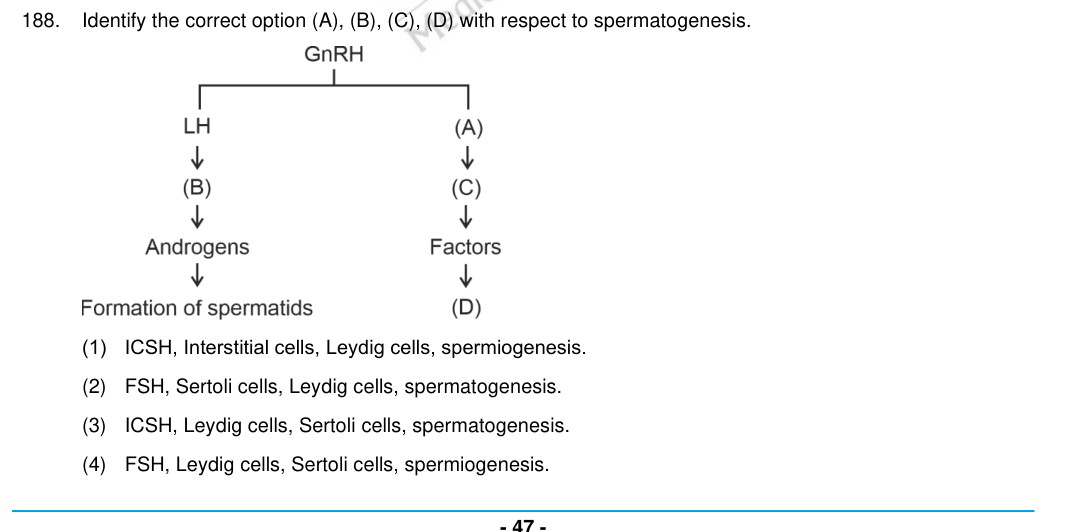
Identify the correct option for (A), (B), (C), (D) in the given flow chart with respect to spermatogenesis:

Question 188 as printed in the NEET 2024 booklet

  1. A.ICSH, Interstitial cells, Leydig cells, spermiogenesis
  2. B.FSH, Sertoli cells, Leydig cells, spermatogenesis
  3. C.ICSH, Leydig cells, Sertoli cells, spermatogenesis
  4. D.FSH, Leydig cells, Sertoli cells, spermiogenesis

Solution

Spermatogonia are stimulated by FSH acting on Sertoli cells; LH (ICSH) acts on Leydig cells; Sertoli cells nourish the developing germ cells; the final transformation of spermatids into spermatozoa is spermiogenesis. Reading the flow chart's blanks in order gives FSH, Leydig cells, Sertoli cells, spermiogenesis.

Save for spaced revision (free account)

Q39openBody Fluids and Circulation · Human heart, cardiac cycle and ECG

Match List I with List II.

List IList II
A. P waveI. Heart muscles are electrically silent
B. QRS complexII. Depolarisation of ventricles
C. T waveIII. Depolarisation of atria
D. T–P gapIV. Repolarisation of ventricles

Choose the correct answer from the options given below:

  1. A.A-III, B-II, C-IV, D-I
  2. B.A-II, B-III, C-I, D-IV
  3. C.A-IV, B-II, C-I, D-III
  4. D.A-I, B-III, C-IV, D-II

Solution

The P wave is atrial depolarisation (III); the QRS complex, ventricular depolarisation (II); the T wave, ventricular repolarisation (IV); in the T–P gap the heart is electrically silent (I).

Save for spaced revision (free account)

Q40openHuman Health and Disease · Immunity, vaccination, AIDS, cancer

Given below are two statements:

Statement I: Bone marrow is the main lymphoid organ where all blood cells including lymphocytes are produced.

Statement II: Both bone marrow and thymus provide micro-environments for the development and maturation of T-lymphocytes.

In the light of the above statements, choose the most appropriate answer from the options given below:

  1. A.Both Statement I and Statement II are incorrect.
  2. B.Statement I is correct but Statement II is incorrect.
  3. C.Statement I is incorrect but Statement II is correct.
  4. D.Both Statement I and Statement II are correct.

Solution

Bone marrow is the primary lymphoid organ where all blood cells including lymphocytes are made (I true), and both bone marrow and thymus provide the micro-environment for lymphocyte maturation — T cells maturing in the thymus (II true).

Save for spaced revision (free account)

Q41openOrganisms and Populations · Population attributes, growth models and interactions

Given below are two statements:

Statement I: Gause's competitive exclusion principle states that two closely related species competing for different resources cannot exist indefinitely.

Statement II: According to Gause's principle, during competition the inferior will be eliminated. This may be true if resources are limiting.

In the light of the above statements, choose the correct answer from the options given below:

  1. A.Both Statement I and Statement II are false.
  2. B.Statement I is true but Statement II is false.
  3. C.Statement I is false but Statement II is true.
  4. D.Both Statement I and Statement II are true.

Solution

Gause's principle concerns species competing for the same limited resource — Statement I, which says 'different resources', is wrong. That the inferior competitor is eliminated when resources are limiting is a correct reading of the principle — Statement II is true.

Save for spaced revision (free account)

Q42openChemical Coordination and Integration · Disorders

Match List I with List II.

List IList II
A. Exophthalmic goitreI. Excess secretion of cortisol, moon face & hyperglycaemia
B. AcromegalyII. Hyposecretion of thyroid hormone and stunted growth
C. Cushing's syndromeIII. Hypersecretion of thyroid hormone & protruding eyeballs
D. CretinismIV. Excessive secretion of growth hormone

Choose the correct answer from the options given below:

  1. A.A-IV, B-II, C-I, D-III
  2. B.A-III, B-IV, C-II, D-I
  3. C.A-III, B-IV, C-I, D-II
  4. D.A-I, B-III, C-II, D-IV

Solution

Exophthalmic goitre (Graves' disease): hyperthyroidism with protruding eyes (III). Acromegaly: excess growth hormone in adults (IV). Cushing's syndrome: excess cortisol, moon face, hyperglycaemia (I). Cretinism: hypothyroidism in infancy with stunted growth (II).

Save for spaced revision (free account)

Q43openStructural Organisation in Animals · Frog: morphology and anatomy

Match List I with List II, related to the digestive system of the cockroach.

List IList II
A. The structure used for storing foodI. Gizzard
B. Ring of 6–8 blind tubules at the junction of foregut and midgutII. Gastric caeca
C. Ring of 100–150 yellow-coloured thin filaments at the junction of midgut and hindgutIII. Malpighian tubules
D. The structure used for grinding foodIV. Crop

Choose the correct answer from the options given below:

  1. A.A-I, B-II, C-III, D-IV
  2. B.A-IV, B-III, C-II, D-I
  3. C.A-III, B-II, C-IV, D-I
  4. D.A-IV, B-II, C-III, D-I

Solution

The crop stores food (IV); the gastric caeca are the 6–8 blind tubules at the foregut–midgut junction (II); the Malpighian tubules are the 100–150 yellow filaments at the midgut–hindgut junction (III); the gizzard grinds food (I).

Save for spaced revision (free account)

Q44openPrinciples of Inheritance and Variation · Mendel's laws and deviations

As per the ABO blood grouping system, the blood group of the father is B+, the mother is A+ and the child is O+. Their respective genotypes can be:

A. · B. · C. · D. · E.

Choose the most appropriate answer from the options given below:

  1. A.B only
  2. B.C & B only
  3. C.D & E only
  4. D.A only

Solution

An O-group child (ii) must receive an i allele from each parent, so the B⁺ father is and the A⁺ mother . Only set A fits; the other sets give at least one parent no i allele or the child a wrong genotype.

Save for spaced revision (free account)

Q45openMolecular Basis of Inheritance · Transcription, genetic code, translation

Match List I with List II.

List IList II
A. RNA polymerase IIII. snRNPs
B. Termination of transcriptionII. Promoter
C. Splicing of exonsIII. Rho factor
D. TATA boxIV. snRNAs, tRNA

Choose the correct answer from the options given below:

  1. A.A-III, B-II, C-IV, D-I
  2. B.A-III, B-IV, C-I, D-II
  3. C.A-IV, B-III, C-I, D-II
  4. D.A-II, B-IV, C-I, D-III

Solution

RNA polymerase III transcribes tRNA, 5S rRNA and snRNAs (IV); rho factor terminates transcription in prokaryotes (III); snRNPs carry out splicing (I); the TATA box is part of the promoter (II).

Save for spaced revision (free account)

Q46openEvolution · Origin of life and evidences of evolution

Match List I with List II.

List IList II
A. Mesozoic EraI. Lower invertebrates
B. Proterozoic EraII. Fish & Amphibia
C. Cenozoic EraIII. Birds & Reptiles
D. Paleozoic EraIV. Mammals

Choose the correct answer from the options given below:

  1. A.A-III, B-I, C-II, D-IV
  2. B.A-I, B-II, C-IV, D-III
  3. C.A-III, B-I, C-IV, D-II
  4. D.A-II, B-I, C-III, D-IV

Solution

Mesozoic: age of reptiles and first birds (III); Proterozoic: lower invertebrates (I); Cenozoic: age of mammals (IV); Paleozoic: fishes and amphibians (II).

Save for spaced revision (free account)

Q47openNeural Control and Coordination · Central nervous system

Given below are two statements:

Statement I: The cerebral hemispheres are connected by a nerve tract known as the corpus callosum.

Statement II: The brain stem consists of the medulla oblongata, pons and cerebrum.

In the light of the above statements, choose the most appropriate answer from the options given below:

  1. A.Both Statement I and Statement II are incorrect.
  2. B.Statement I is correct but Statement II is incorrect.
  3. C.Statement I is incorrect but Statement II is correct.
  4. D.Both Statement I and Statement II are correct.

Solution

The corpus callosum is the tract joining the two cerebral hemispheres (Statement I true). The brain stem is the midbrain, pons and medulla — not the cerebrum — so Statement II is false.

Save for spaced revision (free account)

Q48openBiomolecules · Enzymes: mechanism, factors, classification

Regarding the catalytic cycle of enzyme action, select the correct sequential steps:

A. Substrate–enzyme complex formation.

B. Free enzyme ready to bind with another substrate.

C. Release of products.

D. Chemical bonds of the substrate broken.

E. Substrate binding to the active site.

Choose the correct answer from the options given below:

  1. A.A, E, B, D, C
  2. B.B, A, C, D, E
  3. C.E, D, C, B, A
  4. D.E, A, D, C, B

Solution

The catalytic cycle: substrate binds the active site (E) → enzyme–substrate complex forms (A) → the enzyme strains the substrate's bonds, which break (D) → products are released (C) → the free enzyme is ready for another substrate (B).

Save for spaced revision (free account)

Q49openCell: The Unit of Life · Mitochondria, plastids, ribosomes, cytoskeleton, nucleus

Given below are two statements:

Statement I: Mitochondria and chloroplasts are both double-membrane-bound organelles.

Statement II: The inner membrane of mitochondria is relatively less permeable, as compared to the chloroplast.

In the light of the above statements, choose the most appropriate answer from the options given below:

  1. A.Both Statement I and Statement II are incorrect.
  2. B.Statement I is correct but Statement II is incorrect.
  3. C.Statement I is incorrect but Statement II is correct.
  4. D.Both Statement I and Statement II are correct.

Solution

Both mitochondria and chloroplasts are double-membrane-bound organelles (Statement I correct). NCERT describes the chloroplast's inner membrane as the relatively less permeable one, so Statement II, which says the reverse, is incorrect.

Save for spaced revision (free account)

Q50openAnimal Kingdom · Basis of classification

The following are statements about non-chordates:

A. The pharynx is perforated by gill slits.

B. The notochord is absent.

C. The central nervous system is dorsal.

D. The heart is dorsal, if present.

E. A post-anal tail is absent.

Choose the most appropriate answer from the options given below:

  1. A.A, B & D only
  2. B.B, D & E only
  3. C.B, C & D only
  4. D.A & C only

Solution

Non-chordates lack a notochord (B), have a dorsal heart if any (D) and no post-anal tail (E). Their central nervous system is ventral, and the pharynx is not perforated by gill slits — A and C are chordate features.

Save for spaced revision (free account)