The reagents with which glucose does not react to give the corresponding tests/products are:
A. Tollens' reagent
B. Schiff's reagent
C. HCN
D.
E.
Choose the correct option from those given below:
All 50 Chemistry questions we hold from this paper, of the 200 on the site for this sitting — every option and the answer key. 4 marks each, −1 for a wrong answer.
45 questions, one correct option each. +4 for a correct answer, −1 for a wrong one, nothing for a blank.
The reagents with which glucose does not react to give the corresponding tests/products are:
A. Tollens' reagent
B. Schiff's reagent
C. HCN
D. NH2OH
E. NaHSO3
Choose the correct option from those given below:
Solution
Glucose has an aldehyde group, so it reduces Tollens' reagent and adds HCN and NH2OH. It does not give the Schiff's test and does not form a bisulphite adduct with NaHSO3 — anomalies explained by its cyclic hemiacetal structure. So B and E.
The energy of an electron in the ground state (n=1) of the He+ ion is −x J. Then that of an electron in the n=2 state of the Be3+ ion, in J, is:
Solution
En=−n2Z2×13.6 eV. For He+ (Z=2, n=1): factor 4. For Be3+ (Z=4, n=2): factor 416=4. Same factor, so the energy is −x J.
Which reaction is not a redox reaction?
Solution
BaCl2+Na2SO4→BaSO4+2NaCl is a double displacement (precipitation) with no change in any oxidation number. The other three involve electron transfer.
Match List I with List II.
| List I (Process) | List II (Condition) |
|---|---|
| A. Isothermal process | I. No heat exchange |
| B. Isochoric process | II. Carried out at constant temperature |
| C. Isobaric process | III. Carried out at constant volume |
| D. Adiabatic process | IV. Carried out at constant pressure |
Choose the correct answer from the options given below:
Solution
Isothermal: constant temperature (II). Isochoric: constant volume (III). Isobaric: constant pressure (IV). Adiabatic: no heat exchange (I).
For the reaction 2A⇌B+C, Kc=4×10⁻³. At a given time the composition of the reaction mixture is [A]=[B]=[C]=2×10⁻³ M. Then which of the following is correct?
Solution
Qc=[A]2[B][C]=(2×10⁻³)2(2×10⁻³)2=1, which is greater than Kc=4×10⁻³. The reaction proceeds backward to reduce Qc.
Match List I with List II.
| List I (Complex) | List II (Type of isomerism) |
|---|---|
| A. [Co(NH3)5(NO2)]Cl2 | I. Solvate isomerism |
| B. [Co(NH3)5(SO4)]Br | II. Linkage isomerism |
| C. [Co(NH3)6][Cr(CN)6] | III. Ionisation isomerism |
| D. [Co(H2O)6]Cl3 | IV. Coordination isomerism |
Choose the correct answer from the options given below:
Solution
NO2− can bind through N or O — linkage isomerism (A-II). Exchanging SO42− and Br− between coordination sphere and counter-ion — ionisation isomerism (B-III). Two complex ions can swap ligands — coordination isomerism (C-IV). Water inside versus outside the sphere — solvate/hydrate isomerism (D-I).
In which of the following processes does entropy increase?
A. A liquid evaporates to vapour.
B. The temperature of a crystalline solid is lowered from 130 K to 0 K.
C. 2NaHCO3(s)→Na2CO3(s)+CO2(g)+H2O(g)
D. Cl2(g)→2Cl(g)
Choose the correct answer from the options given below:
Solution
Entropy rises when disorder rises: liquid → vapour (A), a solid giving two gases (C), and one gas molecule becoming two (D). Cooling a crystal towards 0 K lowers entropy (B). So A, C and D.
Identify the correct reagents that would bring about the transformation shown in the figure.
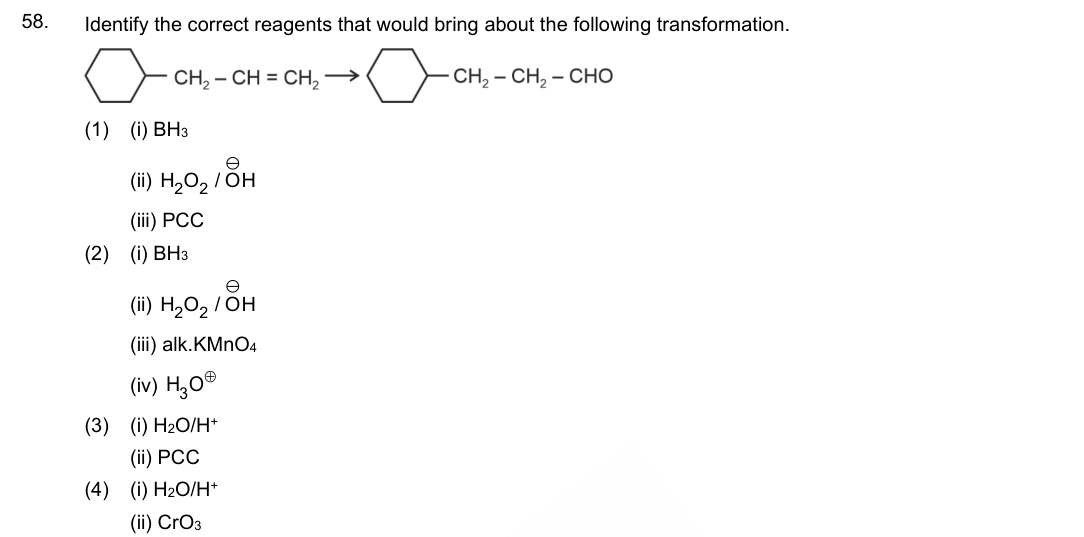
Solution
Converting a terminal alkene to the aldehyde with one more carbon at the chain end needs anti-Markovnikov hydration: BH3 then H2O2/OH− gives the primary alcohol, and PCC oxidises it gently to the aldehyde without going on to the acid — option (1).
Match List I (reactions, shown as structures) with List II (reagents/conditions):
I. (reagent shown in figure) · II. CrO3 · III. KMnO4/KOH, Δ⋅ IV. (i) O3 (ii) Zn–H2O
Choose the correct answer from the options given below:
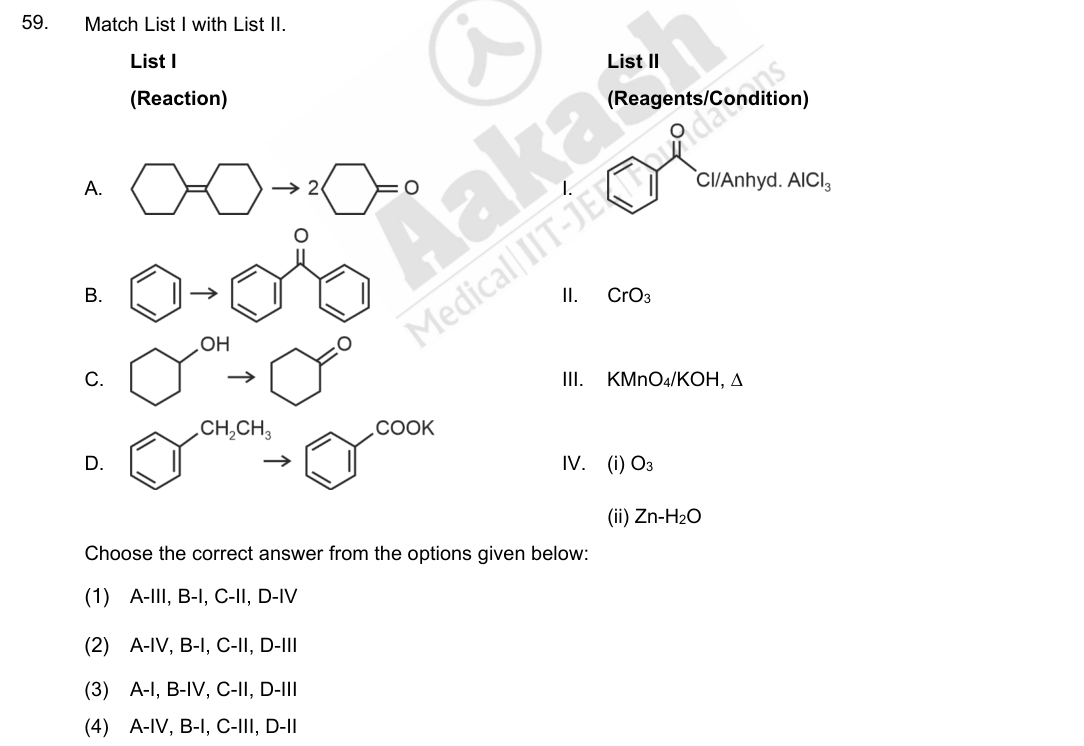
Solution
A: cleaving a C=C to two ketones is ozonolysis, (i) O3 (ii) Zn–H2O (IV). B: benzophenone from benzene is Friedel–Crafts acylation with benzoyl chloride/AlCl3 (I). C: cyclohexanol to cyclohexanone uses CrO3 (II). D: ethylbenzene to benzoate needs KMnO4/KOH, Δ(III). A-IV, B-I, C-II, D-III.
In which of the following equilibria are Kp and Kc not equal?
Solution
Kp=Kc(RT)Δng; they are equal only when Δng=0. For PCl5⇌PCl3+Cl2, Δng=2−1=1, so Kp=Kc. The other three have equal moles of gas on both sides.
Which one of the following alcohols (three drawn as structures; the fourth is CH3CH2CH2CH2OH) reacts instantaneously with Lucas reagent?
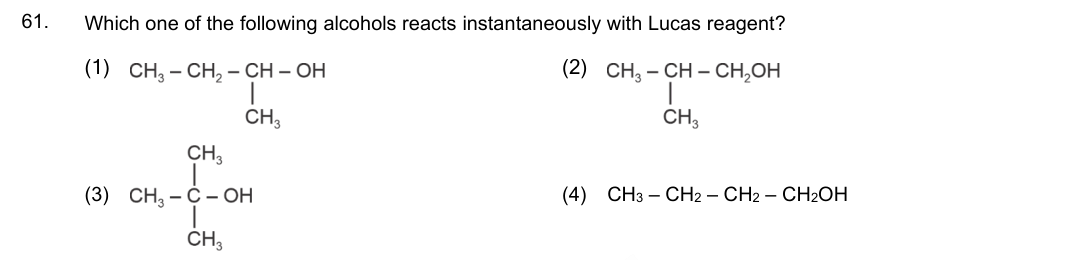
Solution
The Lucas test turns turbid instantly only with tertiary alcohols, which form a stable tertiary carbocation. 2-Methylpropan-2-ol, (CH3)3C−OH (structure 3), is tertiary; (1) is secondary and (2), (4) are primary.
Given below are two statements:
Statement I: The boiling points of the three isomeric pentanes follow the order n-pentane > isopentane > neopentane.
Statement II: When branching increases, the molecule attains the shape of a sphere. This results in a smaller surface area for contact, due to which the intermolecular forces between the spherical molecules are weak, thereby lowering the boiling point.
In the light of the above statements, choose the most appropriate answer from the options given below:
Solution
Branching makes a molecule more compact and spherical, reducing surface contact and hence the van der Waals forces, so boiling point falls from n-pentane to isopentane to neopentane. Both statements are correct and II explains I.
Given below are two statements:
Statement I: Aniline does not undergo Friedel–Crafts alkylation reaction.
Statement II: Aniline cannot be prepared through Gabriel synthesis.
In the light of the above statements, choose the correct answer from the options given below:
Solution
Aniline forms a complex with the Lewis-acid catalyst AlCl3 through its nitrogen lone pair, so Friedel–Crafts fails. Gabriel synthesis needs an alkyl halide to undergo SN2 with phthalimide; aryl halides do not, so aniline cannot be made this way. Both true.
The E∘ value for the Mn3+/Mn2+ couple is more positive than that of Cr3+/Cr2+ or Fe3+/Fe2+ due to the change of:
Solution
Mn3+ is d4; gaining an electron gives the stable half-filled d5 configuration of Mn2+. This extra stability makes the reduction unusually favourable, i.e. E∘ unusually positive.
On heating, some solid substances change from the solid to the vapour state without passing through the liquid state. The technique used for the purification of such solid substances, based on the above principle, is known as:
Solution
A solid that passes directly to vapour on heating (e.g. camphor, naphthalene, ammonium chloride) is purified by sublimation: the vapour is condensed back to pure solid, leaving non-volatile impurities behind.
Fehling's solution 'A' is:
Solution
Fehling's solution A is aqueous copper(II) sulphate; Fehling's B is alkaline sodium potassium tartrate. They are mixed just before use.
Match List I with List II.
| List I (Molecule) | List II (Number and type of bonds between two carbon atoms) |
|---|---|
| A. ethane | I. one σ−bond and two π−bonds |
| B. ethene | II. two π−bonds |
| C. carbon molecule, C2 | III. one σ−bond |
| D. ethyne | IV. one σ−bond and one π−bond |
Choose the correct answer from the options given below:
Solution
Ethane: one C–Cσ bond (III). Ethene: one σ and one π(IV). Ethyne: one σ and two π(I). By molecular orbital theory the C2 molecule has a double bond made of two π bonds only (II). Hence A-III, B-IV, C-II, D-I.
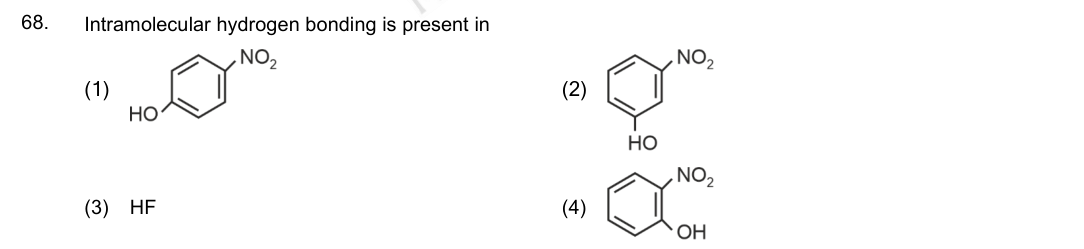
Intramolecular hydrogen bonding is present in (three options drawn as structures; the third is HF):
Solution
Only in o-nitrophenol are the –OH and –NO2 groups close enough to form a hydrogen bond within the same molecule (a six-membered chelate ring). The m- and p-isomers and HF hydrogen-bond only between molecules.
The highest number of helium atoms is in:
Solution
One mole contains 6.022×10²³ atoms, so 4 mol has the most. 4 g of He is 1 mol; 22.71 L at STP is 1 mol, so 2.271 L is 0.1 mol; 4 u is a single atom.
Match List I with List II.
| List I (Conversion) | List II (Number of Faraday required) |
|---|---|
| A. 1 mol of H2O to O2 | I. 3 F |
| B. 1 mol of MnO4− to Mn2+ | II. 2 F |
| C. 1.5 mol of Ca from molten CaCl2 | III. 1 F |
| D. 1 mol of FeO to Fe2O3 | IV. 5 F |
Choose the correct answer from the options given below:
Solution
Faradays needed equal electrons transferred. H2O→21O2: 2 e⁻ per mole (II). MnO4−→Mn2+: 5 e⁻ (IV). Ca2+→Ca: 2 e⁻ per mole, so 1.5 mol needs 3 F (I). FeO→Fe2O3: Fe goes +2 → +3, 1 e⁻ per Fe, 1 F (III). Hence A-II, B-IV, C-I, D-III.
Among Group 16 elements, which one does not show the –2 oxidation state?
Solution
Polonium, the heaviest and most metallic member, does not show the −2 state; O, S, Se and Te all form −2 ions or hydrides.
The 'spin only' magnetic moment is the same for which of the following ions?
A. Ti3+ · B. Cr2+ · C. Mn2+ · D. Fe2+ · E. Sc3+
Choose the most appropriate answer from the options given below:
Solution
Spin-only moment depends on unpaired electrons: Ti3+ (d1) 1, Cr2+ (d4) 4, Mn2+ (d5) 5, Fe2+ (d6) 4, Sc3+ (d0) 0. B and D both have 4 unpaired electrons, μ=24≈4.9 BM.
A compound with the molecular formula C6H14 has two tertiary carbons. Its IUPAC name is:
Solution
A tertiary carbon is bonded to three other carbons. 2,3-Dimethylbutane, (CH3)2CH−CH(CH3)2, has two such carbons (C2 and C3). The others have at most one, or none.
The Henry's law constant (KH) values of three gases (A, B, C) in water are 145, 2×10⁻⁵ and 35 kbar, respectively. The solubility of these gases in water follows the order:
Solution
Henry's law p=KHx: a larger KH means a lower mole fraction dissolved at a given pressure. Solubility therefore increases as KH falls: B (2×10⁻⁵) > C (35) > A (145).
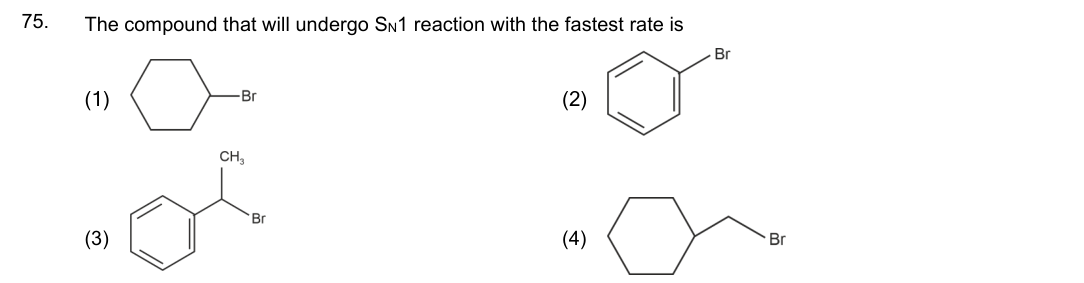
The compound (from the four structures shown) that will undergo the SN1 reaction with the fastest rate is:

Solution
SN1 rate depends on carbocation stability. 1-Bromo-1-phenylethane (3) ionises to a secondary benzylic cation stabilised by resonance with the ring — far more stable than the secondary cyclohexyl (1) or the primary (4) cations; bromobenzene (2) does not undergo SN1 at all.
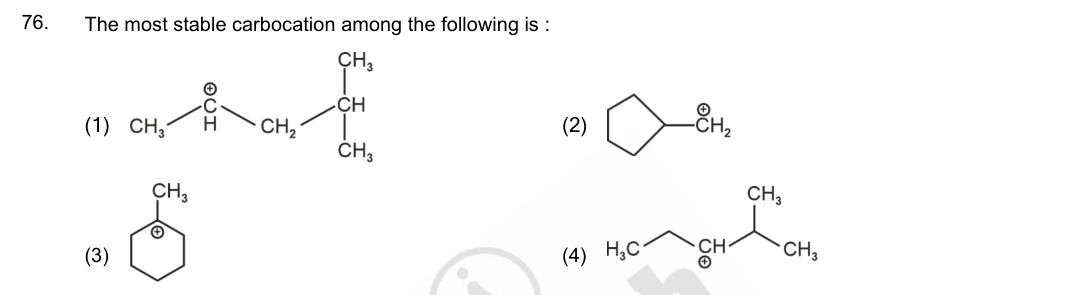
The most stable carbocation among the four structures shown is:
Solution
The 1-methylcyclohexyl cation (3) is tertiary — three alkyl groups stabilise it by hyperconjugation and +I effect. (1) and (4) are secondary and (2) is primary.
Given below are two statements:
Statement I: Both [Co(NH3)6]3+ and [CoF6]3− complexes are octahedral but differ in their magnetic behaviour.
Statement II: [Co(NH3)6]3+ is diamagnetic whereas [CoF6]3− is paramagnetic.
In the light of the above statements, choose the correct answer from the options given below:
Solution
Both are octahedral Co3+ (d6) complexes. NH3 is a strong-field ligand, giving low-spin t2g6 — diamagnetic. F− is weak-field, giving high-spin with four unpaired electrons — paramagnetic. Both statements are true.
1 gram of sodium hydroxide was treated with 25 mL of 0.75 M HCl solution. The mass of sodium hydroxide left unreacted is equal to:
Solution
1 g NaOH =401=0.025 mol. HCl supplied =0.025×0.75=0.01875 mol. NaOH left =0.025−0.01875=0.00625 mol =0.25 g =250 mg.
Given below are two statements:
Statement I: The boiling points of the hydrides of Group 16 elements follow the order H2O>H2Te>H2Se>H2S.
Statement II: On the basis of molecular mass, H2O is expected to have a lower boiling point than the other members of the group, but due to the presence of extensive H-bonding in H2O, it has a higher boiling point.
In the light of the above statements, choose the correct answer from the options given below:
Solution
Boiling points rise with molar mass down the group (H2S<H2Se<H2Te), but water sits above all of them because of extensive hydrogen bonding. Both statements are true.
Arrange the following elements in increasing order of first ionisation enthalpy: Li, Be, B, C, N.
Choose the correct answer from the options given below:
Solution
Ionisation enthalpy generally rises across the period, but Be (2s2, filled subshell) is higher than B (whose 2p electron is easier to remove). Order: Li < B < Be < C < N.
The activation energy of any chemical reaction can be calculated if one knows the value of:
Solution
The Arrhenius equation in two-temperature form, lnk1k2=REa(T11−T21), gives Ea from rate constants measured at two temperatures.
Arrange the following elements in increasing order of electronegativity: N, O, F, C, Si.
Choose the correct answer from the options given below:
Solution
Electronegativity rises across a period and falls down a group: Si < C < N < O < F.
Match List I with List II.
| List I (Quantum number) | List II (Information provided) |
|---|---|
| A. ml | I. Shape of orbital |
| B. ms | II. Size of orbital |
| C. l | III. Orientation of orbital |
| D. n | IV. Orientation of spin of electron |
Choose the correct answer from the options given below:
Solution
n fixes orbital size (II), l its shape (I), ml its orientation (III), and ms the spin orientation of the electron (IV). Hence A-III, B-IV, C-I, D-II.
Match List I with List II.
| List I (Compound) | List II (Shape/geometry) |
|---|---|
| A. NH3 | I. Trigonal pyramidal |
| B. BrF5 | II. Square planar |
| C. XeF4 | III. Octahedral |
| D. SF6 | IV. Square pyramidal |
Choose the correct answer from the options given below:
Solution
NH3: sp3 with one lone pair — trigonal pyramidal (I). BrF5: sp3d2 with one lone pair — square pyramidal (IV). XeF4: sp3d2 with two lone pairs — square planar (II). SF6: octahedral (III).
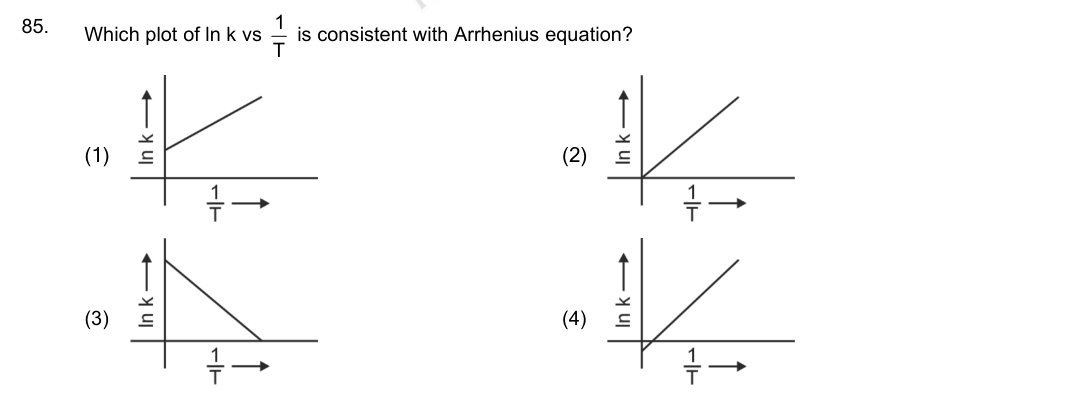
Which plot of lnk vs T1 (from the four graphs shown) is consistent with the Arrhenius equation?
Solution
Arrhenius: lnk=lnA−REa⋅T1. A plot of lnk against 1/T is a straight line with negative slope −Ea/R and positive intercept lnA — graph (3).
The work done during the reversible isothermal expansion of one mole of hydrogen gas at 25∘C from a pressure of 20 atmosphere to 10 atmosphere is (given R=2.0 calK−1mol−1):
Solution
w=−2.303nRTlogp2p1=−2.303×1×2×298×log2=−413.14 cal. Work done by the gas on expansion is negative in the sign convention used.
Identify the correct answer.
Solution
CO32− has three equivalent resonance structures with the double bond on each oxygen in turn. BF3 is trigonal planar with zero dipole; NH3 has a larger dipole than NF3; ozone has two resonance structures.
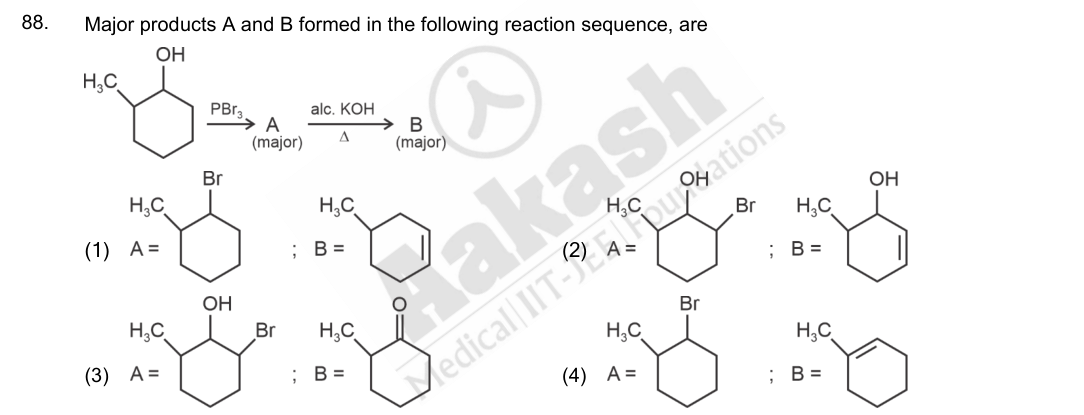
The major products A and B formed in the reaction sequence shown in the figure are:
Solution
PBr3 replaces –OH by –Br without rearrangement, giving 1-bromo-2-methylcyclohexane (A). Alcoholic KOH then eliminates HBr by the Saytzeff rule to the more substituted alkene, 1-methylcyclohexene (B) — option (4).
The pair of lanthanoid ions which are diamagnetic is:
Solution
Diamagnetism needs no unpaired f electrons. Ce4+ is 4f0 and Yb2+ is 4f14 — both diamagnetic. Ce3+ (f1), Eu2+/Gd3+ (f7), Eu3+ (f6), Pm3+ (f4), Sm3+ (f5) are all paramagnetic.
A compound X contains 32% of A, 20% of B and the remaining percentage of C. Then the empirical formula of X is (given atomic masses A = 64, B = 40, C = 32 u):
Solution
Moles per 100 g: A 6432=0.5, B 4020=0.5, C 3248=1.5. Ratio 1:1:3, so ABC3.
Given below are certain cations. Using inorganic qualitative analysis, arrange them in increasing group number from 0 to VI.
A. Al3+ · B. Cu2+ · C. Ba2+ · D. Co2+ · E. Mg2+
Choose the correct answer from the options given below:
Solution
Qualitative-analysis groups: Cu2+ Group II, Al3+ Group III, Co2+ Group IV, Ba2+ Group V, Mg2+ Group VI. Increasing group order: B, A, D, C, E.
Consider the following reaction in a sealed vessel at equilibrium with concentrations N2=3.0×10⁻³ M, O2=4.2×10⁻³ M and NO=2.8×10⁻³ M:
2NO(g)⇌N2(g)+O2(g)
If 0.1 molL−1 of NO(g) is taken in a closed vessel, what will be the degree of dissociation (α) of NO(g) at equilibrium?
Solution
Kc=[NO]2[N2][O2]=(2.8×10⁻³)23.0×10−3×4.2×10−3≈1.607. Starting from 0.1 M NO: Kc=(0.1(1−α))2(0.05α)2=4(1−α)2α2, so 2(1−α)α=1.268⇒α≈0.717.
The rate of a reaction quadruples when the temperature changes from 27∘C to 57∘C. Calculate the energy of activation. (Given R=8.314 JK−1mol−1, log4=0.6021.)
Solution
logk1k2=2.303REa(T11−T21) with k2/k1=4, T1=300 K, T2=330 K: 0.6021=2.303×8.314Ea×300×33030⇒Ea≈38.04 kJ/mol.
During the preparation of Mohr's salt solution (ferrous ammonium sulphate), which of the following acids is added to prevent hydrolysis of the Fe2+ ion?
Solution
Dilute sulphuric acid suppresses hydrolysis of Fe2+ (which would otherwise give a turbid basic salt) without oxidising it; nitric acid would oxidise Fe2+ to Fe3+, and HCl introduces chloride.
Identify the major product C formed in the following reaction sequence:
CH3CH2CH2INaCNAOH−partial hydrolysisBBr2/NaOH(major)C
Solution
CH3CH2CH2I with NaCN gives butanenitrile (A). Partial hydrolysis converts the nitrile to the amide, butanamide (B). Hofmann bromamide degradation with Br2/NaOH removes one carbon, giving propylamine (C).
The mass in grams of copper deposited by passing a current of 9.6487 A through a voltameter containing copper sulphate solution for 100 seconds is (given molar mass of Cu = 63 gmol−1, 1 F = 96487 C):
Solution
Charge =It=9.6487×100=964.87 C =0.01 F. Copper needs 2 F per mole, so 0.005 mol is deposited: 0.005×63=0.315 g.
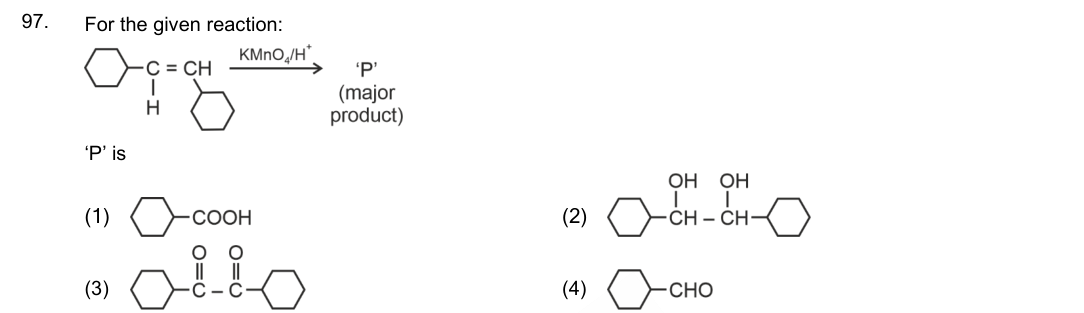
For the reaction shown in the figure, the product 'P' is:
Solution
Hot acidic KMnO4 cleaves the C=C of stilbene completely and oxidises each fragment fully: both ends carry one H, so each becomes benzoic acid — product (1).
Given below are two statements:
Statement I: [Co(NH3)6]3+ is a homoleptic complex whereas [Co(NH3)4Cl2]+ is a heteroleptic complex.
Statement II: The complex [Co(NH3)6]3+ has only one kind of ligand but [Co(NH3)4Cl2]+ has more than one kind of ligand.
In the light of the above statements, choose the correct answer from the options given below:
Solution
A homoleptic complex has only one kind of ligand ([Co(NH3)6]3+); a heteroleptic one has more than one kind ([Co(NH3)4Cl2]+). Both statements are true and II is the definition behind I.
The plot of osmotic pressure (Π) vs concentration (molL−1) for a solution gives a straight line with slope 25.73 Lbarmol−1. The temperature at which the osmotic pressure measurement is done is (use R=0.083 Lbarmol−1K−1):
Solution
Π=CRT, so the slope of Π against C is RT: T=0.08325.73=310 K =37∘C.
The products A and B obtained in the following reactions, respectively, are:
3ROH+PCl3→3RCl+A
ROH+PCl5→RCl+HCl+B
Solution
PCl3 with an alcohol gives the alkyl chloride and phosphorous acid H3PO3; PCl5 gives the alkyl chloride, HCl and phosphoryl chloride POCl3.