Complex II of the mitochondrial electron transport chain is also known as:
NEET 2025 — Botany
All 45 Botany questions we hold from this paper, of the 178 on the site for this sitting — every option and the answer key. 4 marks each, −1 for a wrong answer.
Botany
45 questions, one correct option each. +4 for a correct answer, −1 for a wrong one, nothing for a blank.
Q1openRespiration in Plants · Krebs cycle and electron transport chain
- A.Cytochrome bc1
- B.Succinate dehydrogenase✓
- C.Cytochrome c oxidase
- D.NADH dehydrogenase
Solution
Complex II of the electron transport chain is succinate dehydrogenase, which passes electrons from FADH2 to ubiquinone. Complex I is NADH dehydrogenase, III the cytochrome bc1 complex and IV cytochrome c oxidase.
Q2openBiotechnology: Principles and Processes · Processes: cloning, PCR, bioreactors
Polymerase chain reaction (PCR) amplifies DNA following the equation:
- A.N2
- B.2n✓
- C.2n+1
- D.2N2
Solution
Each PCR cycle doubles the target, so after n cycles there are 2n copies — about a billion after 30 cycles.
Q3openReproductive Health · MTP, STDs and infertility; ART
What are the potential drawbacks in the adoption of the IVF method?
A. High fatality risk to the mother
B. Expensive instruments and reagents
C. Husband/wife necessary for being donors
D. Less adoption of orphans
E. Not available in India
F. Possibility that the early embryo does not survive
Choose the correct answer from the options given below:
- A.B, D, F only✓
- B.A, C, D, F only
- C.A, B, C, D only
- D.A, B, C, E, F only
Solution
IVF is expensive (B), needs sophisticated instruments, may reduce the adoption of orphans (D), and the early embryo transferred may fail to survive (F). It carries no high fatality risk to the mother, the gametes need not come from husband and wife, and it is available in India. Hence B, D and F.
Q4openStructural Organisation in Animals · Frog: morphology and anatomy
What is the name of the blood vessel that carries deoxygenated blood from the body to the heart in a frog?
- A.Aorta
- B.Pulmonary artery
- C.Pulmonary vein
- D.Vena cava✓
Solution
The vena cavae (pre-caval and post-caval) bring deoxygenated blood from the body to the sinus venosus and right atrium. Pulmonary veins return oxygenated blood from the lungs; the aorta carries blood away from the heart.
Q5openThe Living World · Characteristics of living organisms
Which one of the following statements refers to reductionist biology?
- A.Physico-chemical approach to study and understand living organisms✓
- B.Physiological approach to study and understand living organisms
- C.Chemical approach to study and understand living organisms
- D.Behavioural approach to study and understand living organisms
Solution
Reductionist biology explains living systems by breaking them into their physico-chemical parts — the approach described in Statement 1.
Q6openMolecular Basis of Inheritance · DNA structure and replication
Given below are two statements:
Statement I: In the RNA world, RNA is considered the first genetic material, evolved to carry out essential life processes. RNA acts as a genetic material and also as a catalyst for some important biochemical reactions in living systems. Being reactive, RNA is unstable.
Statement II: DNA evolved from RNA and is a more stable genetic material. Its double-helical strands, being complementary, resist changes by evolving a repairing mechanism.
In the light of the above statements, choose the most appropriate answer from the options given below:
- A.Both Statement I and Statement II are correct✓
- B.Both Statement I and Statement II are incorrect
- C.Statement I is correct but Statement II is incorrect
- D.Statement I is incorrect but Statement II is correct
Solution
NCERT presents exactly this account of the RNA world: RNA was the first genetic material and a catalyst, but being reactive it was unstable, and the more stable double-stranded DNA with its repair mechanisms evolved from it. Both statements are correct.
Q7openOrganisms and Populations · Population attributes, growth models and interactions
Epiphytes growing on a mango branch are an example of which of the following?
- A.Commensalism✓
- B.Mutualism
- C.Predation
- D.Amensalism
Solution
An epiphyte uses the mango branch only for support and takes nothing from it — the orchid benefits and the tree is unaffected, which is commensalism.
Q8openCell: The Unit of Life · Mitochondria, plastids, ribosomes, cytoskeleton, nucleus
From the statements given below choose the correct option:
A. The eukaryotic ribosomes are 80S and prokaryotic ribosomes are 70S.
B. Each ribosome has two sub-units.
C. The two sub-units of the 80S ribosome are 60S and 40S while those of the 70S are 50S and 30S.
D. The two sub-units of the 80S ribosome are 60S and 20S and those of the 70S are 50S and 20S.
E. The two sub-units of the 80S are 60S and 30S and those of the 70S are 50S and 30S.
- A.A, B, C are true✓
- B.A, B, D are true
- C.A, B, E are true
- D.B, D, E are true
Solution
Eukaryotic ribosomes are 80S (60S + 40S) and prokaryotic ribosomes are 70S (50S + 30S); every ribosome has two subunits. Statements A, B and C are correct; D and E give wrong subunit sizes.
Q9openBiodiversity and Conservation · Loss of biodiversity and its conservation
Which one of the following is an example of ex-situ conservation?
- A.National park
- B.Wildlife sanctuary
- C.Zoos and botanical gardens✓
- D.Protected areas
Solution
Zoos, botanical gardens, seed banks and cryopreservation keep species outside their natural habitat — ex-situ conservation. National parks, sanctuaries and other protected areas are in-situ.
Q10openEcosystem · Structure, productivity and decomposition
Given below are two statements:
Statement I: The primary source of energy in an ecosystem is solar energy.
Statement II: The rate of production of organic matter during photosynthesis in an ecosystem is called net primary productivity (NPP).
In the light of the above statements, choose the most appropriate answer from the options given below:
- A.Both Statement I and Statement II are correct
- B.Both Statement I and Statement II are incorrect
- C.Statement I is correct but Statement II is incorrect✓
- D.Statement I is incorrect but Statement II is correct
Solution
Solar energy is the primary source for almost every ecosystem (I correct). The rate of organic-matter production during photosynthesis is the gross primary productivity; NPP is what remains after respiratory loss, so II is incorrect.
Q11openBreathing and Exchange of Gases · Regulation and disorders
Match List I with List II.
| List I | List II |
|---|---|
| A. Emphysema | I. Rapid spasms in muscle due to low Ca++ in body fluid |
| B. Angina pectoris | II. Damaged alveolar walls and decreased respiratory surface |
| C. Glomerulonephritis | III. Acute chest pain when not enough oxygen is reaching the heart muscle |
| D. Tetany | IV. Inflammation of the glomeruli of the kidney |
Choose the correct answer from the options given below:
- A.A-III, B-I, C-IV, D-II
- B.A-III, B-I, C-II, D-IV
- C.A-II, B-IV, C-III, D-I
- D.A-II, B-III, C-IV, D-I✓
Solution
Emphysema: damaged alveolar walls and reduced respiratory surface (II). Angina pectoris: acute chest pain from an under-supplied heart muscle (III). Glomerulonephritis: inflammation of the glomeruli (IV). Tetany: rapid muscle spasms from low Ca2+ (I).
Q12openSexual Reproduction in Flowering Plants · Pollination and double fertilisation
Given below are two statements: one is labelled as Assertion (A) and the other is labelled as Reason (R).
Assertion (A): Both wind- and water-pollinated flowers are not very colourful and do not produce nectar.
Reason (R): Wind- and water-pollinated flowers produce an enormous amount of pollen grains.
In the light of the above statements, choose the correct answer from the options given below:
- A.Both A and R are true and R is the correct explanation of A
- B.Both A and R are true but R is NOT the correct explanation of A✓
- C.A is true but R is false
- D.A is false but R is true
Solution
Both statements are true: wind- and water-pollinated flowers are inconspicuous, nectarless and produce pollen in enormous quantity. But the large pollen output compensates for wastage in an unreliable vector — it is not the reason the flowers lack colour and nectar, so R does not explain A.
Q13openMicrobes in Human Welfare · Microbes in household and industrial products
Which of the following is an example of a non-distilled alcoholic beverage produced by yeast?
- A.Whisky
- B.Brandy
- C.Beer✓
- D.Rum
Solution
Beer is fermented by yeast but not distilled. Whisky, brandy and rum are distilled spirits.
Q14openMorphology of Flowering Plants · Inflorescence, flower and floral formula
Given below are two statements:
Statement I: In a floral formula, the symbol % stands for the zygomorphic nature of the flower, and G with a line above it stands for an inferior ovary.
Statement II: In a floral formula, the symbol ⊕ stands for the actinomorphic nature of the flower, and G with a line below it stands for a superior ovary.
In the light of the above statements, choose the correct answer from the options given below:
- A.Both Statement I and Statement II are correct
- B.Both Statement I and Statement II are incorrect
- C.Statement I is correct but Statement II is incorrect
- D.Statement I is incorrect but Statement II is correct✓
Solution
In floral formulae % denotes zygomorphy and ⊕ actinomorphy; a line below G marks a superior ovary and a line above G an inferior ovary. Statement I gets the ovary marking backwards; Statement II is correct.
Q15openMicrobes in Human Welfare · Microbes in household and industrial products
Streptokinase, produced by the bacterium Streptococcus, is used for:
- A.Curd production
- B.Ethanol production
- C.Liver disease treatment
- D.Removing clots from blood vessels✓
Solution
Streptokinase, from Streptococcus, is a 'clot buster' given to patients after a heart attack to dissolve blood clots in vessels.
Q16openMolecular Basis of Inheritance · Gene regulation: lac operon; Human Genome Project, DNA fingerprinting
Which chromosome in the human genome has the highest number of genes?
- A.Chromosome X
- B.Chromosome Y
- C.Chromosome 1✓
- D.Chromosome 10
Solution
Chromosome 1, the largest human chromosome, carries the most genes (about 2,968); the Y chromosome has the fewest (about 231).
Q17openStructural Organisation in Animals · Frog: morphology and anatomy
Which of the following statements is correct about the location of the male frog's copulatory pad?
- A.First and second digit of the fore limb
- B.First digit of the hind limb
- C.Second digit of the fore limb
- D.First digit of the fore limb✓
Solution
The male frog has a copulatory (nuptial) pad on the first digit of each forelimb, used to grip the female during amplexus.
Q18openPlant Growth and Development · Plant growth regulators: auxin, gibberellin, cytokinin, ethylene, ABA
Which one of the following phytohormones promotes nutrient mobilisation, which helps in the delay of leaf senescence in plants?
- A.Ethylene
- B.Abscisic acid
- C.Gibberellin
- D.Cytokinin✓
Solution
Cytokinins promote nutrient mobilisation and so delay leaf senescence; ethylene and abscisic acid promote senescence.
Q19openAnimal Kingdom · Basis of classification
While trying to find out the characteristics of a newly found animal, a researcher did the histology of the adult animal and observed a cavity with the presence of mesodermal tissue towards the body wall, but no mesodermal tissue was observed towards the alimentary canal. What could be the possible coelom of that animal?
- A.Acoelomate
- B.Pseudocoelomate✓
- C.Schizocoelomate
- D.Spongocoelomate
Solution
Mesoderm lining the body wall but not the gut marks a false coelom — a pseudocoelomate, as in Aschelminthes. A true coelom has mesoderm on both sides.
Q20openHuman Reproduction · Gametogenesis and menstrual cycle
Match List I with List II.
| List I | List II |
|---|---|
| A. Head | I. Enzymes |
| B. Middle piece | II. Sperm motility |
| C. Acrosome | III. Energy |
| D. Tail | IV. Genetic material |
Choose the correct answer from the options given below:
- A.A-IV, B-III, C-I, D-II✓
- B.A-IV, B-III, C-II, D-I
- C.A-III, B-IV, C-II, D-I
- D.A-III, B-II, C-I, D-IV
Solution
The sperm head carries the genetic material in its nucleus (IV); the middle piece has mitochondria that supply energy (III); the acrosome holds enzymes for penetrating the egg (I); the tail gives motility (II).
Q21openPlant Kingdom · Bryophytes and pteridophytes
Given below are the stages in the life cycle of pteridophytes. Arrange the following stages in the correct sequence.
A. Prothallus stage
B. Meiosis in spore mother cells
C. Fertilisation
D. Formation of archegonia and antheridia in the gametophyte
E. Transfer of antherozoids to the archegonia in the presence of water
Choose the correct answer from the options given below:
- A.B, A, D, E, C✓
- B.B, A, E, C, D
- C.D, E, C, A, B
- D.E, D, C, B, A
Solution
Spore mother cells undergo meiosis to make spores (B); spores germinate into the prothallus (A); it forms antheridia and archegonia (D); antherozoids swim to the archegonia in water (E); fertilisation follows (C). So B, A, D, E, C.
Q22openBody Fluids and Circulation · Human heart, cardiac cycle and ECG
Cardiac activities of the heart are regulated by:
A. Nodal tissue
B. A special neural centre in the medulla oblongata
C. Adrenal medullary hormones
D. Adrenal cortical hormones
Choose the correct answer from the options given below:
- A.A, B and C only✓
- B.A, B, C and D
- C.A, C and D only
- D.A, B and D only
Solution
The heart is myogenic — its rhythm comes from nodal tissue (A) — but is modulated by a neural centre in the medulla through the autonomic system (B) and by adrenaline and noradrenaline from the adrenal medulla (C). Adrenal cortical hormones do not regulate cardiac activity.
Q23openBiological Classification · Monera, Protista and Fungi
Which of the following organisms cannot fix nitrogen?
A. Azotobacter · B. Oscillatoria · C. Anabaena · D. Volvox · E. Nostoc
Choose the correct answer from the options given below:
- A.A only
- B.D only✓
- C.B only
- D.E only
Solution
Volvox is a green alga with no nitrogen-fixing ability. Azotobacter is a free-living fixer, and Oscillatoria, Anabaena and Nostoc are nitrogen-fixing cyanobacteria.
Q24openMolecular Basis of Inheritance · Transcription, genetic code, translation
Given below are two statements:
Statement I: Transfer RNAs and ribosomal RNA do not interact with mRNA.
Statement II: RNA interference (RNAi) takes place in all eukaryotic organisms as a method of cellular defence.
In the light of the above statements, choose the most appropriate answer from the options given below:
- A.Both Statement I and Statement II are correct
- B.Both Statement I and Statement II are incorrect
- C.Statement I is correct but Statement II is incorrect
- D.Statement I is incorrect but Statement II is correct✓
Solution
tRNA and rRNA both interact with mRNA during translation, so I is false. RNA interference is a cellular-defence mechanism found in all eukaryotes, so II is correct.
Q25openBiotechnology: Principles and Processes · Tools of recombinant DNA technology
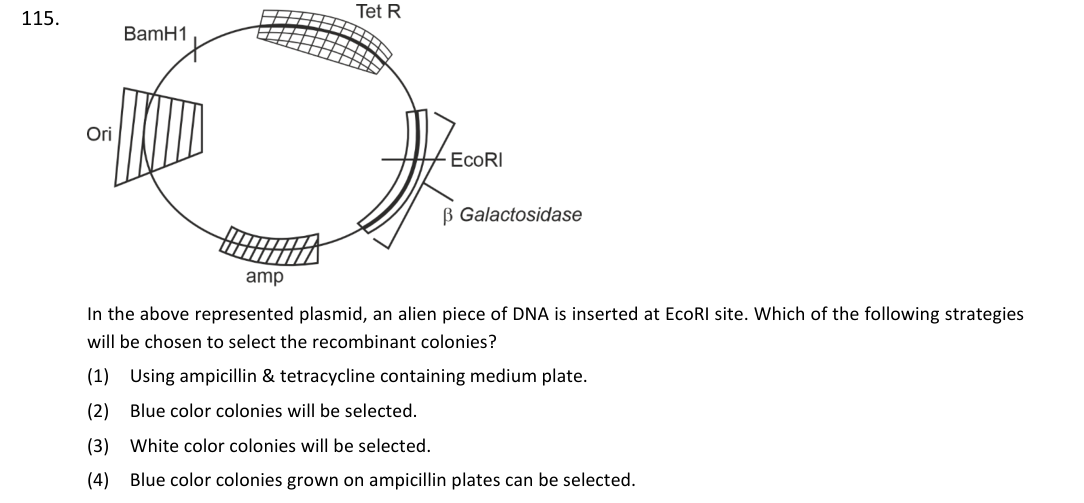
In the plasmid represented in the figure, an alien piece of DNA is inserted at the EcoRI site. Which of the following strategies will be chosen to select the recombinant colonies?
- A.Using an ampicillin- and tetracycline-containing medium plate.
- B.Blue-coloured colonies will be selected.
- C.White-coloured colonies will be selected.✓
- D.Blue-coloured colonies grown on ampicillin plates can be selected.
Solution
The EcoRI site lies within the lacZ gene of the vector. An insert there inactivates β−galactosidase, so recombinant colonies cannot break down the chromogenic substrate and stay white, while non-recombinants turn blue. Select the white colonies.
Q26openBiotechnology and its Applications · Applications in medicine: insulin, gene therapy, molecular diagnosis
Which of the following genetically engineered organisms was used by Eli Lilly to prepare human insulin?
- A.Bacterium✓
- B.Yeast
- C.Virus
- D.Phage
Solution
Eli Lilly produced human insulin (Humulin) in 1983 by expressing the A and B chains in E. coli, a bacterium, and then joining them by disulphide bonds.
Q27openBiomolecules · Enzymes: mechanism, factors, classification
Name the class of enzyme that usually catalyses the following reaction:
S−G+S#→S+S#−G
where G → a group other than hydrogen, S → a substrate, S# → another substrate.
- A.Hydrolase
- B.Lyase
- C.Transferase✓
- D.Ligase
Solution
Moving a group G from one substrate to another is the signature of a transferase. Hydrolases add water, lyases remove groups to form double bonds, and ligases join two molecules with ATP.
Q28openAnatomy of Flowering Plants · Anatomy of dicot and monocot root, stem, leaf
Find the statement that is not correct with regard to the structure of the monocot stem.
- A.The hypodermis is parenchymatous.✓
- B.Vascular bundles are scattered.
- C.Vascular bundles are conjoint and closed.
- D.Phloem parenchyma is absent.
Solution
In a monocot stem the hypodermis is sclerenchymatous, not parenchymatous — Statement 1 is wrong. Scattered, conjoint, closed bundles and absent phloem parenchyma are all correct.
Q29openPlant Kingdom · Bryophytes and pteridophytes
The correct sequence of events in the life cycle of bryophytes is:
A. Fusion of antherozoid with egg
B. Attachment of gametophyte to the substratum
C. Reduction division to produce haploid spores
D. Formation of sporophyte
E. Release of antherozoids into water
Choose the correct answer from the options given below:
- A.D, E, A, C, B
- B.B, E, A, C, D
- C.B, E, A, D, C✓
- D.D, E, A, B, C
Solution
The gametophyte attaches to the substratum (B), releases antherozoids into water (E), an antherozoid fuses with the egg (A), the sporophyte develops on the gametophyte (D), and meiosis in the capsule produces haploid spores (C). So B, E, A, D, C.
Q30openHuman Health and Disease · Immunity, vaccination, AIDS, cancer
Which are correct?
A. Computed tomography and magnetic resonance imaging detect cancers of internal organs.
B. Chemotherapeutic drugs are used to kill non-cancerous cells.
C.α−interferon activates the cancer patient's immune system and helps in destroying the tumour.
D. Chemotherapeutic drugs are biological response modifiers.
E. In the case of leukaemia, blood cell counts are decreased.
Choose the correct answer from the options given below:
- A.B and D only
- B.D and E only
- C.C and D only
- D.A and C only✓
Solution
CT and MRI detect internal cancers (A), and α−interferon is a biological response modifier that activates the patient's immune system (C). Chemotherapeutic drugs kill cancerous cells and are not biological response modifiers; leukaemia raises the blood cell count. Hence A and C.
Q31openCell: The Unit of Life · Mitochondria, plastids, ribosomes, cytoskeleton, nucleus
Match List I with List II.
| List I | List II |
|---|---|
| A. Centromere | I. Mitochondrion |
| B. Cilium | II. Cell division |
| C. Cristae | III. Cell movement |
| D. Cell membrane | IV. Phospholipid bilayer |
Choose the correct answer from the options given below:
- A.A-I, B-II, C-III, D-IV
- B.A-II, B-I, C-IV, D-III
- C.A-IV, B-II, C-III, D-I
- D.A-II, B-III, C-I, D-IV✓
Solution
The centromere functions in cell division (II); a cilium in cell movement (III); cristae belong to the mitochondrion (I); the cell membrane is a phospholipid bilayer (IV).
Q32openPhotosynthesis in Higher Plants · Light reaction: photosystems, electron transport, photophosphorylation
Match List I with List II.
| List I | List II |
|---|---|
| A. Chlorophyll a | I. Yellow-green |
| B. Chlorophyll b | II. Yellow |
| C. Xanthophylls | III. Blue-green |
| D. Carotenoids | IV. Yellow to yellow-orange |
Choose the option with all correct matches:
- A.A-III, B-IV, C-II, D-I
- B.A-III, B-I, C-II, D-IV✓
- C.A-I, B-II, C-IV, D-III
- D.A-I, B-IV, C-III, D-II
Solution
On a chromatogram chlorophyll a is blue-green (III), chlorophyll b yellow-green (I), xanthophylls yellow (II) and carotenoids yellow to yellow-orange (IV).
Q33openHuman Reproduction · Fertilisation, implantation, pregnancy, parturition, lactation
Find the correct statements:
(A) In human pregnancy, the major organ systems are formed by the end of 12 weeks.
(B) In human pregnancy, the major organ systems are formed by the end of 8 weeks.
(C) In human pregnancy, the heart is formed after one month of gestation.
(D) In human pregnancy, limbs and digits develop by the end of the second month.
(E) In human pregnancy, the appearance of hair is usually observed in the fifth month.
Choose the correct answer from the options given below:
- A.A and E only
- B.B and C only
- C.B, C, D and E only
- D.A, C, D and E only✓
Solution
Major organ systems form by the end of 12 weeks (A); the heart forms after one month (C); limbs and digits by the end of the second month (D); hair appears by the fifth month (E). Statement B's 8 weeks is wrong. Hence A, C, D and E.
Q34openMorphology of Flowering Plants · Fruit and seed; families
In the seeds of cereals, the outer covering of the endosperm separates the embryo by a protein-rich layer called:
- A.Coleoptile
- B.Coleorhiza
- C.Integument
- D.Aleurone layer✓
Solution
In cereal grains the endosperm is separated from the embryo by the aleurone layer, a protein-rich layer that also secretes enzymes during germination.
Q35openExcretory Products and their Elimination · Human excretory system and nephron
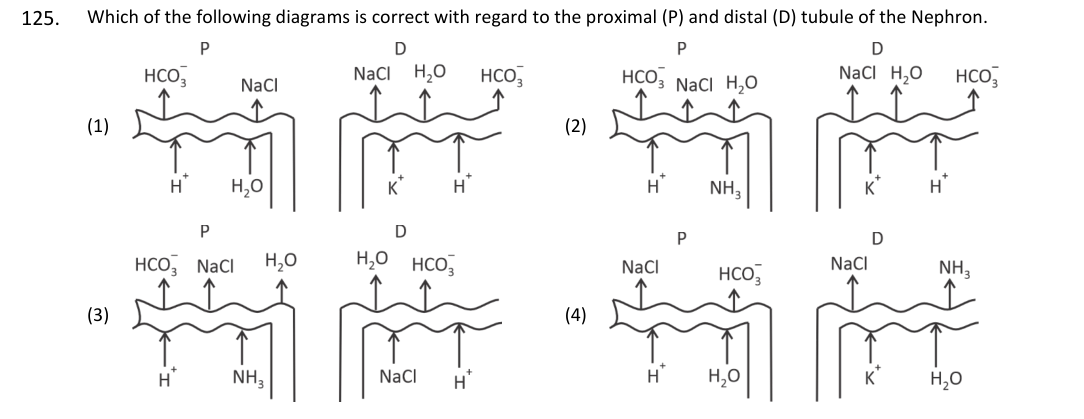
Which of the following diagrams (shown) is correct with regard to the proximal (P) and distal (D) tubule of the nephron?
- A.Diagram (1)
- B.Diagram (2)✓
- C.Diagram (3)
- D.Diagram (4)
Solution
The proximal convoluted tubule has a simple cuboidal brush-border epithelium (microvilli on the lumen side) for reabsorption; the distal tubule is cuboidal without a brush border. The diagram showing microvilli on P and none on D is correct.
Q36openBiotechnology: Principles and Processes · Processes: cloning, PCR, bioreactors
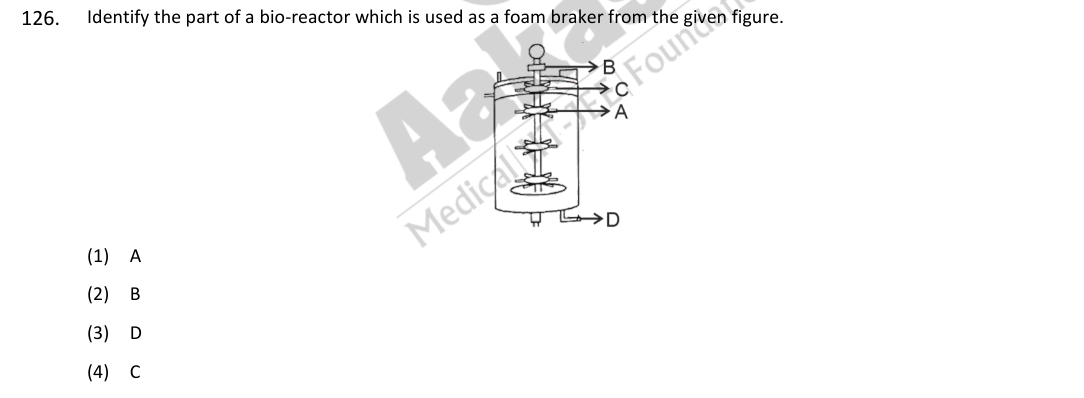
Identify the part of a bioreactor which is used as a foam breaker from the given figure.
- A.A
- B.B
- C.D
- D.C✓
Solution
In a stirred-tank bioreactor the foam breaker sits at the top, above the agitator and the sparger, labelled C in the given figure.
Q37openSexual Reproduction in Flowering Plants · Flower structure, microsporogenesis and megasporogenesis
Given below are two statements: one is labelled as Assertion (A) and the other is labelled as Reason (R).
Assertion (A): A typical unfertilised angiosperm embryo sac at maturity is 8-nucleate and 7-celled.
Reason (R): The egg apparatus has 2 polar nuclei.
In the light of the above statements, choose the correct answer from the options given below:
- A.Both A and R are true and R is the correct explanation of A
- B.Both A and R are true but R is NOT the correct explanation of A
- C.A is true but R is false✓
- D.A is false but R is true
Solution
A mature embryo sac is 7-celled and 8-nucleate (A true) because the central cell carries two polar nuclei. The egg apparatus is the egg plus two synergids — the polar nuclei are not part of it, so R is false.
Q38openCell: The Unit of Life · Cell theory, prokaryotic and eukaryotic cells
A specialised membranous structure in a prokaryotic cell which helps in cell wall formation, DNA replication and respiration is:
- A.Mesosome✓
- B.Chromatophores
- C.Cristae
- D.Endoplasmic reticulum
Solution
The mesosome, an infolding of the prokaryotic plasma membrane, helps in cell-wall formation, DNA replication and its distribution, and in respiration.
Q39openMolecular Basis of Inheritance · Transcription, genetic code, translation
Which of the following are the post-transcriptional events in a eukaryotic cell?
A. Transport of pre-mRNA to the cytoplasm prior to splicing.
B. Removal of introns and joining of exons.
C. Addition of a methyl group at the 5′ end of hnRNA.
D. Addition of adenine residues at the 3′ end of hnRNA.
E. Base pairing of two complementary RNAs.
Choose the correct answer from the options given below:
- A.A, B, C only
- B.B, C, D only✓
- C.B, C, E only
- D.C, D, E only
Solution
hnRNA is capped with a methyl-guanosine at the 5′ end (C), polyadenylated at the 3′ end (D), and spliced to remove introns and join exons (B) — all before it leaves the nucleus. So B, C and D.
Q40openPrinciples of Inheritance and Variation · Mendel's laws and deviations
What is the pattern of inheritance for a polygenic trait?
- A.Mendelian inheritance pattern
- B.Non-Mendelian inheritance pattern✓
- C.Autosomal dominant pattern
- D.X-linked recessive inheritance pattern
Solution
Polygenic traits such as skin colour and height are controlled by several genes with additive effects and show continuous variation — a non-Mendelian pattern.
Q41openBiomolecules · Enzymes: mechanism, factors, classification
Which one of the following enzymes contains 'haem' as the prosthetic group?
- A.RuBisCO
- B.Carbonic anhydrase
- C.Succinate dehydrogenase
- D.Catalase✓
Solution
Catalase contains haem as its prosthetic group. Carbonic anhydrase and carboxypeptidase use zinc; RuBisCO needs Mg2+; succinate dehydrogenase uses FAD.
Q42openBiological Classification · Five-kingdom classification
Each of the following characteristics represents a kingdom proposed by Whittaker. Arrange the following in increasing order of complexity of body organisation.
A. Multicellular heterotrophs with a cell wall made of chitin.
B. Heterotrophs with tissue/organ/organ-system level of body organisation.
C. Prokaryotes with a cell wall made of polysaccharides and amino acids.
D. Eukaryotic autotrophs with tissue/organ level of body organisation.
E. Eukaryotes with cellular body organisation.
Choose the correct answer from the options given below:
- A.A, C, E, B, D
- B.C, E, A, D, B✓
- C.A, C, E, D, B
- D.C, E, A, B, D
Solution
Monera (prokaryotes with peptidoglycan walls, C) → Protista (unicellular eukaryotes, E) → Fungi (multicellular with chitin walls, A) → Plantae (tissue/organ level autotrophs, D) → Animalia (organ-system level heterotrophs, B). So C, E, A, D, B.
Q43openOrganisms and Populations · Organism and its environment; adaptations
Who is known as the father of ecology in India?
- A.S. R. Kashyap
- B.Ramdeo Misra✓
- C.Ram Udar
- D.Birbal Sahni
Solution
Ramdeo Misra, who established ecology as a discipline at Banaras Hindu University, is regarded as the father of Indian ecology.
Q44openMolecular Basis of Inheritance · DNA structure and replication
Match List I with List II.
| List I | List II |
|---|---|
| A. Alfred Hershey and Martha Chase | I. Streptococcus pneumoniae |
| B. Euchromatin | II. Densely packed and dark-stained |
| C. Frederick Griffith | III. Loosely packed and light-stained |
| D. Heterochromatin | IV. Confirmation of DNA as genetic material |
Choose the correct answer from the options given below:
- A.A-II, B-IV, C-I, D-III
- B.A-IV, B-II, C-I, D-III
- C.A-IV, B-III, C-I, D-II✓
- D.A-III, B-II, C-IV, D-I
Solution
Hershey and Chase confirmed DNA as the genetic material (IV); euchromatin is loosely packed and lightly stained (III); Griffith worked with Streptococcus pneumoniae (I); heterochromatin is densely packed and dark (II).
Q45openHuman Health and Disease · Immunity, vaccination, AIDS, cancer
Neoplastic characteristics of cells refer to:
A. A mass of proliferating cells
B. Rapid growth of cells
C. Invasion and damage to the surrounding tissue
D. Those confined to their original location
Choose the correct answer from the options given below:
- A.A, B only
- B.A, B, C only✓
- C.A, B, D only
- D.B, C, D only
Solution
Neoplastic (malignant) cells form a proliferating mass (A), grow rapidly (B) and invade and damage surrounding tissue (C). Being confined to the original site describes a benign tumour. Hence A, B and C.