Skip to content

NEET 2025Physics

All 44 Physics questions we hold from this paper, of the 178 on the site for this sitting — every option and the answer key. 4 marks each, −1 for a wrong answer.

Physics

45 questions, one correct option each. +4 for a correct answer, −1 for a wrong one, nothing for a blank.

Q1openMechanical Properties of Fluids · Surface tension, capillarity, excess pressure

Consider a water tank shown in the figure. It has one wall at and can be taken to be very wide in the direction. When filled with a liquid of surface tension and density , the liquid surface makes an angle () with the -axis at . If is the height of the surface, then the equation for is (take ; is the acceleration due to gravity):
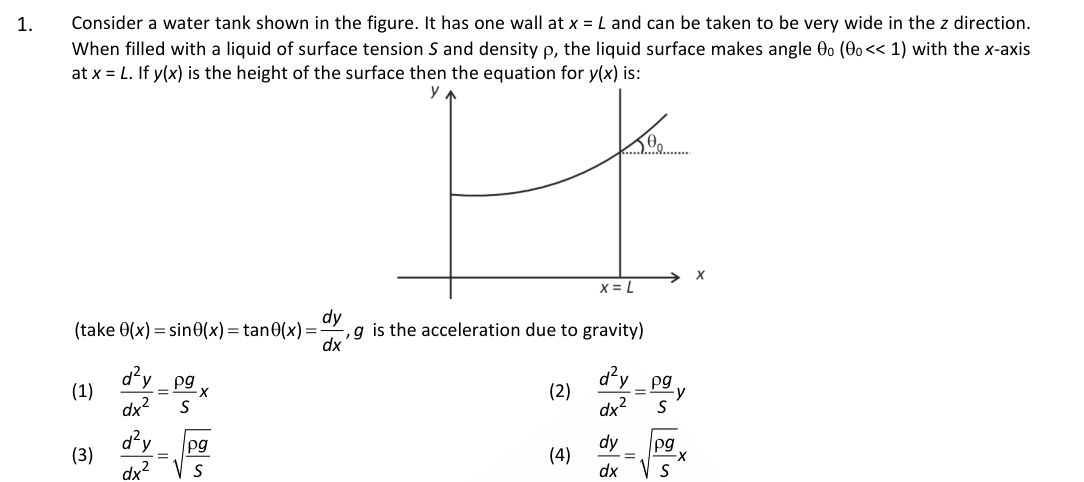
Question 1 as printed in the NEET 2025 booklet

  1. A.
  2. B.
  3. C.
  4. D.

Solution

At height the hydrostatic pressure is balanced by the surface-tension pressure (curvature). For a nearly flat surface the curvature is , so , i.e. .

Save for spaced revision (free account)

Q2openRay Optics and Optical Instruments · Optical instruments: microscope and telescope

A microscope has an objective of focal length 2 cm, an eyepiece of focal length 4 cm and a tube length of 40 cm. If the distance of distinct vision of the eye is 25 cm, the magnification of the microscope is:

  1. A.100
  2. B.125
  3. C.150
  4. D.250

Solution

; with the commonly used approximation , which is the marked answer.

Save for spaced revision (free account)

Q3openMoving Charges and Magnetism · Force on a moving charge and on a current

An electron (mass kg and charge C) moving with speed ( = speed of light) is injected into a magnetic field of magnitude T perpendicular to its direction of motion. We wish to apply a uniform electric field together with the magnetic field so that the electron does not deflect from its path. Then (speed of light ):

  1. A. is perpendicular to and its magnitude is
  2. B. is perpendicular to and its magnitude is
  3. C. is parallel to and its magnitude is
  4. D. is parallel to and its magnitude is

Solution

For no deflection the electric force must cancel the magnetic force: , with perpendicular to both and . V/m.

Save for spaced revision (free account)

Q4openLaws of Motion · Friction: static, kinetic, rolling

There are two inclined surfaces of equal length and the same angle of inclination with the horizontal. One of them is rough and the other is perfectly smooth. A given body takes 2 times as much time to slide down the rough surface as the smooth surface. The coefficient of kinetic friction () between the object and the rough surface is close to:

  1. A.0.25
  2. B.0.40
  3. C.0.5
  4. D.0.75

Solution

Smooth: . Rough: . Same distance, , so .

Save for spaced revision (free account)

Q5openWork, Energy and Power · Work by constant and variable forces

The kinetic energies of two similar cars A and B are 100 J and 225 J respectively. On applying brakes, car A stops after 1000 m and car B stops after 1500 m. If and are the forces applied by the brakes on cars A and B respectively, then the ratio is:

  1. A.
  2. B.
  3. C.
  4. D.

Solution

Work–energy: . .

Save for spaced revision (free account)

Q6openCurrent Electricity · Kirchhoff's rules, Wheatstone bridge, potentiometer

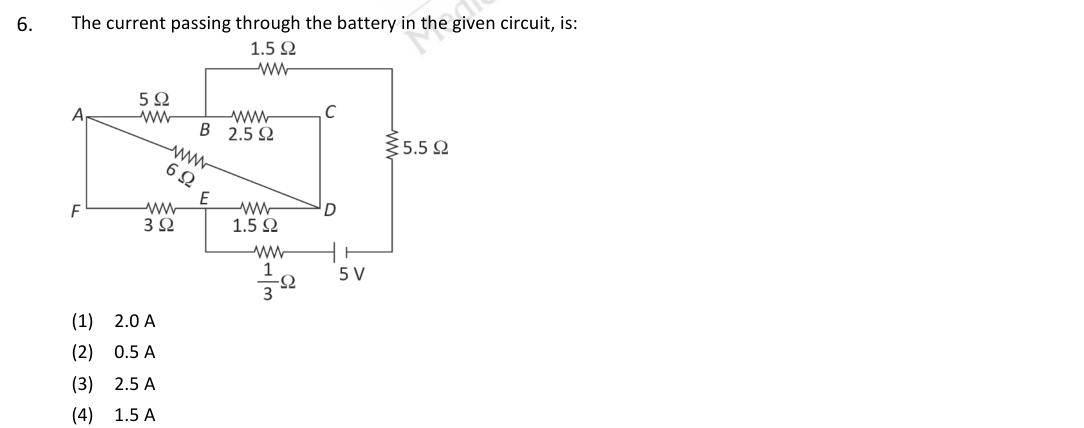
The current passing through the battery in the given circuit is:

Question 6 as printed in the NEET 2025 booklet

  1. A.2.0 A
  2. B.0.5 A
  3. C.2.5 A
  4. D.1.5 A
Save for spaced revision (free account)

Q7openWork, Energy and Power · Power and vertical circular motion

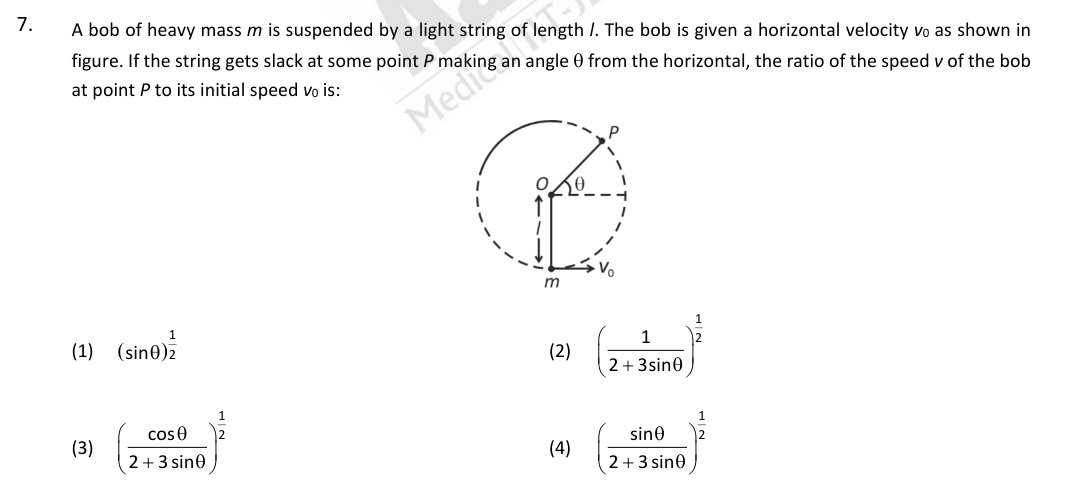
A bob of heavy mass is suspended by a light string of length . The bob is given a horizontal velocity as shown in the figure. If the string gets slack at some point P making an angle from the horizontal, the ratio of the speed of the bob at point P to its initial speed is:

Question 7 as printed in the NEET 2025 booklet

  1. A.
  2. B.
  3. C.
  4. D.

Solution

Let the string go slack at P, where the radius makes angle above the horizontal, so P is at height above the lowest point. Slack means tension is zero: , i.e. . Energy: . Hence .

Save for spaced revision (free account)

Q8openSemiconductor Electronics · Logic gates

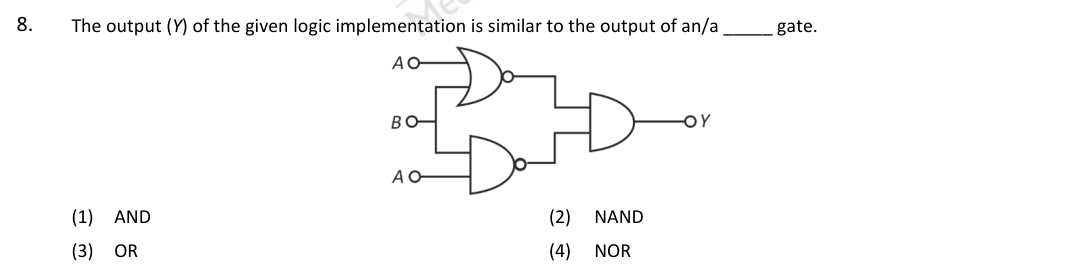
The output () of the given logic implementation is similar to the output of a/an _____ gate.

Question 8 as printed in the NEET 2025 booklet

  1. A.AND
  2. B.NAND
  3. C.OR
  4. D.NOR

Solution

The top gate is a NOR: . The bottom gate is a NAND: . Their AND gives , which is exactly — a NOR gate.

Save for spaced revision (free account)

Q9openElectromagnetic Waves · Electromagnetic spectrum

The electric field in a plane electromagnetic wave is given by V/m. Then the expression for the corresponding magnetic field is (here the subscripts denote the direction of the field):

  1. A. T
  2. B. T
  3. C. T
  4. D. T

Solution

T. The wave travels along (phase ); with along , must point along , which requires along . So T.

Save for spaced revision (free account)

Q10openLaws of Motion · Newton's laws, inertia, impulse and momentum

A ball of mass 0.5 kg is dropped from a height of 40 m. The ball hits the ground and rises to a height of 10 m. The impulse imparted to the ball during its collision with the ground is (take ):

  1. A.21 N s
  2. B.7 N s
  3. C.0
  4. D.84 N s

Solution

Speed just before impact m/s downward; just after m/s upward. Impulse N s.

Save for spaced revision (free account)

Q11openElectromagnetic Induction · Self and mutual inductance

AB is a part of an electrical circuit (see figure). The potential difference , at the instant when the current A and is increasing at a rate of 1 A/s, is:

Question 11 as printed in the NEET 2025 booklet

  1. A.5 volt
  2. B.6 volt
  3. C.9 volt
  4. D.10 volt

Solution

Walk from A to B adding potential drops: across the inductor V (current increasing); across the cell, entering at the positive plate, a drop of 5 V; across the resistor V. V.

Save for spaced revision (free account)

Q12openMoving Charges and Magnetism · Torque on a current loop, moving-coil galvanometer

A 2 A current is flowing through two different small circular copper coils having a radii ratio of 1 : 2. The ratio of their respective magnetic moments will be:

  1. A.1 : 4
  2. B.1 : 2
  3. C.2 : 1
  4. D.4 : 1

Solution

with the same current, so .

Save for spaced revision (free account)

Q13openRay Optics and Optical Instruments · Reflection and refraction, mirror and lens formulae

In a certain camera, a combination of four similar thin convex lenses is arranged axially in contact. Then the power of the combination and the total magnification, in comparison to the power () and magnification () of each lens, will be, respectively:

  1. A. and
  2. B. and
  3. C. and
  4. D. and

Solution

Powers of thin lenses in contact add: . Magnifications multiply: .

Save for spaced revision (free account)

Q14openKinetic Theory · Ideal gas equation and kinetic interpretation of pressure

An oxygen cylinder of volume 30 litre has 18.20 moles of oxygen. After some oxygen is withdrawn from the cylinder, its gauge pressure drops to 11 atmospheres at a temperature of C. The mass of the oxygen withdrawn from the cylinder is nearly equal to: [Given , molecular mass of = 32, 1 atm pressure ]

  1. A.0.125 kg
  2. B.0.144 kg
  3. C.0.116 kg
  4. D.0.156 kg

Solution

Final moles mol (gauge 11 atm means absolute 12 atm). Withdrawn mol kg.

Save for spaced revision (free account)

Q15openMotion in a Straight Line · Displacement, velocity, acceleration; graphs

In some appropriate units, the time () and position () relation of a moving particle is given by . The acceleration of the particle is:

  1. A.
  2. B.
  3. C.
  4. D.

Solution

. Then .

Save for spaced revision (free account)

Q16openAlternating Current · AC through R, L, C and LCR circuits

To an AC power supply of 220 V at 50 Hz, a resistor of capacitor of reactance and an inductor of reactance are connected in series. The corresponding current in the circuit and the phase angle between the current and the voltage are, respectively:

  1. A.7.8 A and 30°
  2. B.7.8 A and 45°
  3. C.15.6 A and 30°
  4. D.15.6 A and 45°

Solution

, so A. .

Save for spaced revision (free account)

Q17openSystem of Particles and Rotational Motion · Torque, angular momentum and their conservation

The Sun rotates around its centre once in 27 days. What will be the period of revolution if the Sun were to expand to twice its present radius without any external influence? Assume the Sun to be a sphere of uniform density.

  1. A.100 days
  2. B.105 days
  3. C.115 days
  4. D.108 days

Solution

No external torque, so is conserved. for a uniform sphere, so doubling quadruples and the period becomes days.

Save for spaced revision (free account)

Q18openMoving Charges and Magnetism · Torque on a current loop, moving-coil galvanometer

A model for the quantised motion of an electron in a uniform magnetic field states that the flux passing through the orbit of the electron is , where is an integer, is Planck's constant and is the magnitude of the electron's charge. According to the model, the magnetic moment of an electron in its lowest energy state will be ( is the mass of the electron):

  1. A.
  2. B.
  3. C.
  4. D.

Solution

Flux quantisation: for the lowest state. In the field, . Magnetic moment .

Save for spaced revision (free account)

Q19openThermal Properties of Matter · Heat transfer: conduction, convection, radiation

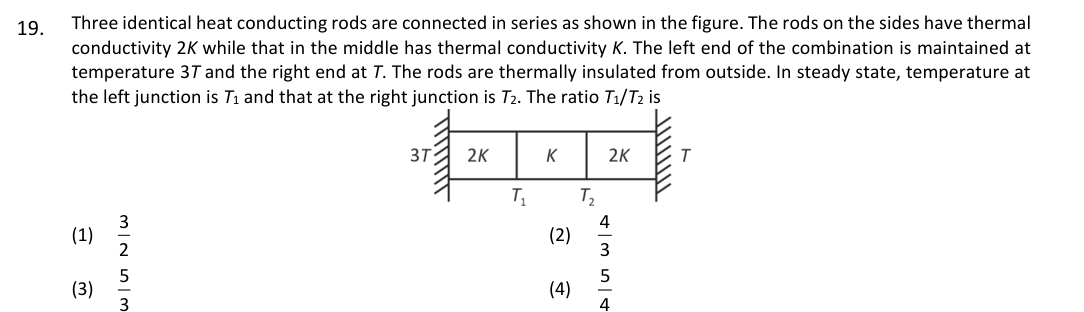
Three identical heat-conducting rods are connected in series as shown in the figure. The rods on the sides have thermal conductivity while that in the middle has thermal conductivity . The left end of the combination is maintained at temperature and the right end at . The rods are thermally insulated from outside. In steady state, the temperature at the left junction is and that at the right junction is . The ratio is:

Question 19 as printed in the NEET 2025 booklet

  1. A.
  2. B.
  3. C.
  4. D.

Solution

In series the heat current is the same, so the temperature drop across each rod is : drops in the ratio across a total drop of , i.e. , , . Hence , and .

Save for spaced revision (free account)

Q20openElectrostatic Potential and Capacitance · Conductors and dielectrics

The plates of a parallel plate capacitor are separated by . Two slabs of different dielectric constants and , with thicknesses and respectively, are inserted in the capacitor. Due to this, the capacitance becomes two times larger than when there is nothing between the plates. If , the value of is:

  1. A.2.66
  2. B.2.33
  3. C.1.60
  4. D.1.33

Solution

Effective gap (air). Capacitance doubling means this equals : . With : .

Save for spaced revision (free account)

Q21openMotion in a Straight Line · Relative velocity in one dimension

Two cities X and Y are connected by a regular bus service with a bus leaving in either direction every min. A girl driving a scooty at a speed of 60 km/h in the direction X to Y notices that a bus goes past her every 30 minutes in the direction of her motion, and every 10 minutes in the opposite direction. Choose the correct option for the period of the bus service and the speed (assumed constant) of the buses.

  1. A.9 min, 40 km/h
  2. B.25 min, 100 km/h
  3. C.10 min, 90 km/h
  4. D.15 min, 120 km/h

Solution

Let bus speed be . Same direction: buses catch her every 30 min, so ; opposite: . Dividing, km/h, then min.

Save for spaced revision (free account)

Q22openSystem of Particles and Rotational Motion · Torque, angular momentum and their conservation

A uniform rod of mass 20 kg and length 5 m leans against a smooth vertical wall making an angle of with it. The other end rests on a rough horizontal floor. The friction force that the floor exerts on the rod is (take ):

  1. A.100 N
  2. B. N
  3. C.200 N
  4. D. N

Solution

Take torques about the foot. The wall pushes horizontally with ; the rod's weight acts at its midpoint. With the rod at to the wall (i.e. to the floor): N. Friction at the floor balances : N.

Save for spaced revision (free account)

Q23openOscillations · Spring–mass system and simple pendulum

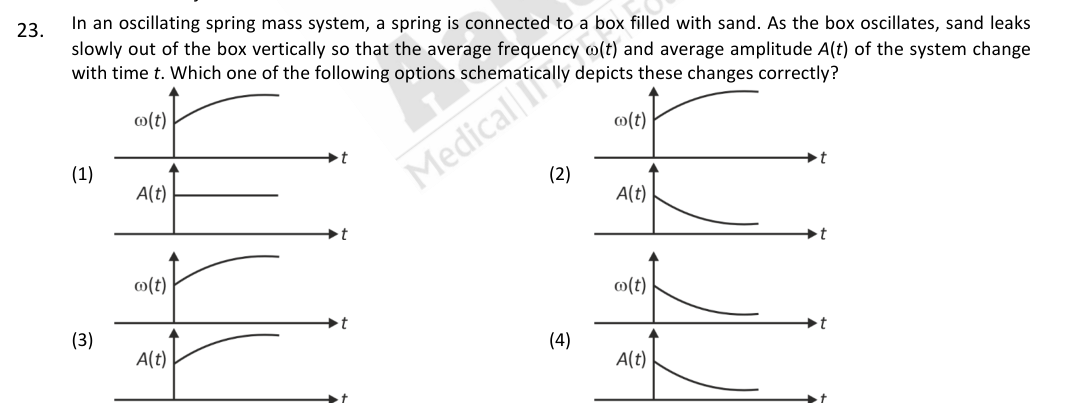
In an oscillating spring–mass system, a spring is connected to a box filled with sand. As the box oscillates, sand leaks slowly out of the box vertically so that the average frequency and average amplitude of the system change with time . Which one of the following options (graphs shown) schematically depicts these changes correctly?

Question 23 as printed in the NEET 2025 booklet

  1. A.Graph (1)
  2. B.Graph (2)
  3. C.Graph (3)
  4. D.Graph (4)

Solution

, so as sand leaves and falls, rises and levels off. Each grain that leaves carries away its share of the kinetic energy, so the oscillator's energy decreases and the amplitude falls — option (2).

Save for spaced revision (free account)

Q24openUnits and Measurements · SI units, dimensions and dimensional analysis

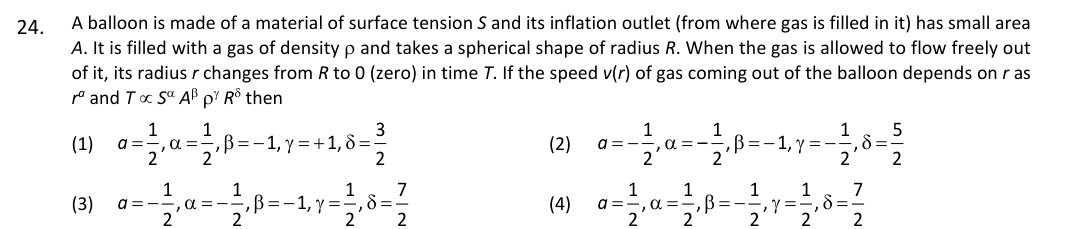
A balloon is made of a material of surface tension and its inflation outlet (from where gas is filled in it) has a small area . It is filled with a gas of density and takes a spherical shape of radius . When the gas is allowed to flow freely out of it, its radius changes from to 0 in time . If the speed of the gas coming out of the balloon depends on as and , then:

Question 24 as printed in the NEET 2025 booklet

  1. A.Option set (1)
  2. B.Option set (2)
  3. C.
  4. D.Option set (4)

Solution

The excess pressure drives the outflow, so , giving . Time to empty : , , , .

Save for spaced revision (free account)

Q25openUnits and Measurements · Measuring instruments: vernier, screw gauge

Consider the diameter of a spherical object being measured with the help of a Vernier callipers. Suppose its 10 Vernier scale divisions (V.S.D.) are equal to its 9 main scale divisions (M.S.D.). The least division on the M.S. is 0.1 cm and the zero of the V.S. is at cm when the jaws of the Vernier callipers are closed. If the main scale reading for the diameter is cm and the number of the coinciding Vernier division is 8, the measured diameter after zero-error correction is:

  1. A.5.18 cm
  2. B.5.08 cm
  3. C.4.98 cm
  4. D.5.00 cm

Solution

1 VSD MSD, so the least count is cm. Reading cm; the zero error is cm, so the corrected diameter is cm.

Save for spaced revision (free account)

Q26openElectromagnetic Waves · Displacement current and Maxwell's equations (qualitative)

A parallel plate capacitor made of circular plates is being charged such that the surface charge density on its plates is increasing at a constant rate with time. The magnetic field arising due to the displacement current is:

  1. A.Zero at all places
  2. B.Constant between the plates and zero outside the plates
  3. C.Non-zero everywhere, with a maximum at the imaginary cylindrical surface connecting the peripheries of the plates
  4. D.Zero between the plates and non-zero outside

Solution

The growing electric field between the plates is a displacement current, and by Ampère–Maxwell it produces a magnetic field that grows with distance from the axis up to the plate edge and then falls as outside — non-zero everywhere, maximum at the rim.

Save for spaced revision (free account)

Q27openWave Optics · Diffraction and polarisation

An unpolarised light beam travelling in air is incident on a medium of refractive index 1.73 at Brewster's angle. Then:

  1. A.The reflected light is completely polarised and the angle of reflection is close to 60°
  2. B.The reflected light is partially polarised and the angle of reflection is close to 30°
  3. C.Both reflected and transmitted light are perfectly polarised with angles of reflection and refraction close to 60° and 30°, respectively
  4. D.The transmitted light is completely polarised with an angle of refraction close to 30°

Solution

Brewster's angle: . The reflected beam (at ) is completely polarised; the refracted beam, at , is only partially polarised.

Save for spaced revision (free account)

Q28openElectric Charges and Fields · Coulomb's law and superposition

Two identical charged conducting spheres A and B have their centres separated by a certain distance. The charge on each sphere is and the force of repulsion between them is . A third identical uncharged conducting sphere is brought in contact with sphere A first and then with B, and finally removed from both. The new force of repulsion between spheres A and B (the radii of A and B are negligible compared to the distance of separation, so they can be considered point charges) is best given as:

  1. A.
  2. B.
  3. C.
  4. D.

Solution

Touching A: the third sphere and A share , so A becomes . Touching B: it carries to B, which then holds . New force , i.e. .

Save for spaced revision (free account)

Q29openKinetic Theory · Ideal gas equation and kinetic interpretation of pressure

A container has two chambers of volumes litres and litres separated by a partition made of a thermal insulator. The chambers contain and moles of ideal gas at pressures atm and atm, respectively. When the partition is removed, the mixture attains an equilibrium pressure of:

  1. A.1.3 atm
  2. B.1.6 atm
  3. C.1.4 atm
  4. D.1.8 atm

Solution

Temperature is the same throughout (no heat exchange with outside, ideal gases). Final and . Using : atm.

Save for spaced revision (free account)

Q30openAtoms · Rutherford and Bohr models

A particle of mass is moving around the origin with a constant force pulling it towards the origin. If the Bohr model is used to describe its motion, the radius of the th orbit and the particle's speed in the orbit depend on as:

  1. A.
  2. B.
  3. C.
  4. D.

Solution

Constant force and Bohr quantisation . From the first, ; substituting, and .

Save for spaced revision (free account)

Q31openGravitation · Kepler's laws, satellites, escape velocity

The radius of the Martian orbit around the Sun is about 4 times the radius of the orbit of Mercury. The Martian year is 687 Earth days. Then which of the following is the length of 1 year on Mercury?

  1. A.88 Earth days
  2. B.225 Earth days
  3. C.172 Earth days
  4. D.124 Earth days

Solution

Kepler's third law: . , so — nearest option 88 Earth days.

Save for spaced revision (free account)

Q32openGravitation · Newton's law of gravitation, g and its variation

A body weighs 48 N on the surface of the earth. The gravitational force experienced by the body due to the earth at a height equal to one-third the radius of the earth from its surface is:

  1. A.16 N
  2. B.27 N
  3. C.32 N
  4. D.36 N

Solution

. With , , so N.

Save for spaced revision (free account)

Q33openCurrent Electricity · Ohm's law, resistivity, temperature dependence

A wire of resistance is cut into 8 equal pieces. From these pieces two equivalent resistances are made by adding four of them together in parallel. Then these two sets are added in series. The net effective resistance of the combination is:

  1. A.
  2. B.
  3. C.
  4. D.

Solution

Each piece is . Four in parallel give ; two such sets in series give .

Save for spaced revision (free account)

Q34openDual Nature of Radiation and Matter · Matter waves and de Broglie wavelength

The de Broglie wavelength of an electron orbiting in the state of the hydrogen atom is close to (given Bohr radius = 0.052 nm):

  1. A.0.067 nm
  2. B.0.67 nm
  3. C.1.67 nm
  4. D.2.67 nm

Solution

In the th orbit the circumference equals de Broglie wavelengths: . With nm: nm nm.

Save for spaced revision (free account)

Q35openElectrostatic Potential and Capacitance · Potential and potential energy of charges and dipoles

An electric dipole with dipole moment C m is aligned with the direction of a uniform electric field of magnitude N/C. The dipole is then rotated through an angle of with respect to the electric field. The change in the potential energy of the dipole is:

  1. A.0.8 J
  2. B.1.0 J
  3. C.1.2 J
  4. D.1.5 J

Solution

. J.

Save for spaced revision (free account)

Q36openCurrent Electricity · Kirchhoff's rules, Wheatstone bridge, potentiometer

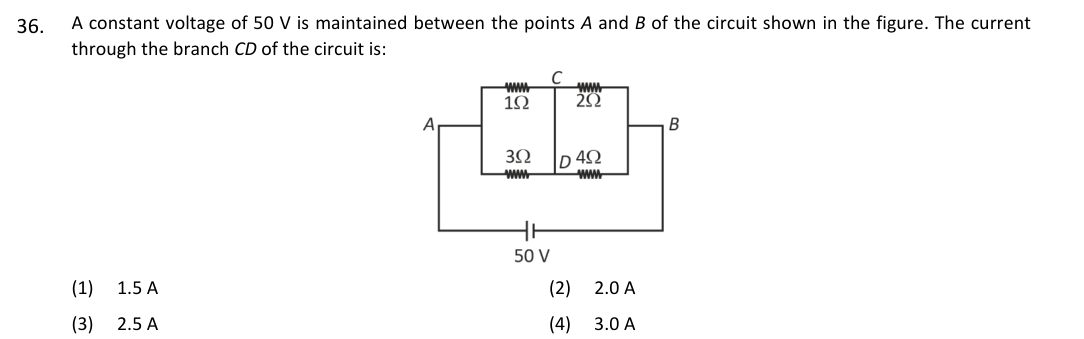
A constant voltage of 50 V is maintained between the points A and B of the circuit shown in the figure. The current through the branch CD of the circuit is:

Question 36 as printed in the NEET 2025 booklet

  1. A.1.5 A
  2. B.2.0 A
  3. C.2.5 A
  4. D.3.0 A

Solution

C and D are joined by a wire, so they are at a common potential (take , V). Current balance at that node: V. Into C through ; out of C through . The difference, 2.0 A, flows along CD.

Save for spaced revision (free account)

Q37openDual Nature of Radiation and Matter · Matter waves and de Broglie wavelength

A photon and an electron (mass ) have the same energy . The ratio of their de Broglie wavelengths is ( is the speed of light):

  1. A.
  2. B.
  3. C.
  4. D.

Solution

Photon: . Electron: . Ratio .

Save for spaced revision (free account)

Q38openDual Nature of Radiation and Matter · Photoelectric effect and Einstein's equation

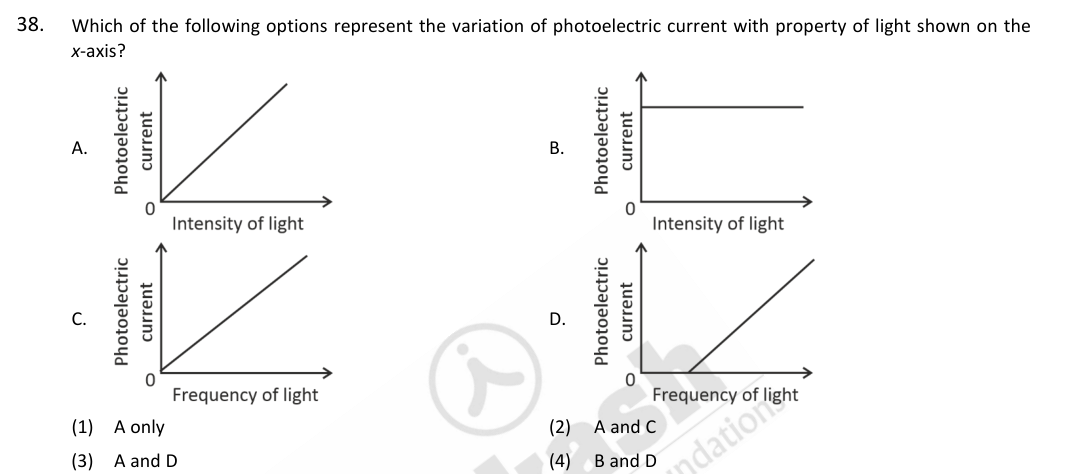
Which of the following options (graphs A–D shown) represent the variation of photoelectric current with the property of light shown on the -axis?

Question 38 as printed in the NEET 2025 booklet

  1. A.A only
  2. B.A and C
  3. C.A and D
  4. D.B and D

Solution

Above the threshold frequency the photoelectric current is proportional to the intensity (graph A, straight line through the origin) and is independent of frequency, so B, C and D are wrong. A only.

Save for spaced revision (free account)

Q39openSystem of Particles and Rotational Motion · Moment of inertia, theorems of axes

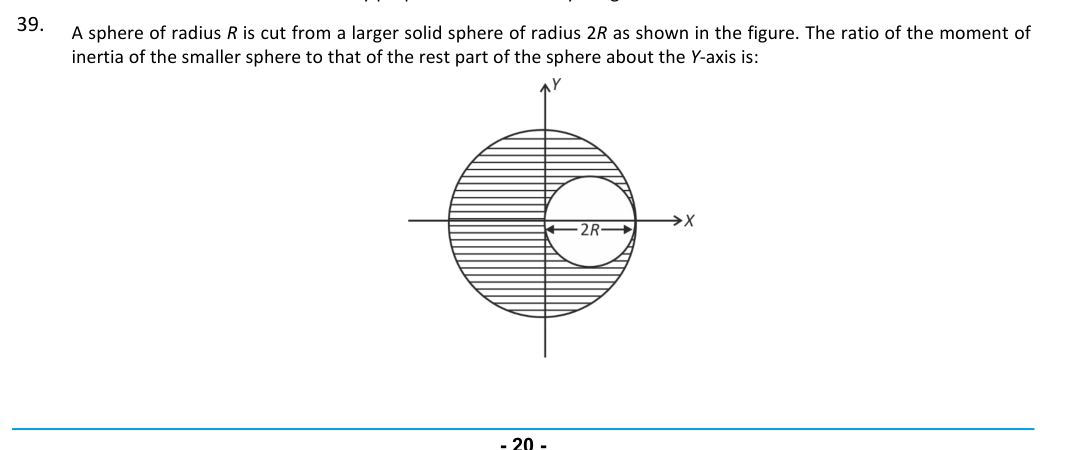
A sphere of radius is cut from a larger solid sphere of radius as shown in the figure. The ratio of the moment of inertia of the smaller sphere to that of the rest part of the sphere about the -axis is:

Question 39 as printed in the NEET 2025 booklet

  1. A.
  2. B.
  3. C.
  4. D.

Solution

The removed sphere has mass (radius halved) and its centre is from the -axis: . The full sphere: . The rest: . Ratio .

Save for spaced revision (free account)

Q40openThermodynamics · First law, work and internal energy

Two gases A and B are filled at the same pressure in separate cylinders with movable pistons of radius and , respectively. On supplying an equal amount of heat to both the systems reversibly under constant pressure, the pistons of gas A and B are displaced by 16 cm and 9 cm, respectively. If the change in their internal energy is the same, then the ratio is equal to:

  1. A.
  2. B.
  3. C.
  4. D.

Solution

Same heat, same , so the work done () is the same: .

Save for spaced revision (free account)

Q41openUnits and Measurements · Significant figures and errors in measurement

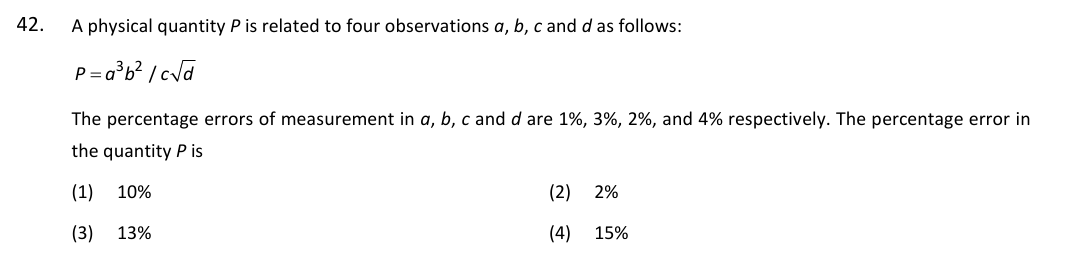
A physical quantity is related to four observations , , and by the relation shown in the booklet. The percentage errors of measurement in , , and are 1%, 3%, 2% and 4% respectively. The percentage error in the quantity is:

Question 42 as printed in the NEET 2025 booklet

  1. A.10%
  2. B.2%
  3. C.13%
  4. D.15%

Solution

.

Save for spaced revision (free account)

Q42openWave Optics · Diffraction and polarisation

The intensity of transmitted light when a polaroid sheet is placed between two crossed polaroids at from the polarisation axis of one of the polaroids is ( is the intensity of polarised light after passing through the first polaroid):

  1. A.
  2. B.
  3. C.
  4. D.

Solution

First polaroid → . The middle sheet at : . The last, crossed with the first, is at to the middle sheet: .

Save for spaced revision (free account)

Q43openOscillations · Spring–mass system and simple pendulum

Two identical point masses P and Q, suspended from two separate massless springs of spring constants and respectively, oscillate vertically. If their maximum speeds are the same, the ratio of the amplitude of mass Q to the amplitude of mass P is:

  1. A.
  2. B.
  3. C.
  4. D.

Solution

Maximum speed , equal for both: . With for equal masses, .

Save for spaced revision (free account)

Q44openWaves · Superposition, standing waves, beats

A pipe open at both ends has a fundamental frequency in air. The pipe is now dipped vertically in a water drum to half of its length. The fundamental frequency of the air column is now equal to:

  1. A.
  2. B.
  3. C.
  4. D.

Solution

Open pipe of length : . Dipped to half its length it becomes a closed pipe of length : .

Save for spaced revision (free account)