The ratio of the wavelengths of the light absorbed by a hydrogen atom when it undergoes the and transitions, respectively, is:
NEET 2025 — Chemistry
All 44 Chemistry questions we hold from this paper, of the 178 on the site for this sitting — every option and the answer key. 4 marks each, −1 for a wrong answer.
Chemistry
45 questions, one correct option each. +4 for a correct answer, −1 for a wrong one, nothing for a blank.
Q1openStructure of Atom · Bohr model and hydrogen spectrum
- A.361
- B.161
- C.91
- D.41✓
Solution
λ1∝n121−n221. For 2→3: 41−91=365. For 4→6: 161−361=1445. So λ4→6λ2→3=5/365/144=41.
Q2openClassification of Elements and Periodicity in Properties · Periodic trends: radius, ionisation enthalpy, electron gain enthalpy, electronegativity
Which of the following statements are true?
A. Unlike Ga, which has a very high melting point, Cs has a very low melting point.
B. On the Pauling scale, the electronegativity values of N and Cl are not the same.
C. Ar, K+, Cl−, Ca2+ and S2− are all isoelectronic species.
D. The correct order of the first ionisation enthalpies of Na, Mg, Al and Si is Si > Al > Mg > Na.
E. The atomic radius of Cs is greater than that of Li and Rb.
Choose the correct answer from the options given below:
- A.A, B and E only
- B.C and E only✓
- C.C and D only
- D.A, C and E only
Solution
Ar, K+, Cl−, Ca2+ and S2− all have 18 electrons (C true); atomic radius grows down Group 1, so Cs > Rb > Li (E true). Ga in fact has a low melting point (A false); N and Cl share the Pauling value 3.0 (B false); Mg > Al in first ionisation enthalpy (D false). Hence C and E.
Q3openPrinciples Related to Practical Chemistry · Titrimetric analysis and salt analysis
Match List I with List II.
| List I (Ion) | List II (Group number in cation analysis) |
|---|---|
| A. Co2+ | I. Group I |
| B. Mg2+ | II. Group III |
| C. Pb2+ | III. Group IV |
| D. Al3+ | IV. Group VI |
Choose the correct answer from the options given below:
- A.A-III, B-IV, C-II, D-I
- B.A-III, B-IV, C-I, D-II✓
- C.A-III, B-II, C-IV, D-I
- D.A-III, B-II, C-I, D-IV
Solution
Pb2+ precipitates as the chloride in Group I; Al3+ as the hydroxide in Group III; Co2+ as the sulphide in Group IV; Mg2+ is in Group VI. So A-III, B-IV, C-I, D-II.
Q4openAldehydes, Ketones and Carboxylic Acids · Named reactions: aldol, Cannizzaro, Clemmensen, Wolff–Kishner
Predict the major product 'P' in the sequence of reactions shown in the figure.
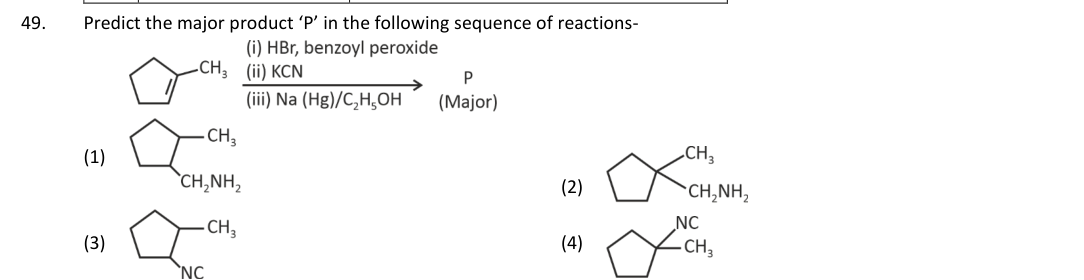
- A.Structure (1)✓
- B.Structure (2)
- C.Structure (3)
- D.Structure (4)
Solution
HBr with peroxide adds anti-Markovnikov, placing Br on the less substituted ring carbon (C-2) of 1-methylcyclopentene. KCN substitutes Br by –CN, and Na/ethanol reduces the nitrile to –CH2NH2. P is 1-methyl-2-(aminomethyl)cyclopentane — structure (1).
Q5openStructure of Atom · Bohr model and hydrogen spectrum
The energy and radius of the first Bohr orbit of He+ and Li2+ are (given RH=2.18×10⁻¹⁸ J, a0=52.9 pm):
- A.E(Li2+)=−19.62×10⁻¹⁸ J, r(Li2+)=17.6 pm; E(He+)=−8.72×10⁻¹⁸ J, r(He+)=26.4 pm✓
- B.E(Li2+)=−8.72×10⁻¹⁸ J, r(Li2+)=26.4 pm; E(He+)=−19.62×10⁻¹⁸ J, r(He+)=17.6 pm
- C.E(Li2+)=−19.62×10⁻¹⁶ J, r(Li2+)=17.6 pm; E(He+)=−8.72×10⁻¹⁶ J, r(He+)=26.4 pm
- D.E(Li2+)=−8.72×10⁻¹⁶ J, r(Li2+)=17.6 pm; E(He+)=−19.62×10⁻¹⁶ J, r(He+)=17.6 pm
Solution
En=−RHn2Z2 and rn=a0Zn2. He+ (Z=2): E=−4×2.18×10−18=−8.72×10⁻¹⁸ J, r=52.9/2=26.4 pm. Li2+ (Z=3): E=−9×2.18×10−18=−19.62×10⁻¹⁸ J, r=52.9/3=17.6 pm.
Q6openCoordination Compounds · Valence bond and crystal field theory
Which of the following are paramagnetic?
A. [NiCl4]2− · B. Ni(CO)4 · C. [Ni(CN)4]2− · D. [Ni(H2O)6]2+ · E. Ni(PPh3)4
Choose the correct answer from the options given below:
- A.A and C only
- B.B and E only
- C.A and D only✓
- D.A, D and E only
Solution
[NiCl4]2− (Ni2+, d8, weak-field tetrahedral) has two unpaired electrons; so does [Ni(H2O)6]2+ (octahedral d8). Ni(CO)4 and Ni(PPh3)4 contain Ni(0), d10; [Ni(CN)4]2− is square planar d8, all paired. Paramagnetic: A and D.
Q7openThe p-Block Elements · Group 15 and 16: nitrogen, oxygen families
Given below are two statements:
Statement I: Like nitrogen, which can form ammonia, arsenic can form arsine.
Statement II: Antimony cannot form antimony pentoxide.
In the light of the above statements, choose the most appropriate answer from the options given below:
- A.Both Statement I and Statement II are correct
- B.Both Statement I and Statement II are incorrect
- C.Statement I is correct but Statement II is incorrect✓
- D.Statement I is incorrect but Statement II is correct
Solution
Arsenic forms arsine, AsH3 (I correct). Antimony does form the pentoxide Sb2O5 (II incorrect).
Q8openClassification of Elements and Periodicity in Properties · Modern periodic table and electronic basis
Which among the following electronic configurations belong to main-group elements?
A. [Ne]3s1 · B. [Ar]3d34s2 · C. [Kr]4d105s25p5 · D. [Ar]3d104s1 · E. [Rn]5f06d27s2
Choose the correct answer from the options given below:
- A.B and E only
- B.A and C only✓
- C.D and E only
- D.A, C and D only
Solution
Main-group elements have their outermost electrons in s or p orbitals: [Ne]3s1 (Na) and [Kr]4d105s25p5 (I). B and D are d-block, E is f-block (a 6d actinoid configuration). So A and C.
Q9openSome Basic Concepts of Chemistry · Mole concept and molar mass
Dalton's atomic theory could not explain which of the following?
- A.Law of conservation of mass
- B.Law of constant proportion
- C.Law of multiple proportion
- D.Law of gaseous volume✓
Solution
Dalton's theory treated atoms as indivisible and gave no account of molecules, so it could not explain Gay-Lussac's law of gaseous volumes — that needed Avogadro's hypothesis.
Q10openRedox Reactions · Oxidation number and balancing redox equations
Consider the following compounds: KO2, H2O2 and H2SO4. The oxidation states of the underlined elements (O in KO2, O in H2O2, S in H2SO4) in them are, respectively:
- A.+1, –1 and +6✓
- B.+2, –2 and +6
- C.+1, –2 and +4
- D.+4, –4 and +6
Solution
In KO2 the superoxide ion O2− gives oxygen −21 each, i.e. K is +1 (the element asked); in H2O2 oxygen is −1; in H2SO4 sulphur is +6. Matching the underlined elements gives +1,−1,+6.
Q11openChemical Kinetics · Integrated rate equations and half-life
If the half-life (t1/2) for a first-order reaction is 1 minute, then the time required for 99.9% completion of the reaction is closest to:
- A.2 minutes
- B.4 minutes
- C.5 minutes
- D.10 minutes✓
Solution
99.9% completion leaves 10001 of the reactant, i.e. about 210-fold reduction — ten half-lives. t≈10×1=10 minutes.
Q12openCoordination Compounds · Valence bond and crystal field theory
The correct order of the wavelength of light absorbed by the following complexes is:
A. [Co(NH3)6]3+ · B. [Co(CN)6]3− · C. [Cu(H2O)4]2+ · D. [Ti(H2O)6]3+
Choose the correct answer from the options given below:
- A.B < D < A < C
- B.B < A < D < C✓
- C.C < D < A < B
- D.C < A < D < B
Solution
Wavelength absorbed is inversely related to Δ0. CN− (strongest field) gives the largest splitting, then NH3; Ti3+ with water splits less, and Cu2+ with water least (absorbs in the red, ~800 nm). So B < A < D < C.
Q13openOrganic Chemistry: Some Basic Principles and Techniques · Isomerism: structural and stereo
Which one of the following compounds can exist as cis–trans isomers?
- A.Pent-1-ene
- B.2-Methylhex-2-ene
- C.1,1-Dimethylcyclopropane
- D.1,2-Dimethylcyclohexane✓
Solution
Cis–trans isomerism needs two different groups on each of two ring carbons (or double-bond carbons). 1,2-Dimethylcyclohexane can place the two methyls on the same or opposite faces of the ring. Pent-1-ene and 2-methylhex-2-ene have identical groups on one double-bond carbon; 1,1-dimethylcyclopropane has both methyls on one carbon.
Q14openEquilibrium · Ionic equilibrium: acids, bases, pH, buffers
Phosphoric acid ionises in three steps with ionisation constant values Ka1, Ka2 and Ka3 respectively, while K is the overall ionisation constant. Which of the following statements are true?
A. logK=logKa1+logKa2+logKa3
B. H3PO4 is a stronger acid than H2PO4− and HPO42−
C. Ka1>Ka2>Ka3
D. Ka1Ka2+Ka3=2
Choose the correct answer from the options given below:
- A.A and B only
- B.A and C only
- C.B, C and D only
- D.A, B and C only✓
Solution
The overall constant is the product K=Ka1Ka2Ka3, so the logs add (A). Removing successive protons from an increasingly negative ion gets harder, so Ka1>Ka2>Ka3 (C) and H3PO4 is the strongest acid of the three (B). D is baseless. Hence A, B and C.
Q15openHydrocarbons · Aromatic hydrocarbons: electrophilic substitution, directing effects
Which one of the following reactions (shown in the figure) does not give benzene as the product?

- A.Reaction (1)
- B.Reaction (2)
- C.Reaction (3)
- D.Reaction (4)✓
Solution
Sodium benzoate with soda lime decarboxylates to benzene; n-hexane over Mo2O3 at 773 K aromatises to benzene; ethyne passed through a red-hot iron tube trimerises to benzene. Benzenediazonium chloride warmed with water gives phenol, not benzene — reaction (4).
Q16openElectrochemistry · Conductance and Kohlrausch's law
If the molar conductivity (Λm) of a 0.050 molL−1 solution of a monobasic weak acid is 90 Scm2mol−1, its extent (degree) of dissociation will be [assume λ+∘=349.6 Scm2mol−1 and λ−∘=50.4 Scm2mol−1]:
- A.0.115
- B.0.125
- C.0.225✓
- D.0.215
Solution
Λm∘=349.6+50.4=400 Scm2mol−1. Degree of dissociation α=Λm∘Λm=40090=0.225.
Q17openChemical Bonding and Molecular Structure · Molecular orbital theory
Given below are two statements:
Statement I: A hypothetical diatomic molecule with bond order zero is quite stable.
Statement II: As bond order increases, the bond length increases.
In the light of the above statements, choose the most appropriate answer from the options given below:
- A.Both Statement I and Statement II are true
- B.Both Statement I and Statement II are false✓
- C.Statement I is true but Statement II is false
- D.Statement I is false but Statement II is true
Solution
Bond order zero means no net bonding — the molecule does not form (I false). Higher bond order means a shorter, stronger bond, so bond length decreases (II false).
Q18openThe p-Block Elements · Group 17 and 18: halogens, noble gases
Match List I with List II.
| List I | List II |
|---|---|
| A. XeO3 | I. sp3d; linear |
| B. XeF2 | II. sp3; pyramidal |
| C. XeOF4 | III. sp3d3; distorted octahedral |
| D. XeF6 | IV. sp3d2; square pyramidal |
Choose the correct answer from the options given below:
- A.A-II, B-I, C-IV, D-III✓
- B.A-II, B-I, C-III, D-IV
- C.A-IV, B-II, C-III, D-I
- D.A-IV, B-II, C-I, D-III
Solution
XeO3: sp3 with one lone pair, pyramidal (II). XeF2: sp3d with three lone pairs, linear (I). XeOF4: sp3d2 with one lone pair, square pyramidal (IV). XeF6: sp3d3, distorted octahedral (III).
Q19openThermodynamics · First law, enthalpy and Hess's law
C(s)+2H2(g)→CH4(g); ΔH=−74.8 kJmol−1. Which of the following diagrams (shown) gives an accurate representation of the above reaction? [R → reactants; P → products]
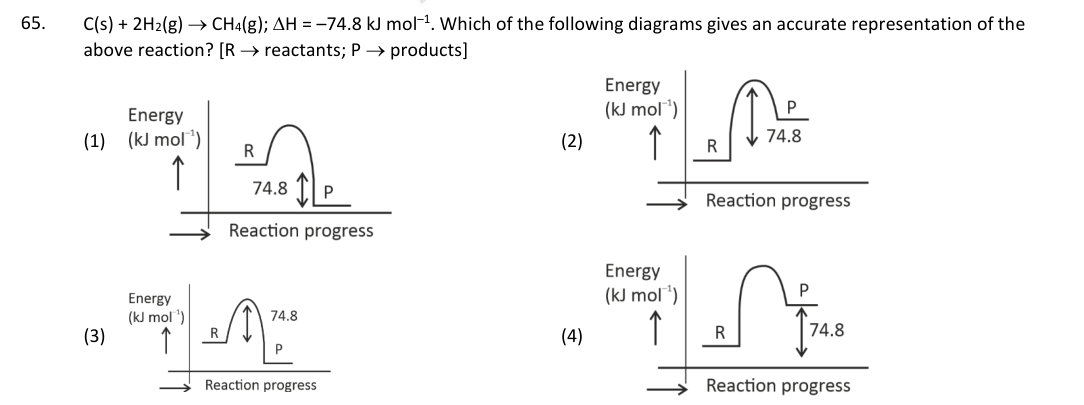
- A.Diagram (1)✓
- B.Diagram (2)
- C.Diagram (3)
- D.Diagram (4)
Solution
The reaction is exothermic (ΔH=−74.8 kJ/mol), so the products must lie 74.8 kJ below the reactants, and there must still be an activation barrier between them. Only diagram (1) shows a hump followed by products lower than reactants.
Q20openSolutions · Concentration terms, Henry's and Raoult's laws
Match List I with List II.
| List I (Example) | List II (Type of solution) |
|---|---|
| A. Humidity | I. Solid in solid |
| B. Alloys | II. Liquid in gas |
| C. Amalgams | III. Solid in gas |
| D. Smoke | IV. Liquid in solid |
Choose the correct answer from the options given below:
- A.A-II, B-IV, C-I, D-III
- B.A-II, B-I, C-IV, D-III✓
- C.A-III, B-I, C-IV, D-II
- D.A-III, B-II, C-I, D-IV
Solution
Humidity is water vapour (liquid) dispersed in air (gas) — II. Alloys are solid in solid — I. Amalgams are mercury (liquid) in a solid metal — IV. Smoke is solid particles in gas — III. Hence A-II, B-I, C-IV, D-III.
Q21openAmines · Basicity of amines
The correct order of decreasing basic strength of the given amines is:
- A.N-methylaniline > benzenamine > ethanamine > N-ethylethanamine
- B.N-ethylethanamine > ethanamine > benzenamine > N-methylaniline
- C.N-ethylethanamine > ethanamine > N-methylaniline > benzenamine✓
- D.benzenamine > ethanamine > N-methylaniline > N-ethylethanamine
Solution
Aliphatic amines are stronger bases than aromatic ones because the aryl lone pair is delocalised into the ring. Among aliphatic amines, the secondary N-ethylethanamine beats primary ethanamine (inductive effect plus solvation balance); among aromatic ones, the N-methyl group makes N-methylaniline slightly stronger than aniline. Order: N-ethylethanamine > ethanamine > N-methylaniline > benzenamine.
Q22openSome Basic Concepts of Chemistry · Mole concept and molar mass
Among the following, choose the ones with an equal number of atoms.
A. 212 g of Na2CO3(s) [molar mass = 106 g]
B. 248 g of Na2O(s) [molar mass = 62 g]
C. 240 g of NaOH(s) [molar mass = 40 g]
D. 12 g of H2(g) [molar mass = 2 g]
E. 220 g of CO2(g) [molar mass = 44 g]
Choose the correct answer from the options given below:
- A.A, B and C only
- B.A, B and D only✓
- C.B, C and D only
- D.B, D and E only
Solution
Atoms = moles × atoms per formula unit. A: 2×6=12 mol atoms. B: 4×3=12. C: 6×3=18. D: 6×2=12. E: 5×3=15. A, B and D are equal.
Q23openBiomolecules · Proteins, enzymes and vitamins
Match List I with List II.
| List I (Name of vitamin) | List II (Deficiency disease) |
|---|---|
| A. Vitamin B12 | I. Cheilosis |
| B. Vitamin D | II. Convulsions |
| C. Vitamin B2 | III. Rickets |
| D. Vitamin B6 | IV. Pernicious anaemia |
Choose the correct answer from the options given below:
- A.A-I, B-III, C-II, D-IV
- B.A-IV, B-III, C-I, D-II✓
- C.A-II, B-III, C-I, D-IV
- D.A-IV, B-III, C-II, D-I
Solution
Vitamin B12 deficiency causes pernicious anaemia (IV); vitamin D, rickets (III); vitamin B2(riboflavin), cheilosis (I); vitamin B6(pyridoxine), convulsions (II).
Q24openAldehydes, Ketones and Carboxylic Acids · Carboxylic acids: acidity and reactions
The correct order of decreasing acidity of the following aliphatic acids is:
- A.(CH3)3CCOOH>(CH3)2CHCOOH>CH3COOH>HCOOH
- B.CH3COOH>(CH3)2CHCOOH>(CH3)3CCOOH>HCOOH
- C.HCOOH>CH3COOH>(CH3)2CHCOOH>(CH3)3CCOOH✓
- D.HCOOH>(CH3)3CCOOH>(CH3)2CHCOOH>CH3COOH
Solution
Alkyl groups are electron-releasing and destabilise the carboxylate anion, so acidity falls as alkyl substitution grows: HCOOH>CH3COOH>(CH3)2CHCOOH>(CH3)3CCOOH.
Q25openThe d- and f-Block Elements · Transition elements: trends and properties
Given below are two statements:
Statement I: Ferromagnetism is considered an extreme form of paramagnetism.
Statement II: The number of unpaired electrons in a Cr2+ ion (Z=24) is the same as that of an Nd3+ ion (Z=60).
In the light of the above statements, choose the correct answer from the options given below:
- A.Both Statement I and Statement II are true
- B.Both Statement I and Statement II are false
- C.Statement I is true but Statement II is false✓
- D.Statement I is false but Statement II is true
Solution
Ferromagnetism is indeed treated as an extreme form of paramagnetism (I true). Cr2+ is 3d4 with 4 unpaired electrons; Nd3+ is 4f3 with 3 — not the same (II false).
Q26openPurification and Characterisation of Organic Compounds · Purification methods: crystallisation, distillation, chromatography
Match List I with List II.
| List I (Mixture) | List II (Method of separation) |
|---|---|
| A. CHCl3+C6H5NH2 | I. Distillation under reduced pressure |
| B. Crude oil in the petroleum industry | II. Steam distillation |
| C. Glycerol from spent-lye | III. Fractional distillation |
| D. Aniline–water | IV. Simple distillation |
Choose the correct answer from the options given below:
- A.A-IV, B-III, C-I, D-II✓
- B.A-IV, B-III, C-II, D-I
- C.A-III, B-IV, C-I, D-II
- D.A-III, B-IV, C-II, D-I
Solution
Chloroform (b.p. 61 °C) and aniline (184 °C) differ widely — simple distillation (IV). Crude oil fractions — fractional distillation (III). Glycerol decomposes at its boiling point — distillation under reduced pressure (I). Aniline from water — steam distillation (II). Hence A-IV, B-III, C-I, D-II.
Q27openEquilibrium · Law of mass action, Kc and Kp, Le Chatelier
For the reaction A(g)⇌2B(g), the backward reaction rate constant is higher than the forward reaction rate constant by a factor of 2500 at 1000 K. [Given R=0.0831 Latmmol−1K−1.] Kp for the reaction at 1000 K is:
- A.83.1
- B.2.077×105
- C.0.033✓
- D.0.021
Solution
Kc=kbkf=25001=4×10⁻⁴. Δng=2−1=1, so Kp=Kc(RT)=4×10−4×0.0831×1000≈0.033.
Q28openAmines · Preparation and reactions; diazonium salts
Given below are two statements:
Statement I: Benzenediazonium salt is prepared by the reaction of aniline with nitrous acid at 273–278 K. It decomposes easily in the dry state.
Statement II: Insertion of iodine into the benzene ring is difficult and hence iodobenzene is prepared through the reaction of benzenediazonium salt with KI.
In the light of the above statements, choose the most appropriate answer from the options given below:
- A.Both Statement I and Statement II are correct✓
- B.Both Statement I and Statement II are incorrect
- C.Statement I is correct but Statement II is incorrect
- D.Statement I is incorrect but Statement II is correct
Solution
Diazotisation of aniline with HNO2 at 273–278 K gives benzenediazonium chloride, which is unstable when dry (I correct). Direct iodination of benzene is reversible and poor, so iodobenzene is made from the diazonium salt and KI (II correct).
Q29openHydrocarbons · Alkanes: conformations and reactions
How many products (including stereoisomers) are expected from the monochlorination of the compound shown?

- A.2
- B.3
- C.5
- D.6✓
Solution
Monochlorination of 2-methylbutane at each distinct hydrogen: C-1 (the two equivalent methyls) gives 1-chloro-2-methylbutane, chiral at C-2 (2 enantiomers); C-2 gives 2-chloro-2-methylbutane (1); C-3 gives 2-chloro-3-methylbutane, chiral (2); C-4 gives 1-chloro-3-methylbutane (1). Total 2+1+2+1=6.
Q30openOrganic Chemistry: Some Basic Principles and Techniques · Reaction intermediates and types of reactions
Among the given compounds I–III (shown), the correct order of bond dissociation energy of the C–H bond marked with * is:
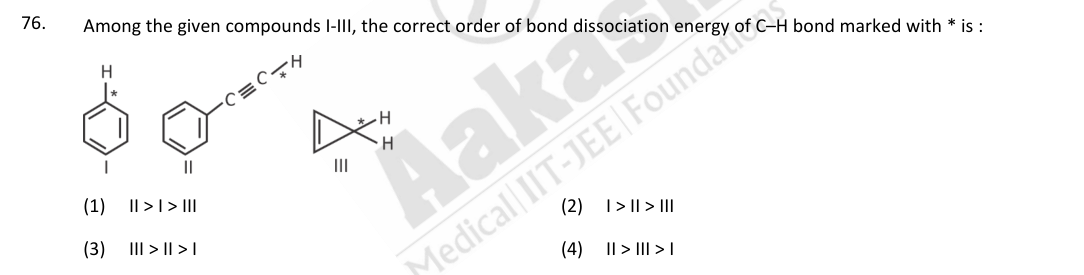
- A.II > I > III✓
- B.I > II > III
- C.III > II > I
- D.II > III > I
Solution
Bond strength rises with the s-character of the carbon orbital. The terminal alkyne C–H (II, sp) is strongest, then the aromatic C–H (I, sp2), then the cyclopropane C–H (III, roughly sp2.5 but weaker than aryl). II > I > III.
Q31openHydrocarbons · Alkenes and alkynes: addition reactions, Markovnikov
Which one of the following compounds (shown) does not decolourise bromine water?

- A.Structure (1)✓
- B.Structure (2)
- C.Structure (3)
- D.Structure (4)
Solution
Bromine water is decolourised by addition to C=C (styrene) and by electrophilic bromination of activated rings (phenol, aniline give tribromo products). Cyclohexane (1) is saturated and unactivated, so it does not react.
Q32openHaloalkanes and Haloarenes · Nucleophilic substitution: SN1 and SN2
The major product of the reaction shown in the figure is:
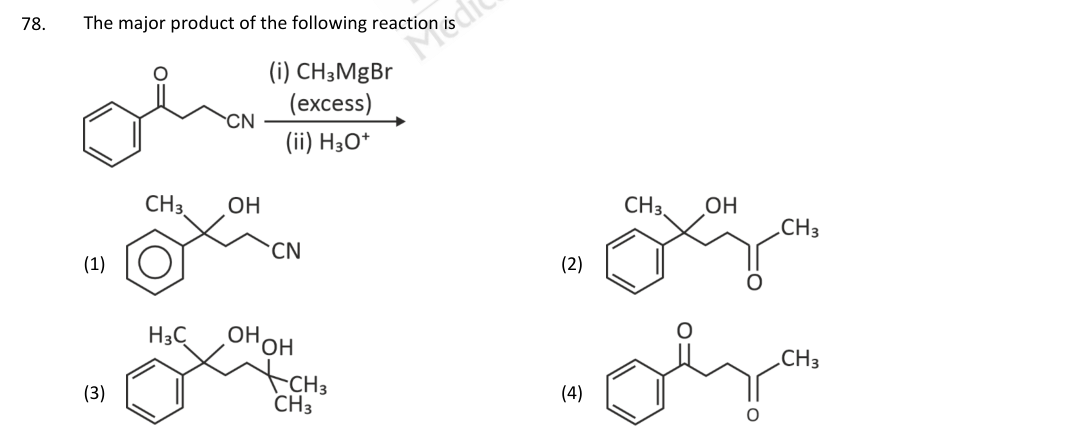
- A.Structure (1)
- B.Structure (2)✓
- C.Structure (3)
- D.Structure (4)
Solution
Excess CH3MgBr attacks both electrophilic sites: the ketone becomes a tertiary alcohol (–C(OH)(CH3)Ph), and the nitrile adds one equivalent to form an imine salt that hydrolyses to a methyl ketone on work-up. Product (2): the hydroxy-ketone.
Q33openSolutions · Colligative properties
Which of the following aqueous solutions will exhibit the highest boiling point?
- A.0.01 M urea
- B.0.01 M KNO3
- C.0.01 M Na2SO4✓
- D.0.015 M C6H12O6
Solution
Boiling-point elevation depends on the total particle concentration iC. Urea: 0.01. KNO3: 2×0.01=0.02. Na2SO4: 3×0.01=0.03. Glucose: 0.015. Na2SO4 boils highest.
Q34openThe d- and f-Block Elements · Transition elements: trends and properties
Match List I with List II.
| List I | List II |
|---|---|
| A. Haber process | I. Fe catalyst |
| B. Wacker oxidation | II. PdCl2 |
| C. Wilkinson catalyst | III. [(PPh3)3RhCl] |
| D. Ziegler catalyst | IV. TiCl4 with Al(CH3)3 |
Choose the correct answer from the options given below:
- A.A-I, B-II, C-IV, D-III
- B.A-II, B-III, C-I, D-IV
- C.A-I, B-II, C-III, D-IV✓
- D.A-I, B-IV, C-III, D-II
Solution
The Haber process uses iron (I); Wacker oxidation uses PdCl2 (II); Wilkinson's catalyst is [(PPh3)3RhCl] (III); Ziegler's catalyst is TiCl4 with triethyl/trimethylaluminium (IV).
Q35openSolutions · Concentration terms, Henry's and Raoult's laws
5 moles of liquid X and 10 moles of liquid Y make a solution having a vapour pressure of 70 torr. The vapour pressures of pure X and Y are 63 torr and 78 torr respectively. Which of the following is true regarding the described solution?
- A.The solution shows positive deviation.
- B.The solution shows negative deviation.✓
- C.The solution is ideal.
- D.The solution has a volume greater than the sum of the individual volumes.
Solution
Raoult's law predicts p=155(63)+1510(78)=21+52=73 torr. The observed 70 torr is lower, so the solution shows negative deviation (stronger A–B interactions).
Q36openBiomolecules · Carbohydrates
Sugar 'X':
A. is found in honey
B. is a keto sugar
C. exists in α and β anomeric forms
D. is laevorotatory
'X' is:
- A.D-Glucose
- B.D-Fructose✓
- C.Maltose
- D.Sucrose
Solution
Fructose is the keto-hexose found in honey, exists in α and β anomeric (furanose) forms, and is laevorotatory — hence 'laevulose'.
Q37openAldehydes, Ketones and Carboxylic Acids · Nucleophilic addition reactions
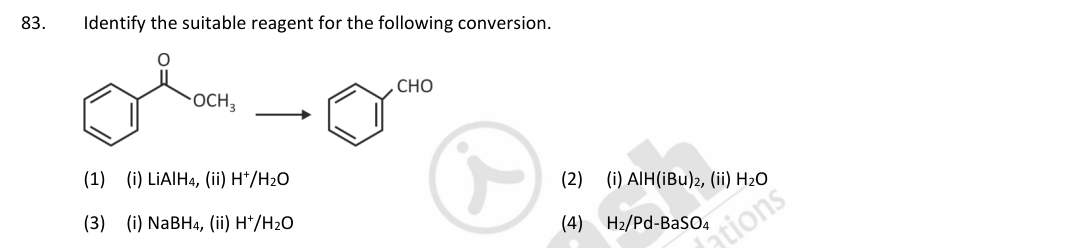
Identify the suitable reagent for the conversion shown in the figure.
- A.(i) LiAlH4, (ii) H+/H2O
- B.(i) AlH(iBu)2, (ii) H2O✓
- C.(i) NaBH4, (ii) H+/H2O
- D.H2/Pd-BaSO4
Solution
Reducing an ester only as far as the aldehyde needs DIBAL-H, AlH(iBu)2, at low temperature followed by water. LiAlH4 would go on to benzyl alcohol, NaBH4 does not reduce esters, and H2/Pd−BaSO4 is for acid chlorides (Rosenmund).
Q38openHaloalkanes and Haloarenes · Nucleophilic substitution: SN1 and SN2
Given below are two statements: one is labelled as Assertion (A) and the other is labelled as Reason (R).
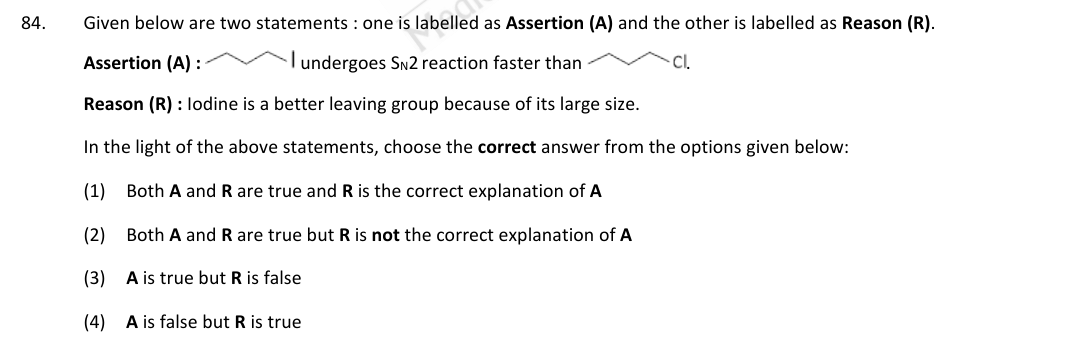
Assertion (A): The first compound shown undergoes the SN2 reaction faster than the second compound shown.
Reason (R): Iodine is a better leaving group because of its large size.
In the light of the above statements, choose the correct answer from the options given below:
- A.Both A and R are true and R is the correct explanation of A✓
- B.Both A and R are true but R is not the correct explanation of A
- C.A is true but R is false
- D.A is false but R is true
Solution
Iodide is the best leaving group among the halides — the large, polarisable ion spreads its charge and is a weak base — so 1-iodobutane reacts faster than 1-chlorobutane in SN2. Both statements are true and R explains A.
Q39openThermodynamics · First law, enthalpy and Hess's law
The standard heat of formation, in kcal/mol, of Ba2+ is: [Given: standard heat of formation of the SO42− ion (aq) = –216 kcal/mol, standard heat of crystallisation of BaSO4(s) = –4.5 kcal/mol, standard heat of formation of BaSO4(s) = –349 kcal/mol]
- A.–128.5✓
- B.–133.0
- C.+133.0
- D.+220.5
Solution
ΔfH∘(BaSO4)=ΔfH∘(Ba2+)+ΔfH∘(SO42−)+ΔHcryst: −349=x−216−4.5⇒x=−128.5 kcal/mol.
Q40openOrganic Chemistry: Some Basic Principles and Techniques · Isomerism: structural and stereo
The total number of possible isomers (both structural as well as stereoisomers) of cyclic ethers of molecular formula C4H8O is:
- A.6
- B.8
- C.10✓
- D.11
Solution
Six structural isomers: oxolane (THF), 2-methyloxetane, 3-methyloxetane, 2-ethyloxirane, 2,2-dimethyloxirane and 2,3-dimethyloxirane. Adding stereoisomers: 2-methyloxetane and 2-ethyloxirane are each a pair of enantiomers, and 2,3-dimethyloxirane exists as the cis (meso) form plus a trans pair. Total 1+2+1+2+1+3=10.
Q41openChemical Bonding and Molecular Structure · VSEPR and molecular shapes
Identify the correct orders against the property mentioned:
A. H2O>NH3>CHCl3 — dipole moment
B. XeF4>XeO3>XeF2 — number of lone pairs on the central atom
C. O–H > C–H > N–O — bond length
D. N2>O2>H2 — bond enthalpy
Choose the correct answer from the options given below:
- A.A, D only✓
- B.B, D only
- C.A, C only
- D.B, C only
Solution
Dipole moments: H2O (1.85 D) > NH3 (1.47 D) > CHCl3 (1.04 D) — A correct. Bond enthalpy: N≡N (945) > O=O (498) > H–H (436 kJ/mol) — D correct. XeF2 has three lone pairs on Xe, more than XeF4's two — B wrong. Bond lengths run N–O (~140 pm) > C–H (109 pm) > O–H (96 pm), the reverse of C — C wrong. Hence A and D.
Q42openEquilibrium · Law of mass action, Kc and Kp, Le Chatelier
A higher yield of NO in N2(g)+O2(g)⇌2NO(g) can be obtained at [ΔH of the reaction =+180.7 kJmol−1]:
A. Higher temperature · B. Lower temperature · C. Higher concentration of N2 · D. Higher concentration of O2
Choose the correct answer from the options given below:
- A.A, D only
- B.B, C only
- C.B, C, D only
- D.A, C, D only✓
Solution
The reaction is endothermic, so higher temperature shifts it forward (A). Adding either reactant also pushes it forward (C, D). Lower temperature would reduce the yield. Hence A, C and D.
Q43openChemical Kinetics · Integrated rate equations and half-life
If the rate constant of a reaction is 0.03 s−1, how much time does it take for a 7.2 molL−1 concentration of the reactant to get reduced to 0.9 molL−1? (Given log2=0.301)
- A.69.3 s✓
- B.23.1 s
- C.210 s
- D.21.0 s
Solution
A rate constant in s−1 means first order. t=k2.303log[A][A]0=0.032.303log8=0.032.303×3×0.301≈69.3 s.
Q44openPurification and Characterisation of Organic Compounds · Qualitative and quantitative analysis
Which one of the following reactions does not belong to Lassaigne's test?
- A.Na+C+NΔNaCN
- B.2Na+SΔNa2S
- C.Na+XΔNaX
- D.2CuO+CΔ2Cu+CO2✓
Solution
Fusing sodium with the compound gives NaCN, Na2S and NaX from nitrogen, sulphur and halogen respectively — the basis of Lassaigne's test. Oxidising carbon with CuO to CO2 is the Liebig combustion method for estimating carbon, not Lassaigne's.